

EU election observers visit The Deltagram to discuss 13th general election

Staff Reporter
Publish: 18 Feb 2026, 01:17 AM
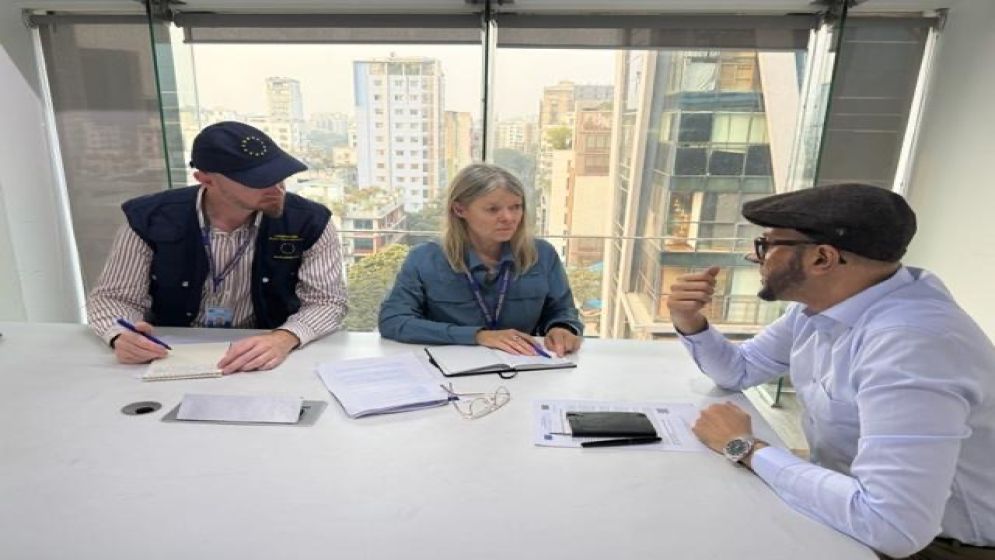
Two representatives of the European Union’s Election Observer Mission met senior editors at The Deltagram in Dhaka on Monday as part of their post-election assessment of Bangladesh’s 13th general election.
Karin Bergquist and Žiga Šubic, long-term observers with the EU mission, visited The Deltagram to exchange views on the conduct and implications of the 12 February national poll.
They held discussions with the publication’s editor, Ahmede Hussain, focusing on the credibility of the election and the broader political climate.
The meeting formed part of the EU delegation’s consultations with journalists, civil society organisations and other stakeholders. The mission has been observing different phases of the electoral process, including campaigning, polling, vote counting and post-election developments. Its final report is expected in the coming weeks.
Bangladesh’s latest general election has been widely described as the first credible national vote in 17 years, following a prolonged period of disputed elections and political unrest.
The poll has generated cautious optimism at home and renewed interest among international partners.
Hussain told the EU representatives that, in his assessment, the voting process itself was largely free and fair. He noted that incidents of overt intimidation and the use of money and muscle power appeared to be significantly lower than in previous elections.
However, he expressed concern about the composition of the incoming parliament. According to Hussain, women and members of ethnic and religious minority communities are likely to remain underrepresented, despite improvements in polling day procedures.
“The election was free and fair,” he said, “but it is not a fair game.” He argued that structural barriers continue to prevent many women and non-Muslim citizens from entering competitive politics.
Entrenched patriarchy and economic concentration, he said, make it difficult for marginalised groups to access resources, build networks and sustain campaigns.
Hussain suggested that while administrative management of the polls had improved in several areas, deeper inequalities within the political system persist.
He pointed to longstanding cultural and financial obstacles that discourage women and minorities from seeking nomination or contesting winnable seats.
The editor also raised questions about the performance of the Election Commission. While acknowledging positive steps in certain constituencies, he said the commission’s actions were not uniform across the country.
In some areas, he claimed, officials adopted an unnecessarily abrasive approach, leading to confusion and complaints.
Bergquist and Šubic observed voting in constituencies across Dhaka during election day. As long-term observers, they have been stationed in Bangladesh for several weeks, monitoring not only polling but also campaign activities, media coverage and the legal framework governing the vote.
The election took place in a charged political environment shaped by last year’s mass protests, widely referred to as the July revolution. The demonstrations, which culminated in the ousting of the Sheikh Hasina government in 2024, were driven by demands for equality, dignity and social justice.
Hussain told the EU delegation that the events of July have raised public expectations of the new administration. Voters, he said, are now more attentive to issues of accountability, institutional reform and inclusive governance. “Every move of the government will be closely observed,” he added.
The discussion also addressed the role of the media in safeguarding democratic gains. Hussain emphasised the need to protect press freedom and ensure that journalists can operate without intimidation.
Independent reporting, he said, remains vital for strengthening public trust in institutions and scrutinising those in power.
The EU observers did not offer formal remarks during the meeting, in keeping with standard practice.
—