

Netra Report on BB governor raises valid questions….but market data gives a different viewpoints

Staff Reporter
Publish: 04 Mar 2026, 11:59 PM
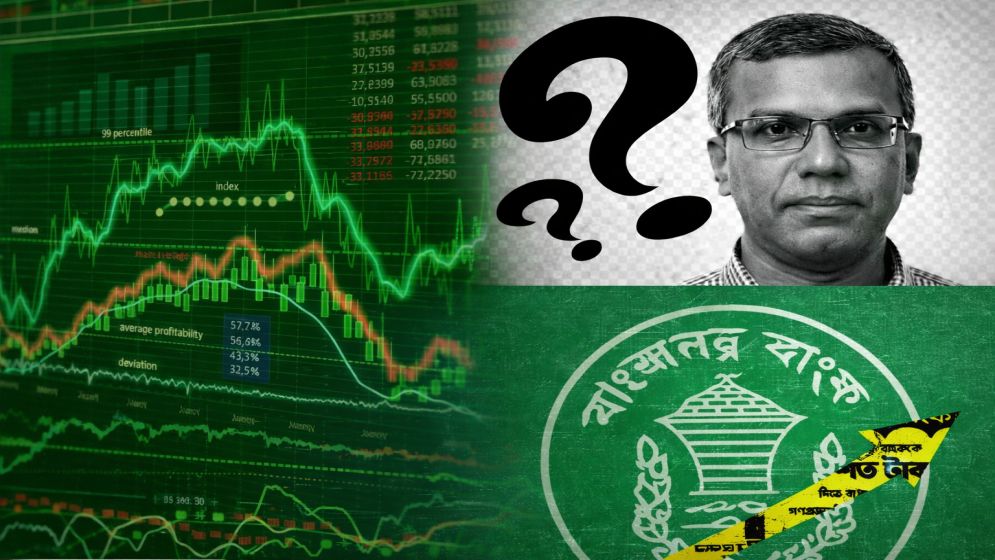
A recent report by Netra News drawing a connection between the new governor of Bangladesh Bank Md Mostaqur Rahman, a listed technology company, and business interests linked to S. Alam Group raises valid questions about potential conflicts of interest.
However, a closer examination of publicly available records suggests that the conclusions presented in the report may rely on “far-teched interpretation” rather than a full reading of the available data and records.
The central premise of the report appears to be that the governor’s shareholding in the ICT company Intech Ltd indicates a potential business link with S. Alam–associated investors.
Yet corporate records cited in various media reports indicate that the governor has held shares in the company since around 2010, more than a decade before individuals linked to the S. Alam business group reportedly entered the firm as investors in 2021.
The timeline matters. A shareholding predating the entry of another investor group cannot automatically be construed as evidence of a joint business relationship, unless additional evidence shows coordination or collaboration.
So far, such evidence has not been presented by Netra News.
The reporting around the company’s ownership suggests that the governor’s shareholding is relatively small—just over half a percent of the company’s shares—and that he has not been involved in day-to-day management decisions.
Company officials quoted in Netra report have also indicated that the introduction of investors associated with the S. Alam family occurred several years after the governor became a sponsor shareholder and was facilitated by other directors to meet regulatory shareholding requirements.
The second claim highlighted in the Netra report concerns a rise in the company’s share price, which moved from roughly Tk33 to about Tk37–38 in late February 2026. Presented in isolation, such a movement might appear noteworthy.
But stock-market data from the Dhaka Stock Exchange suggests that similar price increases occurred across the ICT sector during the same period, but not at the same percentage point of course.
Shares of Aamra Networks Limited closed at Tk17.20 on 26 February, up 1.78% from the previous session with trading volume exceeding 262,000 shares.
On the same day, Agni Systems Limited also posted a gain, closing near Tk21.80 with a positive change of about 0.46%. BDCOM Online Limited rose from about Tk25.9 on 26 February to Tk26.4 by 28 February.
Over the same period, Daffodil Computers PLC advanced from roughly Tk60.9 to Tk61.6, while aamra technologies limited increased from around Tk35.5 to Tk36.2.
Information Services Network Limited edged up from about Tk21.3 to Tk21.7, and IT Consultants PLC climbed from roughly Tk44.7 to Tk45.6. The data shows that multiple ICT stocks were gaining at the same time—pointing to broader sector-wide trading activity rather than an isolated movement in any single company.
Because many of these companies are small-capitalisation ICT firms, their share prices often respond quickly to shifts in investor demand.
Market reporting from the same period further indicates that the broader market had been experiencing renewed investor interest.
In late February, the benchmark index of the Dhaka Stock Exchange crossed the 5,600-point mark as investors increased buying in several sectors, particularly bank and technology shares. In such a context, price increases in individual stocks are hardly unusual.
Historical trading data also undercuts the implication that the late-February rise represented a significant or unusual spike. The same company’s—Intech’s–-shares traded at significantly higher levels earlier—reaching around Tk46 in September 2025.
That peak occurred months before the governor’s appointment and well before the recent controversy emerged. Highlighting a smaller, later increase while ignoring earlier and higher price levels probably creates a distorted impression of market activity.
Significantly, even the Netra report itself acknowledges that it did not find evidence that the governor used his official position to obtain financial gain from the company’s share price movements.
Instead, the report appears to rely largely on “circumstantial framing”—linking an existing shareholding, a later investment by another group, and a seemingly “routine stock-market fluctuations”.
None of this necessarily eliminates the broader policy question of whether senior public officials should maintain shareholdings in listed companies, especially when they occupy positions that influence financial regulation.
—