

Hypertension now Bangladesh’s top disease as experts urge bigger budget for free medicines

Staff Reporter
Publish: 13 May 2026, 05:35 PM
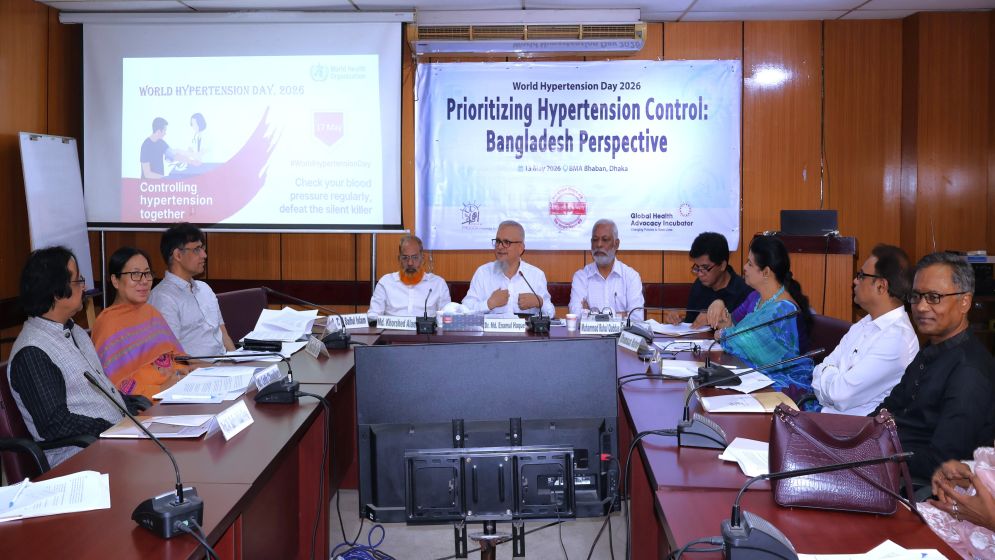
Hypertension has emerged as the most prevalent disease in Bangladesh, prompting health experts to call for increased government funding and sustainable financing to combat the growing public health crisis in the upcoming national budget for fiscal year 2026-27.
The concerns were raised at a discussion titled “Prioritizing Hypertension Control: Bangladesh Perspective,” organized Tuesday at the BMA Bhaban in Dhaka by research and advocacy organization PROGGA (Knowledge for Progress) with support from the Global Health Advocacy Incubator (GHAI), marking World Hypertension Day 2026.
According to the Health and Morbidity Status Survey 2025 conducted by the Bangladesh Bureau of Statistics (BBS), hypertension now ranks first among the top 10 diseases in the country.
Experts at the event warned that despite government initiatives to provide free anti-hypertensive medicines at the grassroots level, the programme has not been fully implemented due to inadequate and unsustainable financing.
Speakers noted that non-communicable diseases (NCDs) currently account for 71 percent of all deaths in Bangladesh, with hypertension identified as one of the leading risk factors.
Citing the World Health Organization’s 2025 report, they said 283,800 people in Bangladesh died from cardiovascular diseases in 2024, and 52 percent of those deaths were linked to hypertension.
“Alongside increasing budget allocation for hypertension control, it is equally important to ensure effective implementation of the allocated funds,” said Dr. Md. Enamul Haque, Director General of the Health Economics Unit.
Md. Khorshed Alam, Managing Director of the Community Clinic Health Support Trust, said the government is working to ensure uninterrupted medicine supply at Community Clinics and Upazila Health Complexes across the country.
Public health expert Dr. Lelin Choudhury stressed that ensuring free medicines for all at the grassroots level could significantly reduce hypertension-related illnesses and deaths.
Professor Dr. Malay Kanti Mridha of BRAC James P Grant School of Public Health said hypertension could be effectively managed through research-based treatment and preventive strategies.
Media representatives and health economists also highlighted the importance of awareness campaigns and long-term investment in hypertension control. Professor Dr. Shafiun Nahin Shimul of Dhaka University described sustainable financing for hypertension control as “an effective investment” for the country’s future healthcare system.
World Hypertension Day will be observed globally on 17 May under the theme “Controlling Hypertension Together.”
—