


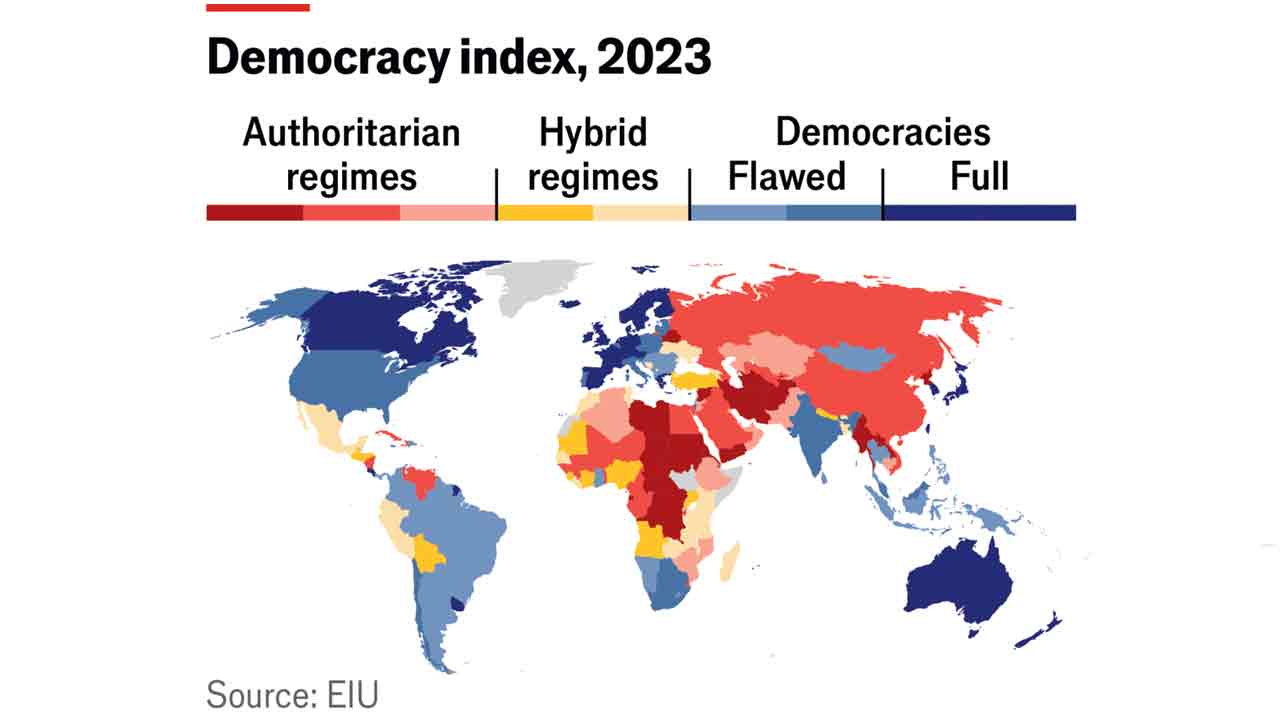
State repression against opposition political parties has been pervasive in Bangladeshi elections since 2008, with none being deemed free and fair. Freedom of speech is severely restricted, and the electoral process fails to facilitate a transfer of power or the establishment of genuine democracy.
These findings were highlighted in the 2023 Democracy Index released by The Economist Intelligence Unit (EIU). The report categorizes Bangladesh as a "hybrid democracy." The index was published on the EIU website on February 15th.
The UK-based Economic Intelligence Unit (EIU) of The Economist magazine has released its 2023 Global Democracy Index. Bangladesh has experienced a two-step deterioration compared to the previous year. The index, which assesses the democratic situations of 165 countries and two regions, was unveiled on Wednesday.
The EIU's index is based on five criteria: electoral process and pluralism, functioning of government, political participation, political culture, and civil liberties. It evaluates each country's democracy using a scale of 10 scores.
The index categorises countries into four groups: full democracies, flawed democracies, hybrid regimes, and authoritarian regimes. According to The Economist's classification, a country with an average score above eight is deemed a full democracy, a score of 6 to 8 qualifies as a flawed democracy, 4 to 6 indicates a hybrid regime, and below 4 denotes an authoritarian regime.
In the 2023 index, Bangladesh is ranked 75th with a score of 5.87. In previous years, specifically 2022, 2021, and 2020, Bangladesh was classified as a hybrid regime, with a score of 5.99. Its score was 5.57, securing the 88th position in the 2019 index.
The British magazine introduced the Global Democracy Index in 2006, with Bangladesh scoring 6.11 that year, followed by 5.52 in 2007 and 5.87 in 2008. Bangladesh maintained the same score for the subsequent three years, at 5.86.
In the latest index, Norway retains the top position with a score of 9.81, while New Zealand secures second place, maintaining its position from 2022, with a score of 9.61. Finland follows closely in third place with a score of 9.45. Sweden ranks fourth with a score of 9.39, and Denmark fifth with a score of 9.30. Finland secured another position in the top five, this time in fifth place with a score of 9.30, followed by Denmark in sixth place with a score of 9.28. Ireland ranks seventh with a score of 9.19, Switzerland eighth with a score of 9.14, the Netherlands ninth with a score of 9.00, and Taiwan tenth with a score of 8.92.
In the inaugural 2006 democracy index, Bangladesh was categorised as a flawed democratic country, scoring 6.11. The following year, democratic standards deteriorated further, leading Bangladesh to be classified as a hybrid regime. Since then, the Economic Intelligence Unit has consistently listed Bangladesh as a hybrid regime.
The report highlighted the preceding year as "an ominous year for democracy" globally, with the average score dropping to its lowest since the index's inception in 2006.
In the 2023 index, India emerged as the top-ranking South Asian country with a score of 7.41, climbing from 46th place in 2022 to 41st place in 2023. Conversely, Pakistan's ranking plummeted to 118th place with a score of 3.25, marking a decline of 14 points compared to the previous year.
Sri Lanka is in 70th place with a score of 6.17, a slight decline from last year's 67th-place finish. Bhutan is in 81st place with a score of 5.54, the same as last year. On the other hand, Nepal has improved by two places to claim the 98th-place finish, with a score of 4.60.
Meanwhile, Afghanistan remains at the bottom of the list, consistent with the previous year, while Myanmar, under a dictatorship, ranks 166th with a score of 0.85. Additionally, North Korea, primarily isolated from the rest of the world, ranks 165th with a score of 1.08.
The EIU reports a positive development for democracy worldwide, noting an increase in democratic countries to 74 in 2023, marking a rise of two from the previous year. However, despite this expansion, the past year has seen a decline in global democracy according to other metrics within the index. The average score on the Global Democracy Index dropped to 5.23, down from 5.29 in 2022.
The Economic Intelligence Unit's report indicates that nearly half of the world's population resides in some form of democracy, comprising approximately 45.5 per cent. However, the proportion of individuals living in fully democratic environments is a modest 7.8 per cent of the global population, a decrease from 8.9 per cent in 2015. Furthermore, more than one-third of the world's population lives under mixed democratic regimes, accounting for 39.4 per cent.
The United States is classified as a flawed democracy in this year's index, as last year. The country is ranked 29th with a score of 7.85.