

Fire safety concerns in Dhaka malls and markets cast shadow over Eid festivities

Nazmul Islam
Publish: 23 Mar 2024, 05:09 AM
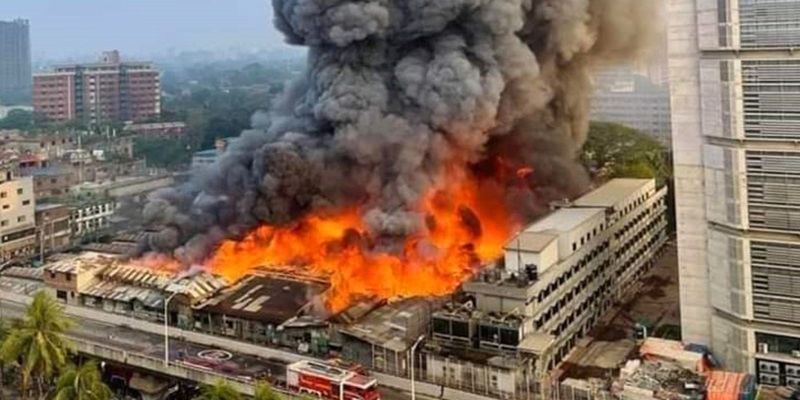
As Eid-ul-Fitr approaches, the country buzzes with shoppers flocking to malls and markets adorned with festive decorations. Businesses unveil their latest wares, and the celebratory spirit fills the air. However, a shadow of concern looms large – the abysmal fire safety standards in most shopping centers.
Reports indicate that a significant number of malls and markets lack proper fire safety measures, raising serious questions about public safety during this period of increased foot traffic. This poses a significant risk to the lives of both shoppers and shopkeepers during this festive season.
The recent devastating fire at a high-rise building in Dhaka's Baily Road area, housing restaurants and shops, on February 29th has reignited urgent discussions about fire safety, particularly in high-rise structures.
Incidentally, just weeks after the Baily Road tragedy, at least three additional fire incidents erupted in separate Dhaka shopping malls and bazaars. Thankfully, these subsequent fires resulted in no casualties, but caused significant property damage.
An inspection by the Fire Service and Civil Defence (FSDC), done just last year, paints a concerning picture of fire safety in Dhaka's markets and shopping arcades. Their report, based on inspections of 58 locations, reveals that a staggering three out of four establishments lack proper fire safety measures.
The FSDC classified the inspected locations into three categories: "highly risky," "risky," and "satisfactory." The results are cause for alarm, with nine markets deemed "highly risky" and an additional 35 categorized as "risky."
These classifications are based on factors such as the number and accessibility of exits, the availability of fire extinguishers and hydrants, and the adequacy of water reserves. Only 14 of the inspected locations were found to have satisfactory fire safety measures in place.
Brig Gen Md Main Uddin, Director General of the FSCD told Bangla Outlook that most shopping malls fail to comply with the Bangladesh National Building Code (BNBC).
The BNBC outlines mandatory fire safety measures, including proper building design for swift evacuation, adequate fire suppression systems, and regular fire drills.
"We have proper rules and regulations in place," Brig Gen Uddin said, "but very few are actually abiding by these rules." This concerning gap between regulations and reality exposes shoppers and mall employees to significant fire risks.
Sorry states of fire safety
A visit to several Dhaka markets by this correspondent revealed a disturbing lack of basic fire safety measures. Crucial equipment like fire extinguishers, fire hydrants, and fire hoses were scarce or missing altogether. Perhaps most alarmingly, some markets even had blocked fire exits, creating potential death traps in case of a fire.
Chandrima Super Market, a bustling four-story complex with over 200 shops, serves as a prime example of these safety lapses. While the market boasts seven staircases for entry and exit, these vital escape routes were obstructed in several places by piles of clothing for sale. Adding to the concern, only a handful of fire extinguishers were visible mounted on the walls.
Both shop-owners and shoppers there are equally oblivious to the lack of fire-safety measures. “We have to make a living, right? If the building authority doesn’t take fire safety measures, what can we do?” Masum Billah, an owner of a T-shirt shop in Chandrima market told Bangla Outlook.
Nargis Akhter, who came to visit the Chandrima market meanwhile said, she got good deals here and was not that concerned about fire safety. “At least it is better than those high-rise shopping malls. A fire in those buildings is way more dangerous than a fire here,” she said.
A visit to the "highly risky" Rajdhani Supermarket, with its bustling 1,500 shops, also paints a similar disturbing picture of fire safety neglect. This correspondent found the market to be woefully unprepared for a potential fire emergency.
Most alarmingly, the entire market lacked fire hydrants, a crucial element for extinguishing large fires. Furthermore, a search of 300 shops yielded no fire extinguishers, the first line of defense against small fires.
Shop owners expressed a mix of resignation and helplessness. One owner, who wished to remain anonymous, stated, "No one told us about having any fire safety equipment.”
Faznun Hoque Biplob, a leader of the Shop Owner's Association, offered a concerning perspective. He argued that implementing proper fire safety measures would make selling clothes at affordable prices impossible. "This market is not for rich people. We don't have the capacity to install all those fire safety measures,” he said bluntly.
What do the experts say?
Dr Mehedi Ahmed Ansari, a Civil Engineering professor at BUET and Director of the Bangladesh Network Office for Urban Safety (BNUS), paints a grim picture of fire safety awareness in Dhaka's shopping malls. In an interview with Bangla Outlook, he revealed a shocking lack of knowledge about fire safety regulations among mall owners.
"It's ironic," Prof Ansari said, "that most mall owners are completely unaware of the rules governing their establishments." The BNBC mandates a specific number of staircases based on a mall's capacity: two staircases for malls accommodating 50-500 people, three for 500-1,000, and four for over 1,000 shoppers.
Inspections, however, reveal widespread non-compliance with these critical safety measures, said Professor Ansari.
The Fire Protection Act 2003 adds another layer of concern. Malls exceeding a 1,000-person capacity require each floor to be equipped with a minimum of two fire extinguishers, a fire hydrant point, a water reservoir, and a rooftop tank with a mandatory water reserve.
Furthermore, the act mandates the establishment of in-house firefighting teams and the conduct of regular fire drills. Unfortunately, these essential protocols are often neglected.
Dr Ansari said, the average footfall in a multi-storied mall having 300 shops is around 8,000 people daily. “Hence, a fire alarm system is very important in such places,” he said, adding that the malls must have a robust fire fighting system on all floors, a fire alarm system, multiple escape routes and several lifts.
Passive safety measures suggested by him, included fire doors, fire lifts, air-conditioning duct with dampers etc. “It’s very important to take preemptive action in ensuring fire safety. Otherwise, another tragic incident will happen and then we will swing into taking some momentarily action,” said Dr Ansari.