


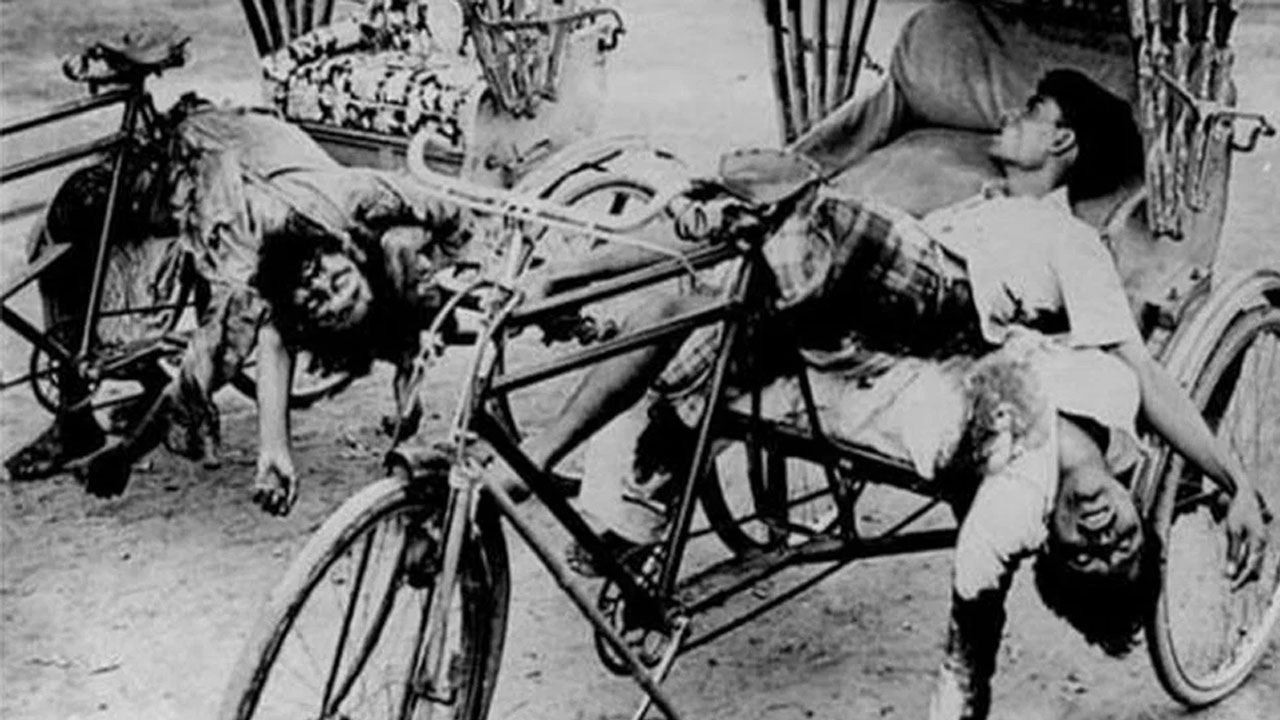
Today, the nation solemnly observes March 25th — National Genocide Day, marking one of the darkest days in our history. On this day in 1971, as evening fell, a horrific chapter began in the life of the Bengali people. In a premeditated assault, known as Operation Searchlight, the Pakistani military launched a brutal attack just before midnight against the unsuspecting and defenseless Bengalis throughout the nation, including the capital, Dhaka, with the vile objective of permanently extinguishing the voice of the Bengali nation.
On March 25, 1971, the Pakistani invasionary forces initiated a genocide to crush the Bengali aspiration for independence. Subsequently, Bangladesh's independence was achieved after nine months of a grueling armed conflict. Operation Searchlight was executed on that fateful night to annihilate the Bengali populace.
Major General Khadim Hussain Raja and Major General Rao Farman Ali were instrumental in shaping the strategies for this operation, which was shrouded in secrecy, with no written orders, as the directives for the massacre were relayed verbally to commanders and other relevant individuals. It was not until 2012 that Major General Khadim Hussain Raja disclosed some details about Operation Searchlight in his autobiography 'A Stranger in My Own Country,' published by Oxford University Press.
Raja recounts the planning of Operation Searchlight, describing how on March 17, 1971, at around 10 am, he and Major General Farman were summoned by Tikka Khan to the command house. There, alongside General Abdul Hamid Khan, they were briefed on the dire state of the reconciliation talks between Sheikh Mujib and the President and were instructed to prepare for a military operation without any further written or verbal guidance. On March 18, they were tasked with consulting high-ranking officials to finalize the plan.
By the following morning, Raja and Rao Farman Ali had christened their genocidal campaign Operation Searchlight. American journalist Robert Payne documented that on the night of March 25, around 7,000 people were killed, with 3,000 more detained. The carnage in Dhaka was just the beginning, as the military proceeded to escalate the death toll throughout East Pakistan, with rampant arson, looting, and destruction. The streets became a ghastly tableau of death, feasted upon by scavengers, as Bangladesh turned into a macabre wasteland.
Even the government of Pakistan has acknowledged this mass genocide in its own documents. A white paper released during the war on the crisis in East Pakistan acknowledges over 100,000 lives lost from March 1 until the night of March 25, 1971.
The genocide was precipitated by the political impasse that followed the failure of the Pakistani regime to transfer power to the Awami League, despite its majority victory in the 1970 general elections. This resulted in the launch of the infamous Operation Searchlight, targeting innocent Bengali civilians indiscriminately, with a particular focus on eliminating members of the Awami League, progressive political figures, and enlightened citizens of then East Pakistan. On March 25th, amid escalating tension, the army's presence was noticeable from the morning. They traveled to various cantonments by helicopter and reconvened at Dhaka cantonment by afternoon.
The 22nd Baloch Regiment, based at Pilkhana, the EPR headquarters in Dhaka, was seen positioning itself at various strategic locations. At midnight, Pakistani troops launched their assault on Pilkhana, Rajarbagh, and Neelkhet. Occupying the university area including Nilkhet with tanks and mortars, they transformed the night with relentless machine-gun fire and bombardment.
An account of these events is detailed in 'Witness to Surrender' by Siddique Salik, who served as the Public Relations Officer to Generals Tikka Khan and A.K. Niazi. Present during the liberation war, Salik offers a perspective on the strategies employed by the Pakistani military junta against the people of Bangladesh. He notes that Operation Searchlight commenced prematurely, setting the stage for an infernal onslaught.
Tragically, the students of Rokeya Hall were among those who could not escape the brutality of the Pakistani forces. Esteemed academics, including Dr. Govinda Chandra Dev, Jyotirmoy Guha Thakurta, and Professor Santosh Bhattacharya, along with 9 other university faculty members, met with barbaric deaths. The most extensive massacre occurred at Jagannath Hall, where the slaughter persisted from night until dawn.
President Yahya Khan stealthily fled Dhaka for Karachi after orchestrating the Operation Searchlight strategy. As the military operation began, the invading forces detained Sheikh Mujibur Rahman at his home in Dhanmondi. It was at that time when the then Major Ziaur Rahman broadcasted the declaration of Bangladesh's independence from the Kalurghat Radio Station in Chittagong. In a resonant voice, he urged the nation to resist the enemy at all costs. Heeding his call, the Bengali people valiantly engaged in the war against the Pakistani forces, culminating in a hard-fought victory on December 16, 1971, after nine months of armed conflict. Thus, Bangladesh emerged as a sovereign nation on the global stage.
National initiatives have been undertaken to commemorate this day with the respect it deserves. In honor of this occasion, a nationwide symbolic 'blackout' will be observed from 11:00 PM to 11:31 PM on Monday. Key Point Installations (KPIs) and emergency services, however, will be exempt from this observance. Marking the day, President Md. Sahabuddin and Prime Minister Sheikh Hasina have delivered their messages. A discussion event focused on Genocide Day was also held at the Liberation War Museum at around 10:30 am.
Cultural programmes and ballads related to the genocide and war of independance are being conducted throughout the country. Educational institutions, including schools, colleges, and madrasas, will host remembrance and discussion sessions on March 25, featuring speeches by notable individuals and esteemed freedom fighters.
To preserve the memory of the genocide, rare photographs and documentaries will be displayed across all municipal corporations, including Dhaka. Additionally, on the evening of March 25, a special prayer will be conducted in all mosques and places of worship following the Zohor prayers, or at a suitable time, in remembrance of those who lost their lives. This same observance will take place at the district and upazila levels, as well as in Bangladesh's embassies worldwide, to underscore the importance of this day.