


Eid celebrations in the Bengal region boast a rich and ancient history, perhaps even older than most of us imagine. Traces of this religious festival’s observation can be found woven into the fabric of East Bengal since the arrival of Islam itself. While grander observances were initially confined to the affluent upper class – rulers, merchants, and their families – there were no barriers for ordinary people to partake in the festivities.
Fast forward to Dhaka's reign as the Mughal capital of Bengal. Here, Eid celebrations, alongside those for Ramadan and Muharram, flourished under the patronage of the ruling elite. Grander festivities became the norm, solidifying Eid's place as a cherished tradition in the region.
Eid celebrations during the Mughal era
While detailed accounts of these celebrations remain frustratingly scarce, a glimmer of light shines through the 17th-century chronicle, "Baharistan e Gayebi." Authored by Mirza Nathan, a Mughal military official stationed in Bengal, the text offers a fleeting glimpse into Ramadan and Eid observances within the cities and military camps (1608-1624).
His seminal works allow us to visualize earlier celebrations under Afghan/Pathan rulers who likely fostered a sense of community through Eid festivities. Nathan's account however doesn't delve into the specifics of Dhaka's festivities, but it offers a fascinating window into how the Mughals in Bengal observed Ramadan and Eid.
Back then, Dhaka was still a fledgling Mughal outpost, with the city centered around the old Afghan fort (present-day central jail area). The month of Ramadan however buzzed with activity. Soldiers of all ages gathered in the camps for Iftar (evening meal) and Sehri (pre-dawn meal). A key event was the sighting of the new moon on the eve of Eid. This celestial spectacle sparked joyous pandemonium! Bugles blared, soldiers fired muskets, cannons boomed, and fireworks illuminated the night sky, a celebratory symphony that lasted until midnight.
Come Eid, grand feasts unfolded within palaces, forts, and barracks, a delightful indulgence that stretched across the entire day and night. Courtiers and dignitaries gathered for these lavish occasions, some featuring enchanting performances by skilled singers and dancers.The spirit of Eid extended beyond merriment. Mughal officials marked the day with acts of charity, generously distributing alms to the less fortunate. This blend of celebration, community, and compassion paints a vivid picture of how the Mughals in Bengal observed Eid – a spectacle fit for an emperor.
The Nawabi period added splendor to the celebration
Dhaka's vibrant Eid celebrations during the Nawabi period boast a rich history, with the first documented account emerging from the 18th century. "Nawbahar e Murshid Quli Khan" by Azad Hossain Bilgrami details festivities during Nawab Shuja-ud-Din Muhammad Khan's reign (1727-1739).
Historians, including Abdur Rahim, quote the text describing a grand procession – the Naib (deputy) traversing a two-mile route from the old fort to the Eidgah (present-day Dhanmondi) while generously distributing alms. While the sheer scale might be embellished, the account hints at the growing significance of Eid in Dhaka's social fabric.
Interestingly, the famed Dhanmondi Eidgah itself dates back to the 1640s. Built by Mir Abul Quashem, a courtier of Subahdar Shah Shuja (1641-1661), it stands as a testament to the Mughal era's influence on Dhaka's Eid traditions. However, Munshi Rahman Ali Tayesh's accounts in "Tawarikh-e-Dhaka" paint a contrasting picture of the late 19th century.
As Dhaka shrunk, the Eidgah found itself amidst encroaching forests. Despite this, the spirit of Eid persevered. People continued to visit for Eid prayers, and locals even organized bustling fairs, attracting visitors from afar. This fusion of religious observance with festive merriment – a quintessential Bengali cultural trait – solidified Eid's place as a cherished tradition in the evolving city.
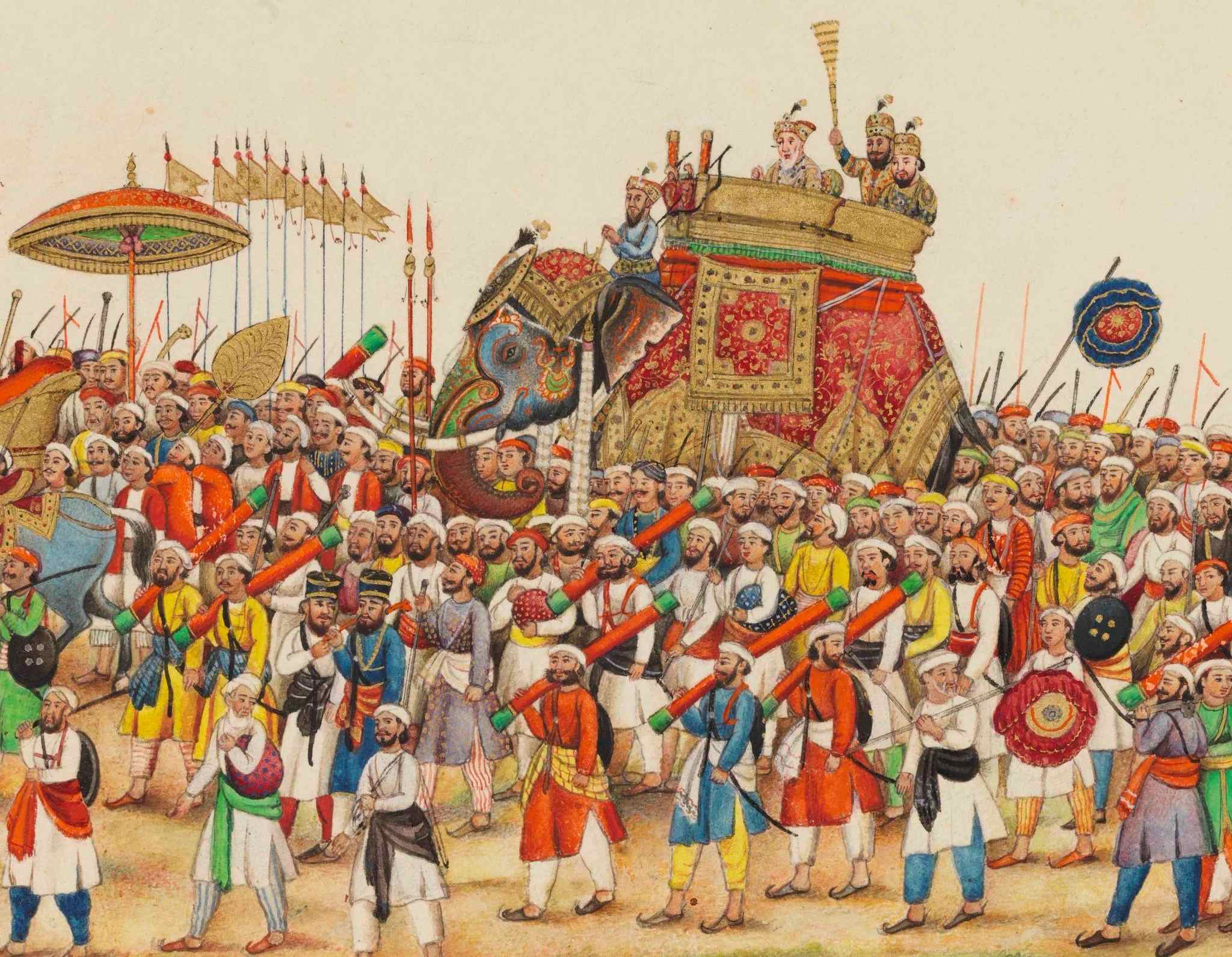
Dhaka's Eid celebrations gained another layer of grandeur with the introduction of a spectacular Eid procession, spearheaded by the Naib Nazims (Dhaka's governors). Imagine a vibrant parade snaking through the streets of Dhaka – a spectacle that was once a defining feature of Eid celebrations. Led by the Naib Nazims themselves, these grand processions weaved their way from the majestic Nimtoli Palace (completed in 1766), traversing various streets and undoubtedly passing by the bustling Chwak and Hussaini Dalan areas before returning to the palace gates.
These processions boasted an air of opulence. Towering elephants adorned with ornate decorations, camels laden with rich fabrics, and majestic horses formed part of the parade. Palanquins carrying dignitaries added to the grandeur, while the Naib Nazim himself would ride proudly atop an elephant at the forefront.
The visual feast was further enhanced by a kaleidoscope of colors. Participants proudly waved flags in vibrant hues, while the rhythmic beats of drums and bugles filled the air. Infantrymen marched with meticulously decorated umbrellas, and street performers added a touch of whimsy to the spectacle.
History enthusiasts can experience a glimpse of this bygone era thanks to 39 paintings by Alam Musawar, housed in the National Museum. These captivating works showcase not only Eid processions but also those for Muharram, offering a window into Dhaka's vibrant cultural tapestry.
The exact origins of the procession however remain shrouded in some mystery. Historian Muntasir Mamoon posits that the tradition might have coincided with the Naib Nazims' relocation to the newly built Nimtoli Palace in 1766. This shift in residence might have spurred the initiative for a grand procession, further solidifying Eid's status as a major public spectacle in Dhaka.
This vibrant display drew massive crowds, with locals, Mughals, and even the English gathering to witness the festivities. Sadly, the procession's reign was short-lived. The last Naib Nazim died in 1843, and the tradition likely faded away even before then. Historian Muntasir Mamoon suggests waning support might have contributed to its demise. This is corroborated by Bishop Heber's (1783-1826) account of his visit to Dhaka in 1824. He described the Nimtoli Palace as being in a state of disrepair, hinting at a decline in the Nazims' power and resources, perhaps impacting their ability to sustain the grand procession.
While the tradition itself may be lost to time, Alam Musawar's captivating paintings at the National Museum offer a window into this bygone era. These 39 artworks, depicting not just Eid processions but also those for Muharram, serve as a testament to the vibrant cultural tapestry that once unfolded on the streets of Dhaka.
How was Eid celebrated under the colonial rule of the British?
Dhaka's Eid celebrations underwent a metamorphosis during the British Raj. The traditional Naib Nazim position was abolished, leading to a significant overhaul of the city's ruling structure. As the 19th century progressed, the Khwaja family emerged as the preeminent Muslim entity in Dhaka, eventually earning the moniker "Nawab Family.”
However, Dhaka itself was experiencing a period of decline. The once-grand city fell into disrepair, and the journey to the Dhanmondi Eidgah became a deterrent for many. Eid prayers continued, but attendance dwindled, with only local residents venturing out. The city's two main Eid congregations shifted to the Lalbagh Shahi Jame Masjid and the Nawabbari Masjid, reflecting this shift in focus.
The rise of the Nawab family in Dhaka's Muslim community coincided with a period of adaptation for Eid traditions. While the once-grand Eidgah in Dhanmondi saw a decline in attendance due to the city's decay, the Nawab family's residence, Ahsan Manzil (also known as Nawabbari), emerged as a new focal point.
This majestic building became synonymous with Eid moon sightings. The sighting of the new moon on Chand Raat (the night before Eid) would be announced with booming cannon fire from the Nawabbari grounds. Anticipation would build as people gathered around the Nawabbari's pond, Gol Talab, eagerly awaiting the news.
The spirit of celebration continued to thrive in the form of vibrant fairs. Open spaces across the city, like Chawk, Armanitola, and Ramna Green, transformed into bustling fairgrounds. These gatherings transcended social barriers, drawing people from all walks of life, including members of the Nawab family themselves.
These traditions, as documented in various memoirs from the 1930s and 40s, paint a picture of a city fully embracing the spirit of Ramadan and Eid. James Taylor, a civil surgeon in Dhaka during the 1840s, even noted the festive atmosphere that pervaded the entire month of Ramadan. This sentiment was echoed by Hakim Habibur Rahman, a prominent figure of the late 19th century, who wrote about Dhaka's vibrant Eid preparations in the 1890s.
However, with the passage of time, many older traditions and culinary delights have unfortunately faded from memory. The Subahdars, Naib Nazims, and Nawabs are now relegated to the pages of history. Yet, Eid continues to evolve, incorporating new elements like special television programs, concerts, and the growing consumerism of Chand Raat.
While some traditions, like the procession, singing of Qasida, and Eid fairs, are undergoing a revival, the essence of Eid in Dhaka remains remarkably enduring. The new moon sighting, celebratory fireworks, and bustling fairs continue to be central to the festivities. As Dhaka embraces these enduring traditions with renewed enthusiasm, Eid remains an all-encompassing celebration that transcends social divisions and unites the city in a spirit of joy and togetherness.