

Bangladesh’s far right wasn’t born in mosques…it was built in markets

Mikail Hossain
Publish: 12 Sep 2025, 09:55 PM
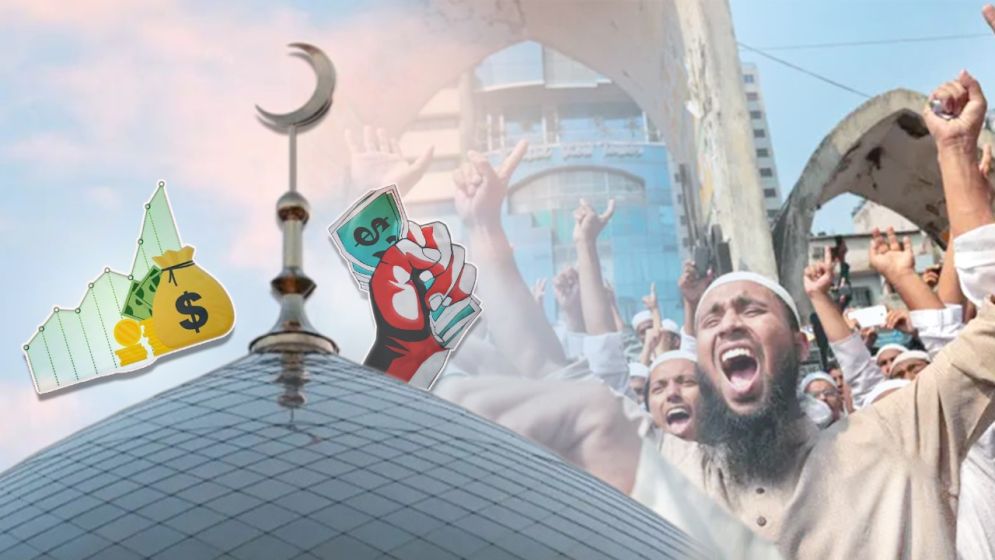
You cannot grasp the inner workings of fascism or authoritarianism without first confronting the hidden politics of capitalism. Power is never just about who rules; it is also about who eats and who starves.
Take John Steinbeck’s The Grapes of Wrath. It is more than just a novel about Dust Bowl refugees rather also a chronicle of how capitalism, in its rawest form, treats human suffering as collateral damage.
A father steals an orange for his sick child and meets the barrel of a shotgun. Oranges are doused with kerosene, potatoes dumped into rivers, pigs slaughtered and buried–all to protect “the market.”
Steinbeck captured the obscenity in a single, unforgettable line: “And children dying of pellagra must die because profit cannot be taken from an orange.”
This was no literary exaggeration. The Agricultural Adjustment Act of 1933 of the United States institutionalized destruction. President Roosevelt’s New Deal officers initially bought surplus crops to distribute as relief, but when that “charity” lowered demand, they turned to outright annihilation.
Food became both a weapon and spectacle and the state was guarding garbage heaps to ensure the poor could not feed themselves.
Two decades later, President Eisenhower found a more sophisticated use for surplus: Public Law 480, the so-called “Food for Peace” program. America’s wheat mountains were no longer dumped in rivers; they were exported to “friendly nations”--a euphemism for compliant ruling classes.
Recipient governments bought the food in local currency, which U.S. embassies then recycled to bankroll their own political projects. Aid was soft power disguised as generosity.
In Pakistan, Ayub Khan–guided by Harvard economists–turned this imported wheat into the “Works Program,” selling it cheaply on local markets and using the proceeds to build roads.
The economist Rehman Sobhan later dissected how the scheme entrenched dependency while dressing itself up as development.
The pattern is clear. From Depression-era California to Cold War South Asia, food has been a lever of power, and a reminder that capitalism’s cruelties are not accidents but structures.
To miss this is to miss how authoritarian systems are built–not only with guns and propaganda, but with oranges rotting in the fields.
Seeing through the
veneer
The so-called “Works Program” in Pakistan was about control. Instead of investing in water management, East Pakistan was dotted with useless roads that led nowhere, perfect conduits for corruption.
Ayub Khan designed the scheme to funnel easy money to his handpicked “basic democrats.” The result was predictable: a new class of rural speculators, suddenly flush with cash, who bound their fortunes to the military regime.
By 1971, many of these men formed the backbone of the Peace Committee and the Razakars, collaborators who abetted Yahya Khan’s genocide.
Food, once again, was the instrument. By the early 1970s, Bangladesh had grown dependent on American PL 480 wheat. When Washington abruptly canceled shipments in retaliation for Dhaka’s modest trade with Cuba, the country was thrust toward the famine of 1973.
What began as Steinbeck’s orange in Depression-era California–guarded with shotguns to protect profit–echoed all the way to Chuknagar. The logic was the same: starve in one place, weaponize food in another.
Eisenhower’s “Food for Peace” was essentially about Cold War power, about propping up pliant regimes, about using wheat as leverage against socialism. His broader doctrine paired subsidized grain with subsidies for authoritarianism: from military dictators in South Asia to Islamist proxies in the Middle East.
Understanding the famine in Bangladesh–or the rapid rise of pro-military collaborators in 1971–requires seeing this structure.
Strip away the rhetoric, and what remains is Max Horkheimer’s old truth: “Whoever is not willing to talk about capitalism should also keep quiet about fascism.”
And it is not just South Asia. The United States toppled Chile’s Salvador Allende for the sin of being elected socialist, proof that “free markets” and “free contracts” were never sacrosanct principles but flexible tools of empire.
To contain communism, Washington armed generals, funded zealots, and yes–weaponized wheat and corn. The hidden politics of capitalism do not simply accompany authoritarianism; they nourish it.

Systematic hollowing
out
The champions of “free markets” sneer at the very mention of state intervention. They spend their careers lobbying to shrink welfare programs, slash public budgets, and privatize what remains.
And yet–as Karl Polanyi argued in The Great Transformation–capitalism itself was never “natural.” It was engineered by state power. Markets had to be created, protected, and policed by law.
The true accidents, the unplanned outcomes, were the social protections erected in response to the devastation of unfettered markets. Even in 2008, when global finance collapsed under its own contradictions, it was public money that rescued private capital.
The same voices who rail against “big government” had no qualms about demanding trillion-dollar bailouts.
In Bangladesh, the politics are no different. Even without direct subsidies, today’s right-wing project has a clear goal: hollow out the state’s welfare capacity and shift power to non-state actors.
Neoliberal structural adjustment forced cuts to education and healthcare, leaving public hospitals and schools starved of resources. In their place rose private coaching centers like Retina and Focus.
These are obviously not neutral institutions. They became breeding grounds for reactionary politics, offering makeshift dormitories where young people were socialized not into civic life but into a parallel world of resentment and authoritarian discipline.
Much like Francis Ford Coppola’s Godfather world, where people turned to the mafia when the state failed them, Bangladesh’s youth turned to non-state surrogates that offered ideological indoctrination.
The result is a generation desensitized to inequality, taught to find political agency not in challenging economic exploitation but in misogyny, and scapegoating.
Theft is framed as the root of all poverty, solved by chopping off hands. Family dislocation is reduced to a women’s issue, solved by forcing them back into kitchens.
Meanwhile, the real engines of exploitation–the garment factories churning out cheap labor for the West, and the recruitment mills exporting workers to the Middle East–run without interruption.
You can analyze this far-right politics through ideology alone, but you’ll only see half the picture. To grasp its roots, you have to follow the money: the structural adjustment that dismantled welfare, the private markets that replaced public goods, the manufactured dependency that allowed reactionary politics to thrive.
Economics, not just rhetoric, is what keeps authoritarianism alive.
—
Mikail Hossain is a writer and analyst