


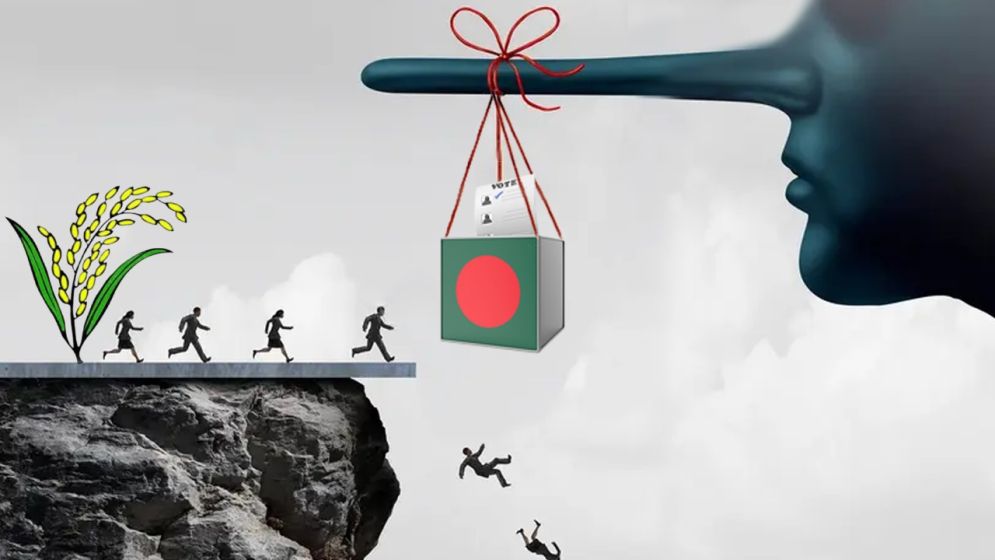
Bangladesh Nationalist Party (BNP) has walked into a trap laid by a curious alliance of opportunists inside the interim administration and Islamist hardliners who now occupy strategic posts.
Their essential aim is delaying the election. The sudden proclamation of a referendum, announced without dissent despite a charter that explicitly preserved it, is probably not an accidental betrayal.
It is in all good sense a ruse that exposes the Reform and Consensus Commission for what it is: a theater of consensus with no intention of delivering one.
Faced with that reality, the BNP’s options narrow to a single, grim arithmetic. Vote “No” or be complicit in the charade. But the distinction between opposing the referendum and trying to stop it entirely is perilously thin.
The party’s national leadership may declare principled resistance, but the machinery that must translate that stance into disciplined, nonviolent action on the ground is broken.
The BNP is a house run more by opportunists than by organizers. Local cadres, untethered from central discipline and with little to lose, will find it more expedient to sabotage polling than to marshal votes for a formal “No.”
If the referendum and the national election collide on the same day, that sabotage will not merely disrupt a constitutional exercise, it will probably cancel the election itself.
Chaos at polling stations provides the perfect pretext for those who benefit from postponement. Extend the interim government’s authority “for stability” and invoke emergency measures.
And let a holding pattern become permanence.
In short, the referendum is the thin end of a wedge that can hollow out democracy without a single convincing majority in favor of it.
The one route out of this trap is politics–hard, uncompromising negotiation. The BNP must sit down for exhaustive talks with the interim government and insist on ironclad guarantees.
They should negotiate hard for transparent schedules, fixed dates, independent oversight, and unambiguous protections against the weaponization of voter disruption.
But the credibility of such talks is doubtful when the same hands that signed a charter guaranteeing dissent now call for a unanimous referendum.
When your counterpart can switch from pledges to performative unanimity overnight, then “negotiation” risks becoming a ceremony in bad faith.
-6904a2ede6b9b.png)
The perils of dual dilemma
Worse still, by staking itself publicly on a “No” vote, the BNP will be forced into the awkward posture of partial alignment with the Awami League.
Not because the two share aims but because both are trying, in different ways, to avoid the referendum’s legitimacy.
The Awami League seems to prefer a scenario of paralysis. No referendum, no election without them, but plenty of chaos to justify their absence from the process. The BNP, desperately wanting an election, must nevertheless preserve the flexibility to pivot– to convert a “No” into leverage rather than letting it harden into self-defeating obstruction.
At stake is more than one vote or one calendar day. The real contest is for the rules of the game itself.
If the BNP wants to avoid becoming an accomplice in its own marginalization, it must rebuild discipline, insist on enforceable safeguards, and refuse the false choice between acquiescence and anarchy.
Otherwise, the referendum will not resolve anything, rather it will be the fig leaf for a prolonged suspension of democratic contestation.
Let me be clear at the outset: my intention here is not to hand the BNP a sermon wrapped in political advice, like a missionary tract from the Serampore Press (pun intended). They hardly need that.
The party’s leadership is packed with minds sharper than any algorithm, people capable of conjuring constitutional amendments overnight, proposing to raise judges’ retirement age from 65 to 67, or suggesting that the referendum’s “Yes” or “No” outcome should require a two-thirds majority.
They don’t need counsel from “useless” observers like me.
My interest lies elsewhere–with the rest of us “useless” people who sit on the sidelines and scroll through this drama, trying to extract a lesson or two for our own civic lives.
Maybe, in contrast to all that political brilliance, we can try to defend something humbler: a kind of grounded, everyday stupidity–an intelligence that doesn’t try to outsmart the system but simply tries to live within its moral boundaries.
Let me start with one word: nirongkush.
-6904a30a96244.png)
Politics of political jargon
It’s a familiar term in Bengali politics, tossed around like a slogan.
We hear of nirongkush shongkhagorishthota–“absolute majority”--and nirongkush bijoy–“absolute victory.” But linguistically, neither captures what the word truly means.
Nirongkush literally means “without the ankush,” the hooked iron goad that a mahout uses to control an elephant. To be nirongkush is not merely to be powerful–it is to be ungoverned.
To move without restraint. To lose the capacity for self-limitation.
There’s a difference, though, between a wild elephant and a rogue one. The wild elephant still moves within the codes of the forest, aware of its herd and habitat. The rogue elephant, once domesticated and now free of control, obeys nothing but its own panic and rage.
That, unfortunately, is what the BNP has begun to resemble: not the free elephant reclaiming its wilderness, but the rogue one, maddened by its loss of direction.
It had, in its hands, a coherent blueprint–the 31-point reform plan–that could have steered the country toward genuine renewal: a constituent assembly, a national government, a fresh constitution, and then, at last, an election with meaning.
But the party never took its own ideas seriously. Instead of walking that hard, patient road, it opted for the quick thrill of maneuvering. And now it finds itself, and the nation, trapped inside the very system it once promised to dismantle.
The tragedy of nirongkush power is not that it is evil, but that it forgets its own leash.
The BNP, in the end, chose the path of least resistance and mistook cunning for strategy. Watching the Awami League rule without any visible ongkush–without restraint, without systemic oversight–they, too, came to believe that governance was simply about who got to sit at the levers of power, not about the structure that made those levers legitimate.
Laws, norms, balance, constitutional checks–all of it, to them, looked like bureaucratic clutter. They wanted the same unshackled power, the same thrill of operating “without interference.” In short, they wanted to be nirongkush too.
And so they opted for the shortcut. Why bother with the messy, time-consuming process of a constituent assembly–the debates and the oversight– when one could win a single national election and take the reins?
Why spend on two votes, when a quick victory in one could deliver the real prize: cabinet posts and control over public funds?
In Bangladesh’s political economy, where parliamentary seats are often stepping stones to the ministries that command the money, the arithmetic is simple.
Power is expensive to chase but lucrative to hold.
-6904a3231e6e0.png)
Why “no” to a constituent assembly?
That is the only plausible logic behind the BNP’s rejection of a constituent assembly–even in a political landscape emptied of the Awami League.
They wanted power on the cheap: one election, no reforms, no new constitution, no limits. Ironically, the very shortcut they chose has now brought them back to where they didn’t want to go–two separate votes, a referendum and a national election, both freighted with uncertainty and chaos.
But this raises a deeper question: is nirongkushata–this absence of restraint–really the definition of freedom?
The greatest irony in Bangladesh’s political history is that the only instance where a leader voluntarily imposed a check on his own power came from the BNP’s own founder, Ziaur Rahman.
He was the one who transferred the authority to remove judges from the president to the Supreme Judicial Council, a small but profound gesture toward the idea that even executive power must answer to something larger than itself.
When later amendments rolled back much of his legacy, that one clause was preserved, as if the system itself refused to erase its single moment of self-restraint.
That’s the paradox the BNP refuses to see. The presence of a limit–of a law above you– is not a shackle. It is what makes freedom sustainable. Without it, power doesn’t liberate; it corrodes.
The absence of the ongkush doesn’t make the elephant freer, it only makes it dangerous, to itself and to everything around it.
During my time in the government service, I learned an uncomfortable truth: corruption is a pressure system, rather than just a temptation.
From local enforcers to senior bureaucrats, everyone tries to make you sign the file, move the money, look the other way. But even in that environment, I’ve seen people resist.
The principled and the quietly stubborn–they might be transferred or sidelined, but they are not forced. They still have a choice. The moment you claim absolute power–nirongkush khomota–that choice disappears.
Every act, every omission, every silence becomes your liability. When you answer to no law, you end up being accountable to everyone’s greed.
The BNP’s leadership seems blind to this paradox. They imagine that removing constitutional checks will unleash their ability to do “good”--create ten million jobs, pour money into education and health and build child-care centers in every neighborhood.
It’s a comforting fantasy, the kind that politicians tell themselves when they mistake intentions for institutions. But power without restraint doesn’t make goodness easier; it makes it impossible.
When your party knows that you operate outside any binding law, they will stop bringing you problems, they’ll bring you demands.
You’ll be asked to bless absurdities: to hand out offices to street agitators, to turn loyalists into mayors, to approve projects without proper merits and to trade discipline for flattery.
The opportunists will flood in, because they always do when power is untethered.
-6904a33b635d2.png)
Lessons unlearned, repeatedly
The Awami League’s story is proof enough.
Once it began exercising power without any ongkush, India quickly realized what that meant: a government accountable to no one at home was ripe for external control.
From trade deals to energy contracts, Delhi’s strategic establishment got everything it wanted. In return, the Awami League lost more than sovereignty; it lost its own dignity.
By the end, Sheikh Hasina couldn’t even mediate between the warring factions of her own student and youth wings. The very structure of her absolute power had devoured itself.
Nietzsche, in Beyond Good and Evil, wrote that all morality, art, and culture were born from “the tyranny of arbitrary laws.” Humanity, he argued, evolves not by escaping rules but by inventing and submitting to them.
Johan Huizinga, the Dutch historian, took that further, calling this impulse to play by rules the essence of civilization itself. Homo ludens: the creature who plays.
That’s what politics, at its best, should be–a disciplined act of self-limitation, a collective game where the rules themselves dignify the players. The tragedy of Bangladeshi politics–of both the Awami League and the BNP–is that neither wants to play anymore.
They just want to own the field.
The trouble with the laws we create for ourselves–whether in politics or everyday life–is that the urge to break them comes almost as naturally as the urge to make them.
It doesn’t take genius to notice that these rules are inventions, scaffolds we ourselves erected.
And so the temptation follows: why not tear them down? Why not cheat a little? The thought is childish but seductive–that the real fun of life begins only when you stop playing by the rules.
But the moment you give in to that impulse, the game itself collapses.
You can’t push the ball into the net with your hand and still call it football; you can’t move a knight diagonally and still call it chess.
-6904a35b86fca.png)
The “rules” out of chaos
Once the rules go, the play is meaningless. That, in essence, is what happens to societies when they confuse freedom with the absence of order.
A state without restraint doesn’t become freer–it becomes incoherent.
Civilization, paradoxically, depends on our capacity to resist this “cleverness.” It depends on what might be called a higher stupidity–a deliberate choice to stay within the lines we’ve drawn for ourselves.
Nietzsche understood this when he wrote that “stupidity is a condition of life and growth.” To abide by the rules you know are made-up–to keep faith with them even when no one’s watching–requires not dullness but depth.
Those who chase absolute freedom, imagining they can live “beyond” law or discipline, mistake slavery for liberation. They become captives of their own instincts, driven by impulses they neither understand nor control.
Even in chaos, a hidden order forms–a private, invisible law of compulsion. The difference is that while public laws can be debated, amended, or repealed, this inner law cannot. It rules without appeal.
And that is the final irony of lawlessness: it doesn’t set us free. It replaces visible limits with invisible ones, moral struggle with mechanical instinct. In the name of freedom, we hand over our agency to fate.
That, in the end, is where Bangladesh’s political imagination now teeters–between the discipline of rules and the narcotic of rulelessness.
The tragedy is that our leaders, in chasing power without limits, seem not to realize that the law they seek to escape is the only thing that still makes the game worth playing.
—
Mikail Hossain is a writer and analyst