

Ashraful Alam Khokon and the polished poison of post-truth politics

Shaquib Ahmed
Publish: 05 Nov 2025, 05:22 PM
-690b337e9cbf4.jpeg)
Ashraful
Alam Khokon is not your average Awami League loyalist. To know him–or even to
observe him from a distance–is to sense a peculiar dissonance.
Scroll
through his hyperactive Facebook feed, listen to the anecdotes that circulate
about him, and you’ll realize he doesn’t quite fit the archetype of the
“boorish,” slogan-shouting party man the ruling Awami League became known for
under Sheikh Hasina.
In
fact, “sophisticated” is a word that wouldn’t feel entirely out of place.
His
timeline is a curated collage of soft-lit portraits and carefully composed
photographs–each captioned with verses of poetry or cryptic lines drawn from
philosophy. The aesthetic is almost meditative, a portrayal of a man who
appears cultured and self-possessed.
That
might even be true–on the surface. But beneath that varnish lies a moral
compass long demagnetized by proximity to power. Khokon’s years orbiting one of
the most authoritarian regimes in the world have clearly left their mark.
Since
August 5 of last year–the day dictator Sheikh Hasina fled the country in
disgrace, chased out by a student-led revolt that toppled her 15-year rule–many
of her loyalists have scrambled to rewrite history.
Those
with large online followings have tried to recast her downfall as a tragedy
foretold by the rise of “fundamentalists” and “extremists” rather than the fall
of a despot.
It
was a predictable playbook. Former propagandists and digital apparatchiks
quickly regrouped–the so-called A-team, fronted by Omi Rahman Pial, Nijhoom
Majumder and Nahid “Rains.”
Mohammad
A. Arafat, the regime’s spin-hardened [last] State Minister for Information
jumped in too with his mind-bogglingly convoluted narrative.
Even
Hasina’s son, Sajeeb Wazed Joy, made a brief, humiliating appearance–his
swollen face and vacant stare a portrait of inherited arrogance. His attempts
to peddle conspiracy theories were so absurd that even dyed-in-the-wool Awami
supporters began to cringe.
But
Khokon has stood apart.
Scroll
through his posts over the past 14 months, and you’ll notice something
disarming–his words don’t always read as propaganda.
There’s a measured cadence, even a glimmer of introspection. For all his complicity, he has managed to sound, at least occasionally, like a man wrestling with the ruins of his own political faith while doing criticism for just reasons.
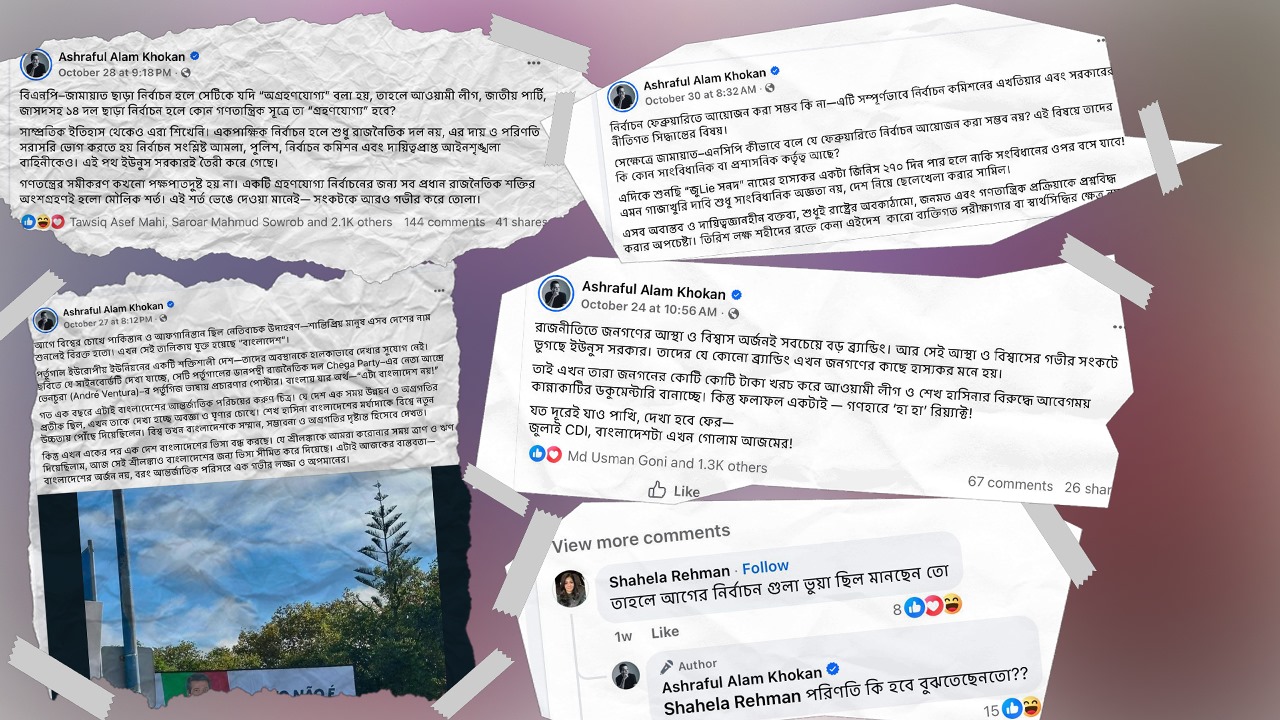
Veneered narrative
In
one of his October posts, Khokon targeted a “controversial” move to grant
television licenses to a handful of young upstarts who, as he wryly noted, had
been “earning barely 20,000 or 30,000 taka a few months ago” and were now
suddenly running entire TV channels.
The
jab was delivered with a polished wit–no vulgarities, just a sly turn of phrase
and a knowing smile.
It
struck a chord. Many ordinary Bangladeshis, already nursing suspicions that the
young faces of the July uprising were cashing in on their newfound fame, found
validation in his words.
In
that moment, Khokon managed to sound less like a bitter partisan and more like
a prudent observer of the times.
In
another post, he went further–back into nostalgia. He reminisced about a
Bangladesh where “stars” once meant intellect and refinement.
He
invoked the rhetorical brilliance of Birupaksha Paul and Abdun Noor Tushar, the
cultural discipline of Abdullah Abu Sayeed, the artistic gravitas of Humayun
Faridi, and the literary imagination of Humayun Ahmed.
Then,
with an artful sigh, he lamented how fame had been reduced to a carnival of
“uneducated YouTubers and TikTokers.”
For
an urban middle-class reader, that post may have read like a harmless cultural
critique–a lament for a lost age of civility. And on the surface, it was
exactly that. But behind the elegy lay something more insidious–obviously.
Khokon’s
real talent lies not in propaganda’s crudeness but in its refinement. He knows
exactly where to press, which nerves to touch, and how to lace his rhetoric
with just enough truth to make the poison go down smoothly.
His
target is clear: to sow distrust among the very coalition that brought Sheikh
Hasina down–the Bangladesh Nationalist Party (BNP), Jamaat-e-Islami, and the
National Citizens Party (NCP).
His
personal animus, of course, is reserved for the interim government led by Nobel
laureate Dr. Muhammad Yunus. But his attacks rarely sound personal. Instead, he
paints himself as the realist, the patriot who simply “sees through” the new
establishment.
To
be fair, Khokon’s propaganda doesn’t need to be invented from scratch.
The
mess is already there. BNP and Jamaat have been trading accusations with the
discipline of old rivals reliving their feud. Both carry their own
baggage–Jamaat still burdened by its wartime stance in 1971 and the lingering
fear that it might drag Bangladesh toward theocratic regression.
BNP
weighed down by its history of corruption and its loud takeover of the
client-patronage networks abandoned by fleeing Awami loyalists.
In short, Khokon doesn’t need to distort reality, he only needs to narrate it selectively. And that’s what makes him, perhaps, the most dangerous kind of propagandist: the one who sounds reasonable.
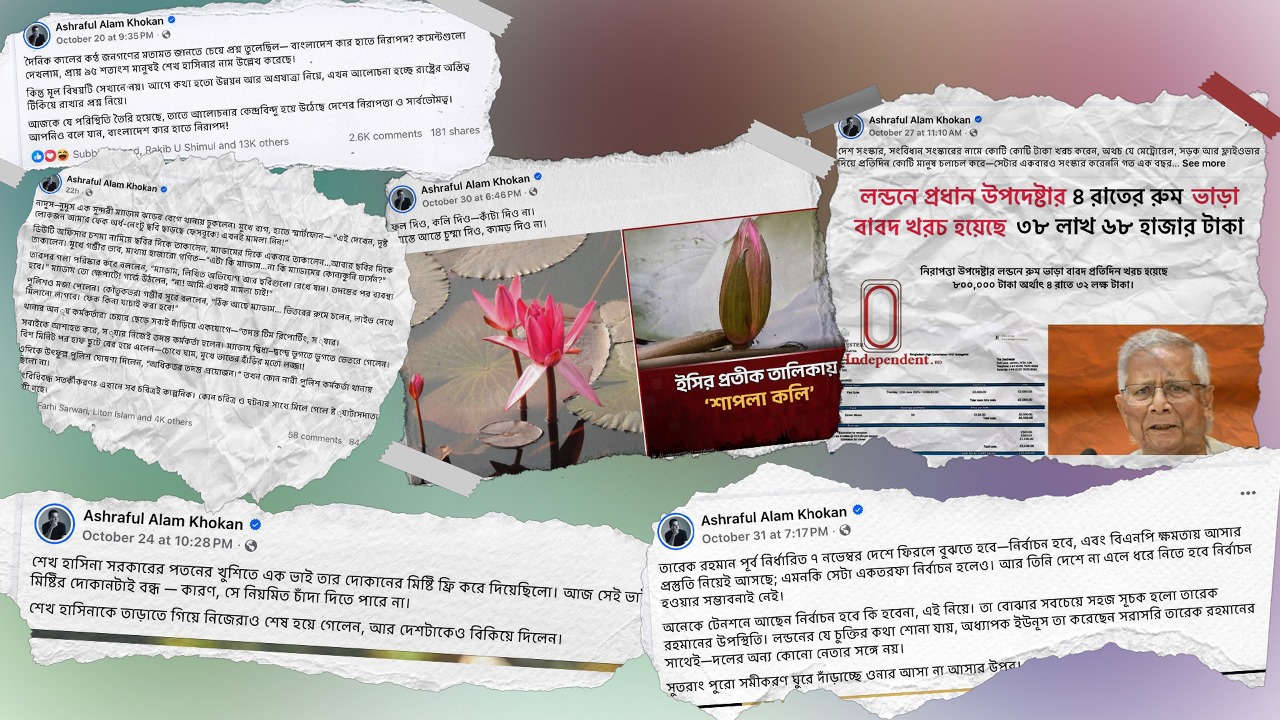
Jabs of hidden propaganda
The
National Citizens Party, or NCP, carries its own kind of baggage–a party that
began as the moral compass of the uprising but is now seen by many as a
“swaggering mob” with the emotional volatility of wounded adolescents.
Allegations
of corruption–some exaggerated, others unverified but widely believed–have only
deepened the disillusionment.
Meanwhile,
the interim government led by Dr. Muhammad Yunus has found itself on
increasingly shaky ground. Its early months were marked by a rare sense of
stability after the revolutionary upheaval of Hasina’s fall.
But
competence has not translated into popularity. The patience of a restless
public is wearing thin; many now accuse the administration of “not doing
enough,” a vague but potent charge that captures the mood of frustration in the
streets and in drawing rooms alike.
This
is the oxygen people like Khokon breathe. The lack of unity and the half-truths–all
of it offers him a peculiar satisfaction, a chance to refine his art of
division.
He
knows precisely where to press: the festering fault lines between the BNP and
Jamaat-e-Islami, once allies, now adversaries.
Khokon
understands the anatomy of their estrangement better than most. He knows that
BNP’s leaders now see Jamaat less as a former partner than as a potent
opponent. And he knows, too, that a disdain between the two former allies has
grown beyond politics into emotion on several issues.
For
many within BNP, the old fury reserved for the Awami League has been displaced
by an almost visceral contempt for Jamaat.
Jamaat
and its student wing, Shibir, have done little to repair that damage. Their
revisionist attempts about 1971 and their aggressive online attacks on BNP
activists have pushed the two camps even further apart.
Khokon
has seized on this rupture like a strategist spotting a crack in the enemy’s
defense. His weapon of course is narrative manipulation.
By
repeatedly painting the interim government as a “Jamaat-backed” regime–a claim
not entirely untrue but deeply misleading–he fans the embers of BNP’s
resentment and keeps the opposition fractured.
It’s
a masterclass in modern disinformation. He doesn’t shout; he suggests. He
doesn’t fabricate; he frames.
And in that subtlety lies his power.
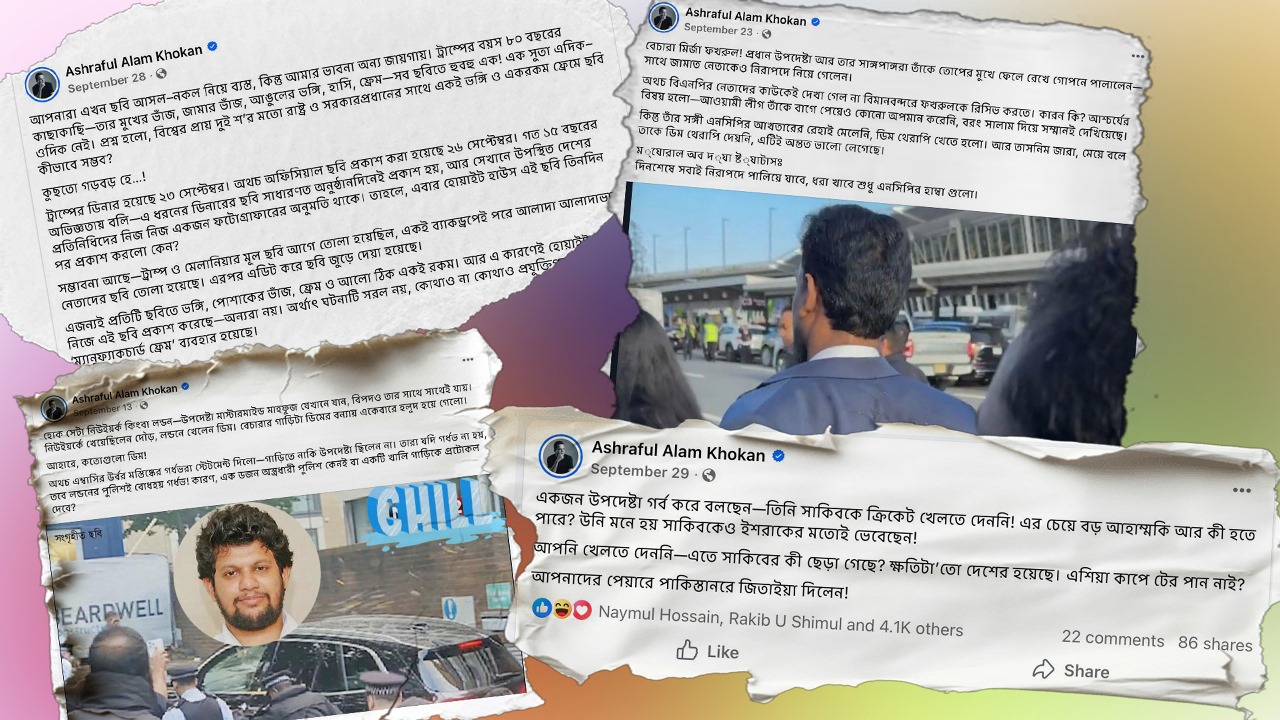
Carefully crafted optic
For
the NCP, Khokon’s playbook is simple: ridicule and delegitimize.
He
paints them as naïve, inexperienced idealists–useful idiots, essentially–doing
the bidding of a shadowy Jamaat conspiracy.
His
posts drip with irony and condescension, the language of a man who enjoys
mocking his targets more than defeating them.
But
it’s the BNP, the Awami League’s true rival, that provokes his deepest
contempt. No matter how artfully Khokon cloaks his commentary in
pseudo-intellectual musings, his resentment occasionally slips through.
Between
the lines of his posts, you can feel the bite toward a party that, for all its
flaws, now occupies the political space once monopolized by its own.
More
troubling, however, is his quiet attempt to turn the armed forces against the
interim government. After several senior generals were brought to trial for
crimes against humanity, Khokon began to sharpen his rhetoric.
In
one widely shared post, he wrote that Dr. Muhammad Yunus “has no expectations
from the country because he has never contributed to its benefit,” before
pivoting to a warning: “On August 5th, Army Chief General Waker stated that he
had taken charge of the country’s responsibility. Therefore, for better or
worse, the people will hold the Army and General Waker accountable for the
state of the nation.”
The
implication was clear–Yunus is expendable; the military, culpable.
It
was a masterstroke of insinuation, a way to seed discontent within the most
disciplined and stable institution [right now] in the country without ever
uttering a call to rebellion.
Scroll
through Khokon’s Facebook page–followed by a quarter million people–and the
pattern is unmistakable.
Each
post, however polished or poetic, feeds the same underlying objective: to
deepen the fractures among the very forces that brought down Hasina.
To
pit party against party and civilian against soldier. And, above all, to
whisper the seductive lie that Bangladesh, for all its suffering, was somehow
“better off under Hasina.”
That’s
the genius of his deceit–it doesn’t seek to convince, only to confuse.
And
confusion, in a country still recovering from the trauma of dictatorship, is
the most effective counterrevolution of all.
—