

November 7,1975: The day Bangladesh escaped the abyss

Faham Abdus Salam
Publish: 07 Nov 2025, 08:32 PM
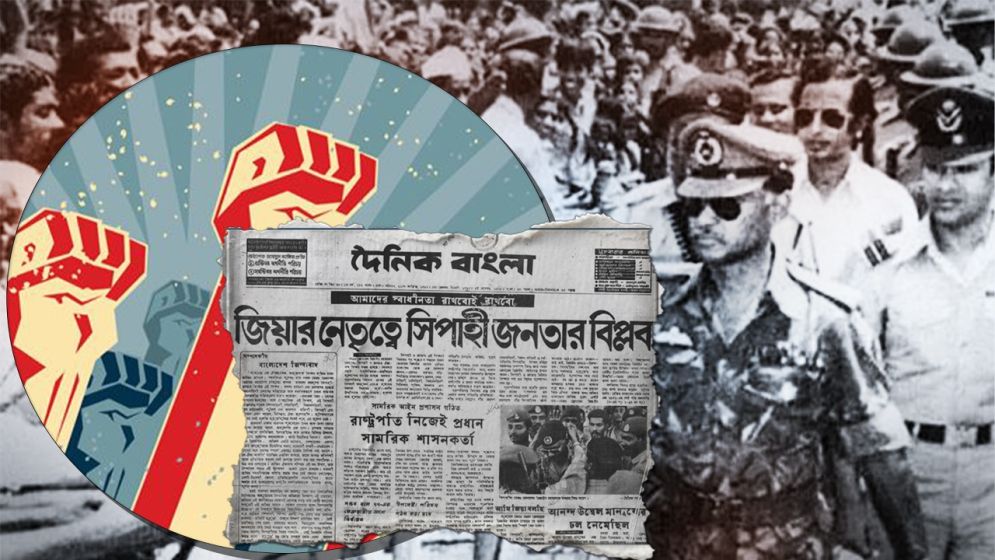
November 7th is a date that Bangladesh’s dominant Awami-leftist intellectual establishment has spent the past two decades dismissing or distorting. Yet to grasp its true significance, one must perform a simple mental exercise.
Imagine the alternative.
Let’s borrow an example from Nassim Nicholas Taleb, the philosopher of probability and history’s “what-ifs.”
Imagine that in January 2001, the U.S. Federal Aviation Administration had passed a dull, bureaucratic rule that every commercial airplane must install a bulletproof cockpit door, locked throughout the flight.
Nobody would have noticed. The news wouldn’t have made the front page, perhaps not even page seven. It would have been a “boring” law, irrelevant to almost all the people of the planet.
And yet, that one regulation could have changed the course of world history. The 9/11 hijackings would likely have failed. A million lives, directly and indirectly, might have been saved.
Sometimes the most consequential events are the ones that seem the least dramatic at the time.
November 7th, 1975, was Bangladesh’s version of that invisible hinge of history. The man at its center was Ziaur Rahman. Call him an accidental hero if you will–he easily could have been killed the day before.
The nation was teetering on the edge of chaos: assassinations, coups, and counter-coups had become routine. It was a moment when the fate of an entire country could have turned in any direction.
But here’s the uncomfortable truth. If anyone other than Zia had seized control, Bangladesh might not have survived as we know it.
The political vacuum was real, and the military’s gaze would have turned naturally toward the only organized force outside the Awami League–the Jatiya Samajtantrik Dal, or JSD. In the volatile ideological climate of the 1970s, that could only mean one thing– a leftist-military regime.
Colonel Abu Taher and his circle were already leaning that way, and the idea found resonance among many in the educated elite of the time.
Across the world, similar hybrids of socialism and soldiering were taking shape–in Peru, Ethiopia, Bolivia, Portugal, Cambodia, Vietnam. Every one of them descended into dysfunction, repression, chaos, bankruptcy or worse.
History’s verdict on left-wing militarism is clear–it is a political bomb that always detonates, and always inward.
Bangladesh was spared that fate by the improbable rise of one man–Zia. His ascent marked a pivot away from ideological absolutism and toward a more pragmatic, pluralistic nationalism.
-690e02588a793.png)
Strongman turned statesman
The most remarkable thing about Ziaur Rahman was not that he emerged from the military–it was that he willingly led Bangladesh out of a military regime and back into democracy.
History offers few such examples. Generals rarely return power to civilians; they consolidate it. Yet Zia did the opposite.
It is true that the Bangladesh Nationalist Party (BNP) was born in the cantonment. But it did not remain there. Over time, it became a party of the poor, a party whose roots reached far beyond the barracks and into the villages.
Yes, after August 5th, opportunists and power brokers rushed to its banner; that is the nature of politics. But even a month before that, the BNP’s backbone was unmistakably working-class.
Military men have founded parties before–look at Hussain Mohammad Ershad in Bangladesh, Parvez Musharraf, Zia-ul-Haq in Pakistan–but theirs evaporated with their regimes.
Ziaur Rahman’s party endures because it transcends its origin.
That is the deeper meaning of November 7th–the Revolution and Solidarity Day. Had anyone other than Ziaur Rahman taken charge then, Bangladesh might have followed Cambodia’s tragic path.
We might have descended into ideological violence and endless purges. History does not allow us to prove the counterfactual but sometimes, the mere shape of what didn’t happen tells us what did.
Why, then, does Bangladesh’s educated class hesitate to recognize him?
Because Zia defied their idea of what a leader should look and sound like.
He was not the intellectual’s ideal–no florid speeches and no pandering to ego. He was a man of precision and restraint. A doer, not a talker. Watch any recording of him: his unease with rhetoric, his clipped tone, his measured words and his discomfort with embellishment.
And yet, that quiet impatience with pretension was his greatest strength. He acted when others debated.
Zia had no pretense, no ornamentation–just purpose. There was something almost cinematic about his bearing–rugged and disciplined–like the Marlboro Man transplanted into South Asian politics.
He did not trade in charisma; he embodied resolve. Bangladesh’s intellectual elite never forgave him for that. They crave polish over performance, speeches over substance. Zia gave them neither–and gave the nation stability instead.
That kind of leadership–action-oriented and untheatrical–is what South Asia still lacks.
-690e026da43a3.png)
Lessons for the future leaders
As for Tarique Rahman, who stands in his father’s shadow with the potential to lead next, one piece of advice is essential–adopt that same no-nonsense ethos.
Ninety percent of your supporters are poor; make their lives the center of your politics. Forget the pretentious elite, their vanity and envy have always been a drain on the nation’s progress. Rebuild from the villages outward, as your father once did.
Bangladesh’s salvation came once from a soldier who refused to act like one. Its future may depend on whether anyone else can summon that same clarity of purpose.
If there is one arena where Bangladesh’s next chapter will be written, it is education. Not the rote, lifeless schooling that clogs our classrooms today, but an education system that truly upskills our children, gives them the tools to compete in a changing world.
This is not an impossible dream. It is entirely within reach, if only our leaders stop wasting energy bickering with political goats and madmen.
Because let’s be honest: Bangladesh does not suffer from a political crisis. It suffers from an economic one. The real emergency is that our young people are unemployed.
An entire generation is drifting–scrolling through Reels, trapped in the dopamine fog of TikTok, or other social media. They are unmoored from purpose. They are not lazy; they are lost. And the country is losing with them.
The task before any serious leader is clear: create jobs. Everything else is noise. Focus on ease of doing business. Protect private property. Cut the bureaucracy that strangles ambition. Give the young a reason to build, to believe.
The politics of endless speeches is finished in Bangladesh. The nation no longer wants orators–it wants operators. The measure of leadership now is not how many slogans you can shout, but how many jobs you can create.
Ziaur Rahman understood this instinctively. His appeal was not in what he said, but in what he did. Bangladesh today yearns for that same spirit of seriousness, of quiet determination unclouded by ideology or vanity.
—
Faham Abdus Salam is an Australia-based writer