

Yunus’s twin ballot gamble tests Bangladesh’s democratic rebirth

Abu Jakir
Publish: 13 Nov 2025, 09:11 PM
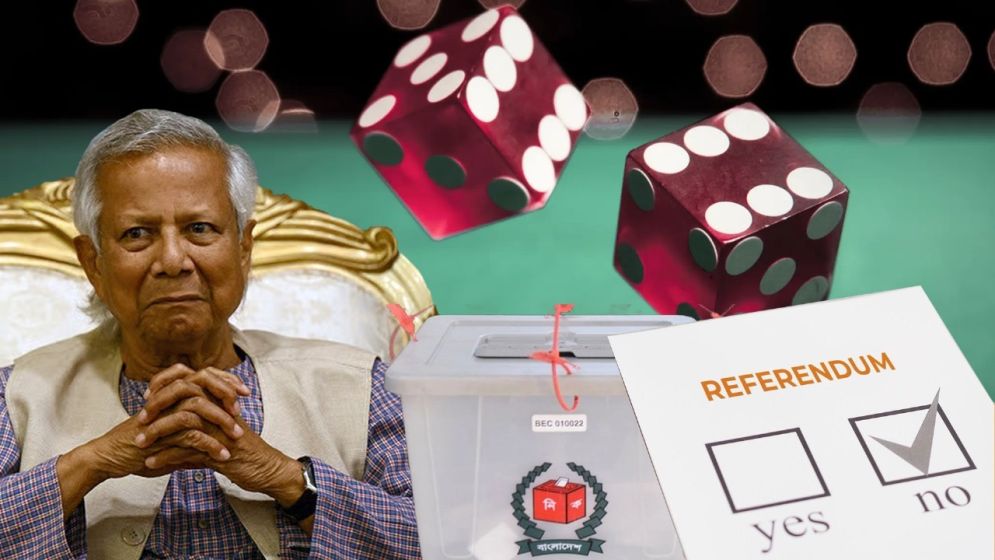
When Chief Adviser Dr Muhammad Yunus appeared on television Thursday afternoon, his voice carried two things–the calm authority of a reformer aware of history’s gaze and an equal tiredness of carrying the mantle of governing a fractured nation.
“We have decided that the referendum will be held on the same day as the national election,” he declared, unveiling a plan that may well define Bangladesh’s post-uprising future.
The decision means that in February, voters will choose a new parliament and at the same time also decide, through a single yes-or-no question, whether to endorse a sweeping constitutional overhaul–the “July National Charter.”
This move essentially binds the country’s democratic renewal to a constitutional gamble.
Yunus framed the moment as both culmination and beginning. The interim government, he reminded the nation, had been born of the “historic July Uprising” that toppled the previous “fascist regime.”
Its three missions, he said, were justice for the uprising’s victims, reform of the state’s institutions, and a democratic handover through free and fair elections. The February referendum, therefore, is meant to close one chapter and open another, fusing electoral choice with constitutional destiny.
At the core of Yunus’s announcement is a four-part referendum question. Each element reflects a lesson from Bangladesh’s recent political traumas.
First, the July Charter proposes that caretaker governments and constitutional bodies overseeing elections, including the Election Commission, be restructured according to new, consensus-based procedures.
This clause seeks to end decades of partisan deadlock over election management, a recurring fault line that fueled a large part of the 2024 July uprising. By embedding the caretaker principle into the constitution, Yunus hopes to ensure electoral neutrality beyond his own interim mandate.
Second, the Charter envisions a bicameral parliament, with a new 100-member upper house elected in proportion to each party’s share of the national vote.
This is perhaps the boldest structural change proposed since independence. The upper house would act as a brake on unilateral constitutional amendments, a common feature of Bangladeshi political majoritarianism.
It would, in principle, give smaller parties a voice in national legislation, injecting proportionality into a system long dominated by winner-takes-all politics.
Third, the referendum would bind the next government to implement 30 reform proposals agreed upon under the July Charter.
These include increasing women’s representation, empowering the opposition by assigning committee chairs and the deputy speakership to it, limiting the prime minister’s tenure, strengthening judicial independence, expanding the president’s powers, and decentralizing authority to local governments.
In effect, this clause would constitutionalize a policy blueprint, preventing the next ruling party from backtracking once in power.
Fourth, it commits the state to honor the broader spirit of the July Charter–an aspirational clause that would make the Charter itself a constitutional document, symbolically equivalent to a national covenant.

Referendum implication and “surprising” factors
Should the “yes” vote prevail, Yunus said, a Constitutional Reform Council would be formed within 30 days of the new parliament’s first sitting to draft the amendments.
The process would be time-bound: 180 working days for the reforms, 30 more for forming the upper house. The Charter would then be incorporated into the constitution as a permanent “commitment document.”
Yunus’s speech was suffused with moral undertones: references to the “martyrs of July,” to the “grave danger” of disunity, and to the “dignity of sacrifice.” The rhetoric evoked reform and redemption.
He touted economic recovery as proof that his interim experiment could deliver stability. Foreign reserves had rebounded, he said, and investor confidence was returning with a $550 million Maersk-linked port investment on the horizon.
Yet even as he spoke of fiscal prudence and institutional progress, Yunus knew that the next step, the synchronized election and referendum, risked political turbulence.
The logic, he argued, was practical: a “festive, cost-effective, and efficient” process. But in Bangladesh’s deeply divided political culture, efficiency rarely equals legitimacy.
The Bangladesh Nationalist Party (BNP), historically one of the country’s two major parties, reacted with suspicion, even betrayal.
Salahuddin Ahmed, a senior BNP Standing Committee member, accused Yunus of violating the July Charter itself. “In his speech, he violated the charter by including matters beyond the signed charter and adding new elements that were not mentioned in it,” he said.
To the BNP, the implementation order–the legal vehicle Yunus cited–appears as executive overreach.
The criticism is twofold. Substantively, BNP leaders claim Yunus expanded the scope of the Charter without consensus. Politically, they fear he is binding the next government, possibly theirs, to reforms negotiated under an unelected regime.
By fusing the election and referendum, they argue, Yunus risks confusing a mandate for government with a mandate for constitutional change.
The BNP’s acting chairman, Tarique Rahman, has called an emergency meeting to chart the party’s position, signaling that the party may not reject the referendum outright but will contest its framing.
The subtext is clear: BNP sees the dual ballot as a mechanism that could legitimize Yunus’s interim architecture even after he steps down.
The National Citizen Party (NCP), a smaller but symbolically important and the newest big force that backed the July Uprising, has taken a more nuanced line.
Joint Convener Sarwar Tushar said that the party had “no objection” to the timing of the referendum but questioned who had the authority to issue the order.
“The chief adviser may have maintained legality,” Tushar said, “but questions remain over legitimacy…and doubts persist about how much legitimacy will retain in the future.”
Essentially the NCP’s concern is constitutional rather than political. It worries that the Charter’s enactment could be tainted if formalized through the president instead of the chief adviser himself.
In Bangladesh’s constitutional practice, the boundary between legal procedure and political authority is blurry. The NCP’s remarks probably reflect anxiety that the reforms could later be invalidated or delegitimized–a risk that would undermine the very stability Yunus seeks.
In essence, NCP’s message is that the process matters as much as the product. Even sympathetic reformists are uneasy with procedural shortcuts.

Procedural rebellion and politics of timing
From the Islamist-right, Bangladesh Jamaat-e-Islami delivered their strident opposition. In a brisk press conference, its Secretary General, Mia Golam Porwar, declared that the dual-ballot decision “does not fulfill the people’s aspirations.”
Jamaat’s critique was procedural but layered with political subtext. It argued that voters “must have time to understand” the 48 reform proposals debated by the National Consensus Commission, and that combining two votes–one partisan, one constitutional–would “blur the distinction between electoral and constitutional questions.”
Porwar also warned of logistical chaos: violence or disruption at polling centers could invalidate both tallies simultaneously. Jamaat and its alliance of eight Islamist and nationalist parties have demanded that the referendum be held before the general election, to provide a clear, uncontested legal foundation for reforms.
Behind the rhetoric probably lies a tactical calculation. By decoupling the referendum, Jamaat could campaign on the reforms separately–positioning itself as a guardian of “people’s aspirations” rather than a mere electoral player.
Yunus’s fusion of the two processes denies them that strategic space. But the interim’s chief adviser’s decision to merge the referendum and election is not just about logistics. It is also about momentum.
By holding both votes on a single day, he collapses the transition into a single national moment, a symbolic break from the “lost decade” of authoritarianism. But this very compression also compresses consent.
In a society where trust in institutions is fragile, simultaneity may appear as efficiency’s triumph, or as its disguise. If the referendum passes easily, Yunus can claim a dual mandate for reform and democracy. If confusion or boycott mars the vote, it could plunge the country back into the uncertainty it has just escaped.
The irony is that all major parties, even those now dissenting, had at some point endorsed the July Charter’s principles. Yunus’s address celebrated the nine months of live-broadcast deliberations by the National Consensus Commission as “an unprecedented example of democratic practice.”
Yet the very parties that helped shape that consensus now question the choreography of its implementation.
For BNP, the referendum’s structure undermines autonomy; for Jamaat, it undermines clarity; for NCP, it undermines legitimacy. Together, their responses reveal that Bangladesh’s transitional unity is as brittle as its newfound optimism.
But as the nation prepares for February’s twin ballot, the stakes are immense. A “yes” vote could inaugurate the most significant constitutional transformation since 1972. A fractured or boycotted referendum, however, could delegitimize both the election and the reforms, reviving the old cycle of contestation.
Yunus thus ended his address with an appeal to unity. “Let us honor the sacrifice of the July martyrs by showing tolerance toward differing opinions.”
—