

We need to understand the politics of manufactured controversy…from ’71 to July

Tuhin Khan
Publish: 11 Dec 2025, 04:10 PM
Every nation, when it has sinned long enough, seems to be visited by its own order of self-appointed prophets. Bangladesh’s punishment, it appears, is an endless procession of great historians of convenience and talk-show crusaders…men who descend on television studios with the certainty of the anointed.
The latest in this divinely dispatched lineage is the indefatigable [Barrister] Shahriar Kabir, who recently erupted into gleeful giggles on live television while branding Dr Zahed Ur Rahman a nasthik, an atheist.
That the man’s name is Shahriar Kabir almost feels like a cosmic punchline.
Kabir is a talk-show archetype, a specialist in “cut-piece” theatrics, those selectively clipped, aggressively misleading rhetorical ambushes that thrive in the age of viral politics.
His performance style channels a classic Jamaat-e-Islami playbook: twist religious text just enough to smear opponents, cast strategic suspicion on the Liberation War, and present Islam and 1971 as irreconcilable truths.
If the method ever needed a mascot, he would be it.
His recent rise owes much to one moment…calling Dr. Zahed an atheist on air, then sealing the accusation with a grin so unsettling it seemed rehearsed.
Since then, he has taken to sermonizing about a selectively edited clip of Abul Sarkar interpreting Surah An-Nas, waving it around as if it were the missing chapter of our national history.
And now, inevitably, he has graduated to distributing the full catalogue of old, pre-packaged Jamaat-style “kasundi” arguments about 1971—antiquated, reheated, but suddenly revived on prime-time TV…and then on Youtube.
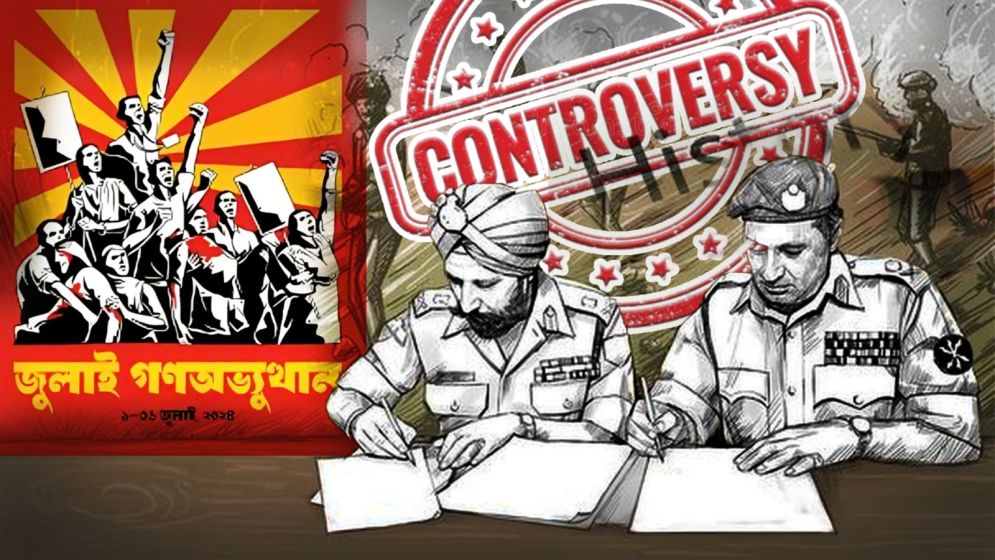
His latest “kasundi” was almost comedic in its confidence. On one talk show, Kabir declared there was no such thing as a “Joint Force” in 1971. According to him, Pakistani troops surrendered purely to India.
He read aloud from the Instrument of Surrender but halted….quite conveniently….just before the document identifies Lt. Gen. Jagjit Singh Aurora as the commander of both the Indian and Bangladeshi forces in the Eastern Theatre.
When confronted with this omission, Kabir unveiled a new argument, delivered with the solemnity of a courtroom surprise: Why does the Instrument of Surrender carry no Bangladeshi signature?
The answer is straightforward enough. Aurora signed on behalf of the Joint Forces; the text of the document says so explicitly. There was no need for a second signature. And yet the question—posed to insinuate—keeps resurfacing.
This is not an original query, of course. Many freedom fighters and Awami League activists asked it during the war itself. Their frustration was emotional and immediate. After all that blood, why should the Pakistani army surrender to anyone but the Mukti Bahini? Why was their victory mediated through another flag?
But the question, revived today by Kabir, carries a different purpose. It is not about dignity or wartime bitterness. It is about recasting the Liberation War as an unresolved, suspect affair—an old rhetorical strategy disguised as bold new inquiry.
And in an era when televised theatrics can masquerade as national introspection, the kasundi tastes fresh again, even when the bottle is decades old.

Why the revisionist attempt
The question, of course, did not emerge in a vacuum.
It was put directly to General M.A.G. Osmani, the Commander-in-Chief of the Mukti Bahini. And Osmani’s reply—clear and free of theatrics—remains the most compelling answer we have.
For those who want to revisit it, the account is preserved in pages 244–246 of Ekattorer Ranangan: Okothito Kichu Kotha (The Battlefront of ’71: Some Untold Stories) by Nazrul Islam, who served as Osmani’s Public Relations Officer during the war.
The explanation is neither mysterious nor politically convenient; it is grounded in the realities of a war unlike any other.
Because the war itself was unlike any other. It was not a conventional conflict between two sovereign states but a struggle between two halves of a single, fractured nation. That distinction shaped every diplomatic and military decision of the time.
Bangladesh had to navigate a maze of international protocols, geopolitical sensitivities, and the legal boundaries of an independence movement fighting for recognition. Compromise was not a sign of weakness; it was the condition of survival.
This is what makes today’s speculative questioning feel oddly incomplete. If one insists on asking why Pakistani forces surrendered to India and not directly to the Mukti Bahini, then one must also ask why Pakistan refused to surrender to those it still called its “own people.”
Why did it choose the Indian command instead? That question rarely appears on our talk shows because it does not serve the narrative that some would prefer to construct. The selective curiosity reveals the intention: not to understand history, but to destabilize it.
Every defining national moment leaves behind ambiguities. Some arise from the chaos of events; others from the limits imposed by law, diplomacy, or circumstance. Those who are genuinely interested in history seek out the complexities.
Those who are interested in controversy stop at the questions themselves.
And this tendency is not confined to 1971. July—our most recent political rupture—has already generated its own archive of unresolved queries.
Where is Sheikh Hasina’s resignation letter? Why did it never surface publicly? How exactly was authority transferred under Article 106? Was the provision used as intended? Was it followed in both letter and spirit?
A writ petition attempted to challenge the process; the court dismissed it, but the questions linger.
More will certainly emerge. Many documents from July remain unreleased or inaccessible, and when they eventually come to light, they will invite scrutiny just as events from 1971 continue to do. That is the nature of any transformative moment: the record is always incomplete at first.
But incomplete does not mean illegitimate. July, like 1971, was not an ordinary political transition; it was a mass uprising. And mass uprisings rarely follow the clean lines of constitutional diagrams or tidy procedural expectations.
They produce their own urgencies, their own deviations, their own improvisations. The questions are part of the historical texture, not evidence against it.
In time, answers will be found, and lessons drawn. But the presence of unanswered questions does not diminish the moral or historical weight of either event. The Liberation War remains what it always was: the defining moment of national self-assertion.
And July stands as another rupture.Both deserve to be examined honestly. Neither deserves to be trivialized by those who find comfort not in understanding history, but in endlessly rearranging its loose ends.
This is the basic calculus that often goes missing. Without grasping these fundamental distinctions, Jamaat-e-Islami and its affiliates continue to recycle questions about 1971 to cast a shadow over the event itself.
More recently, similar tactics have been deployed around the July uprising.
Recycling the problematic framing
Supreme Court lawyer Shishir Monir, for instance, raised procedural objections to Article 106, and during meetings of the Consensus Commission, Jamaat representatives pressed to have the Interim Government declared illegal—a demand that, notably, overlaps with the Awami League’s own challenge to the post-July order.
But Jamaat’s motivation lies elsewhere. By attempting to delegitimize the Interim Government, they also seek to delegitimize the Constitution of 1972. It is a political through-line that Bangladeshis would do well to recall.
The Supreme Court, for now, has blocked that effort.
A distinction, however, is essential. When figures like Farhad Mazhar or parties such as the NCP raised similar questions, they did so from a very different intellectual tradition—one rooted in the language of democratic revolutions and popular sovereignty, ideas inherited from the French Revolution and other modern constitutional ruptures.
Jamaat’s position diverges sharply. It does not accept popular sovereignty as a philosophical or doctrinal foundation; it subscribes instead to the concept of Hakimiyyah, or divine sovereignty.
Thus, its objections to Article 106 cannot be understood as part of a democratic argument. They are political maneuvers aimed at reopening the foundational debates of the early republic and weakening the constitutional settlement that emerged in 1972.
The NCP’s own missteps further complicated the moment. From the outset, it struggled to distinguish its democratic demands from Jamaat’s ideological project. This conceptual overlap—unintentional but politically damaging—blurred the lines between calls for a more representative constitutional process and the agenda of annulling the existing constitutional order.
The confusion weakened the NCP’s push for a Constituent Assembly and undermined the broader argument for drafting a more democratic constitution. In the process, an opportunity for deeper institutional renewal slipped away.
To be sure, this failure cannot be attributed to Jamaat alone. The Interim Government’s own limitations, the structural constraints of the Consensus Commission, and the BNP’s lack of political preparation all played significant roles.
The fragility of the moment created openings that were not used well.
But none of this changes the underlying reality: Jamaat cannot rewrite its record on 1971 through procedural skirmishes. Attempts to reopen debates about the Liberation War invariably strengthen the Awami League’s position.
And when Jamaat extends the same strategy to July, it ends up reinforcing the League’s narrative there as well. In effect, the party has settled into a pattern that benefits its historical rival—perhaps out of political instinct, perhaps out of miscalculation, perhaps simply because it has run out of viable alternatives.
Whatever the reason, the outcome is unlikely to serve Jamaat in the long run. Its strategy keeps tightening the circle around its own relevance. The sooner it confronts that reality, the clearer its political future—however limited—may become.
—
Tuhin Khan is a writer and activist