

Why are the questions around Hadi’s death still unanswered?

Siam Sarower Jamil
Publish: 22 Dec 2025, 06:45 PM
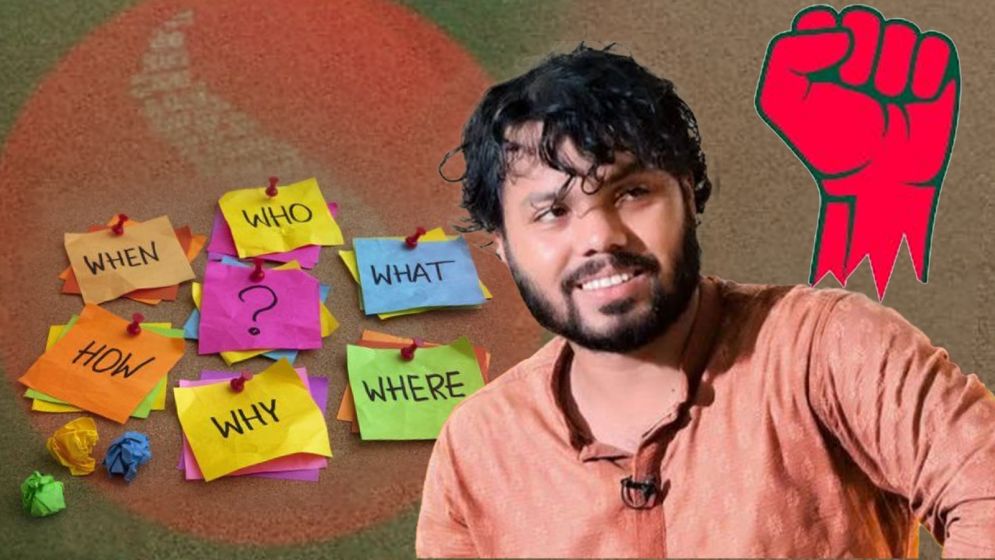
Sharif Osman Hadi was a little younger than me. We met for the first time in Shahbag—four or five years ago, perhaps. I can’t recall the exact date, only the texture of that time.
We spoke about poetry. He recited; I listened. We crossed paths a handful of times afterward—at the book fair, on the margins of public life. Five or six encounters in total, no more.
We were not close, but neither were we strangers. In that narrow space between familiarity and distance, something solid formed. Mutual respect. He called me bhai—brother—as a courteous, deliberate address.
Politically, we stood on opposite sides of the field. I come from the left. On questions central to Bangladesh’s moral and political future—the trial of war criminals, the nature of the state, the distribution of power—Hadi’s positions did not align with mine.
He had his own convictions and did not hide them. He spoke; I listened. Occasionally I agreed; more often I did not. I doubt he found my views particularly appealing either.
But disagreement did not foreclose conversation. Respect held the line where ideology failed.
Before August 5, I did not see Hadi prominently in the movement. At the time, my leg was broken. I spent nearly four months bedridden. When I eventually ventured out, it was on crutches and in a severely limited capacity.
I was not on the streets; I was watching from a distance. During curfew, I went out only to reach the hospital. My experience of that volatile period was largely indirect—filtered, incomplete.
After August 5, I encountered Hadi again, this time transformed into a public figure: a leader of the Inqilab Manch. Until then, I had barely known the organization existed, let alone that he led it.
What immediately stood out was his voice—loud, forceful, unrestrained. He spoke without hedging, without apology. Sometimes he swore. Sometimes he crossed into abuse.
It could be uncomfortable to listen to. Yet it would be dishonest to deny the effect. There was a raw, magnetic power in his speeches.

The dynamism and the flair
Hadi was, in many ways, filling a vacuum—the absence of a visible, articulate, moderate right-wing youth leadership in Bangladesh over the past decade.
This gap had briefly surfaced before, most notably in the rise of former DUCSU vice president Nurul Haque Nur. Hadi stepped into that empty space with volume and certainty.
But that power came with consequences. I believe his followers were instrumental in forming several of the early mobs, and too often I did not see him taking decisive steps to restrain them.
Just days ago, people emerging from his rally attempted to attack a leftist gathering in Shahbag. The tension was acute; violence felt imminent. The situation was eventually defused—perhaps because Hadi later moderated his tone.
But such restraint was rare.
That rarity, more than anything else, is what unsettles me.
I once believed Sharif Osman Hadi might grow into a formidable national leader—precisely because of that uncompromising voice. I assumed time would temper it, that experience would teach him restraint without dulling conviction.
I imagined him learning the burdens of leadership, perhaps one day taking a seat in Parliament and speaking even more forcefully, but with purpose rather than fury.
That future was foreclosed by a bullet.
And no, this was not inexplicable. In fact, it is almost painfully obvious who benefits from such a killing—and why it happened when it did. When a rising political voice is silenced at a moment of volatility, sympathy does not disperse randomly; it flows in predictable directions.
Martyrdom is politically efficient. Turning a young leader into a symbol and then exploiting the ensuing chaos is among the oldest tactics in the region’s playbook. This was repetition.
Hadi could have mattered. He might have become a consequential figure in Bangladesh’s center-right politics, occupying the vast, neglected space between the left and the far right.
He had the potential to mediate rather than polarize, to channel anger into structure, to turn noise into negotiation. That possibility was destroyed—not by fate, but by design.
I pray for peace for Hadi’s soul. But prayer cannot substitute for accountability. His death leaves behind a trail of unanswered questions that the state has made little effort to address.

Unanswered questions
Who, exactly, is responsible for this killing? How did an assassination take place in broad daylight? Where were the police and security agencies at the time?
There was ample opportunity to pursue the attackers after the shooting—so how did they vanish? Who will answer for that failure?
Why, after a year and a half in power, has the police force under the Yunus government still failed to assert basic control? How did the killers escape Dhaka? How did they cross the border?
What was the Border Guard Bangladesh doing? Why was no border alert issued? Was any formal request made to India for cooperation? Were Indian security agencies engaged at all?
Instead of clear answers, the country witnessed something else entirely. Newspaper offices—Prothom Alo, The Daily Star—were set on fire. Cultural institutions like Chhayanaut and Udichi were attacked.
Journalists were trapped on the roof of a burning building while the army pleaded with so-called “protesters” for twenty minutes to let them escape.
Where was the government during all of this? Why was the police force inert when the streets were on fire? And why is the Chief Adviser’s press secretary allowed to walk away with a perfunctory “sorry,” after previously describing this same mob as a helpful pressure group?
Sharif Osman Hadi’s killing exposed a deeper collapse—of responsibility, of governance, and of the state’s willingness to protect either dissent or dialogue. Until these questions are answered, his death will remain an indictment.
Hadi’s death is not merely the loss of one life. It is a mirror held up to the state—and what it reflects is institutional collapse. When a young political leader can be gunned down in public, his killers evaporate, and the aftermath descends into arson and intimidation, the failure is no longer individual.
It is systemic.
Someone must be held accountable for that failure. Not with condolences, not with apologies, not with carefully worded statements—but with responsibility that has names attached to it.
If that reckoning never comes, these questions will not disappear. They will linger, unanswered and unresolved, until another young voice rises, fills the same vacuum, and meets the same fate.
—
Siam Sarower Jamil was an assistant secretary general of Bangladesh Chhatra Union. He can be reached at [email protected]