

The homecoming that must impose control…and restore restraint

Nayel Rahman
Publish: 24 Dec 2025, 10:15 PM
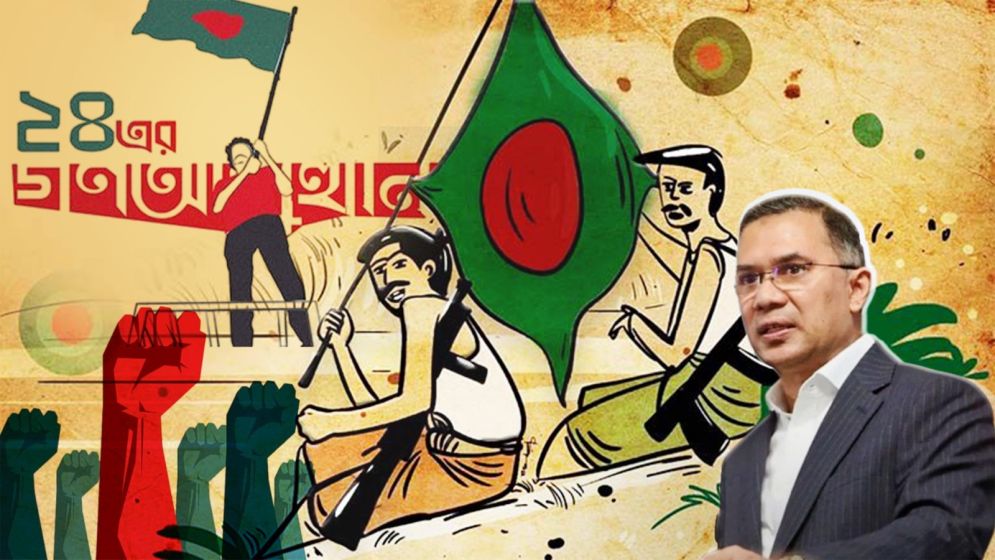
Tarique Rahman’s return is shaping up to be the Bangladesh Nationalist Party’s most consequential moment on the campaign trail.
But in all good senses, it appears to be a carefully choreographed gamble that could either consolidate power or expose the party’s deepest vulnerabilities.
For a party that has struggled for years under Sheikh Hasina’s dictatorship to command sustained public attention from the mainstream media space, the homecoming offers a rare commodity of near-total control of the media narrative.
If handled with discipline, it could drown out rival parties and monopolize the news cycle long enough to present Tarique Rahman not merely as a potential political heir, but as a PM in waiting with no real alternatives or challengers.
Few political openings are this clean…or this unforgiving.
The risk is not [external] opposition but internal excess. BNP’s greatest threat has long come from its own ecosystem. A hyperactive social media machine, unruly street politics, party machinaries with mixed messages and a reflex for spectacle over substance.
One misstep—an inflammatory slogan, an unnecessary clash, a faux pass from the top leadership or a viral moment gone wrong—could collapse the intended message.
Yet the party seems prepared to accept that risk, betting that visibility itself is worth the cost.
For individual operatives, the calculus is more austere. There is little immediate reward on offer beyond proximity to power. Their task is narrow but decisive: impose discipline, if only temporarily.
That has proven difficult in the past, but within South Asia’s legacy parties, frenzy is not necessarily a bug...it is a feature. Political families operate as brands, zealously guarded. Any figure or faction that threatens to divert attention, even indirectly, is treated as a liability to be contained.
This is why talk of “post-narrative” politics rings hollow. Dynastic parties do not function without stories–-without mythologies that elevate lineage into destiny. Governing is complex, slow and uncertain.
But narrative-building is swift and seductive.
The Awami League’s evolution offers a warning though. A party once defined by broad-based nationalism gradually hollowed out into a neopatrimonial personality cult, ultimately serving a single family’s political inheritance.
BNP probably risks walking a familiar path.
Unpredictable rank and file
What often goes unacknowledged is how this informal, personality-driven system distorts the lives of party workers themselves.
Advancement is not merely about influence; it is about survival. For many, politics is the only ladder available for social and economic mobility. Recognition, then, becomes existential…and recognition requires visibility.
The logic is brutal and predictable. The louder the rhetoric, the sharper the theatrics, the greater the chance of being noticed. To the public, it may look reckless or grotesque.
But within the party, it is understood for what it is—a struggle for relevance, security and supremacy, played out in full view.
BNP’s troubles are also compounded by a conviction—nurtured inside the party and reinforced nightly on television—that the next election is already in the bag.
Few forces, however, are more destabilizing than the sense of inevitability.
When victory is assumed, solidarity erodes. The contest shifts inward, as leaders and operatives jostle not to win power but to position themselves within it. Everyone knows the spoils will be limited, even as the line of claimants grows longer: business elites, retired bureaucrats, media-friendly intellectuals and the street-level enforcers who kept the party alive in its lean years.
In such a scramble, restraint is irrational; visibility is everything.
Years of attrition under Sheikh Hasina’s rule have left BNP structurally weakened and psychologically fragmented. The party speaks the language of endurance, but its mid-level cadres tell a different story—one of neglect and drift.
Senior figures, insulated by status and resources, largely withdrew from confrontation during the crackdown, opting for personal safety over collective risk.
When the political ground shifted after August 5, they re-emerged expecting deference, only to find they had lost the authority to command it.

Channeling strength or chaos?
The grassroots operatives—those who had absorbed the violence, arrests and financial ruin at the hands of the Awami League—were no longer inclined to listen.
The collision was inevitable. The damage has been widespread, spilling beyond the party to its supporters and into public life.
What is taking shape now is close to unprecedented in Bangladesh’s political history. BNP’s fiercest battles are no longer with its opponents but with itself. Internal rivalries have begun to eclipse the external contest, hollowing out discipline and pushing confrontations onto the streets.
When factions under the same banner start treating one another as existential threats, escalation becomes almost automatic. Any further spillover risks deepening an already combustible environment.
This is the moment in which Tarique Rahman’s return assumes outsized importance.
Against a backdrop of domestic volatility and regional uncertainty, his homecoming is expected to do what institutions and party mechanisms have failed to achieve: impose order, restore hierarchy and dampen the most dangerous rivalries.
At minimum, it removes a central ambiguity around leadership. Whether that proves enough is an open question. Much will hinge on whether this carefully staged political drama can deliver something rarer than momentum—restraint.
Because the stakes are no longer just electoral. They are measured in stability and the fragile possibility of a democratic transition that does not descend into chaos.
—
Nayel Rahman is a political analyst