

Why governing against the far right destroyed the center in Bangladesh

Mikail Hossain
Publish: 29 Dec 2025, 06:25 PM
When an animal senses mortal danger, a primitive circuit in the autonomic nervous system seizes control. The “fight or flight” response floods the bloodstream with adrenaline and cortisol.
Blood vessels constrict, the heart races, pupils widen. The body enters an emergency conservator mode: survival first, everything else postponed. Growth and long-term metabolic functions are suspended because they are luxuries in a moment of threat.
But what saves a life in the short term becomes destructive if it never switches off. Prolonged stress hollows the body out. Muscle mass withers. Systems meant to regenerate fall into disrepair. Medicine has a name for this condition: chronic stress syndrome—the slow damage caused by living permanently in emergency mode.
Bangladeshi politics today resembles such a body.
In most societies, right-wing and left-wing forces contest space within an agreed framework of civil rights. Tensions are real, sometimes fierce, but negotiable. In Bangladesh, ultra-right politics collapses this spectrum altogether.
It turns civil rights into a non-negotiable battlefield. The rights of minorities and women are pushed immediately into a state of crisis. Even the country’s foundational history is placed under interrogation.
Since the post–9/11 reordering of global power, this ultra-right current has functioned as a permanent stress stimulus in Bangladeshi political life.
Under normal conditions, political debate would revolve around policy—Indian influence, corruption, commodity prices, fiscal discipline. These are the democratic equivalent of metabolism: the routine processes that keep a polity healthy.
But metabolism cannot operate when the body believes it is under existential threat.
When basic civil and political rights are perceived to be at risk, policy disappears from view. Politics narrows into a single reflex. A fight-or-flight frenzy takes over. The message becomes brutally simple: forget everything else—stop the far right first.
This permanent emergency has consequences. It grants mainstream democratic parties a quiet but potent form of impunity. By doing nothing extraordinary—by merely not being overtly far-right—they inherit the loyalty of middle-class civil society.
They are rewarded for being the lesser fear. In the short run, this feels like a triumph.

The ‘power’ equation
But “absolute” power, as I have argued elsewhere, carries its own pathology.
In a political ecosystem shaped by fight-or-flight logic, accountability is not merely weakened; it is delegitimized. Parties cease to self-correct. Their worst elements thrive.
Over time, the organization turns into a sanctuary for scoundrels—men who loot and hollow out the state while cloaking themselves in the language of stability.
The justification is always the same. We are not militants. We are preventing militancy. That claim alone becomes a moral shield. It allows the selling off of national interests, the normalization of corruption, and the steady erosion of democratic norms—all presented as a necessary price for keeping the ultimate danger at bay.
Like a body locked in permanent stress, Bangladesh’s politics survives—but it does not heal or renew. And survival without regeneration is not stability.
It is slow, systemic decay.
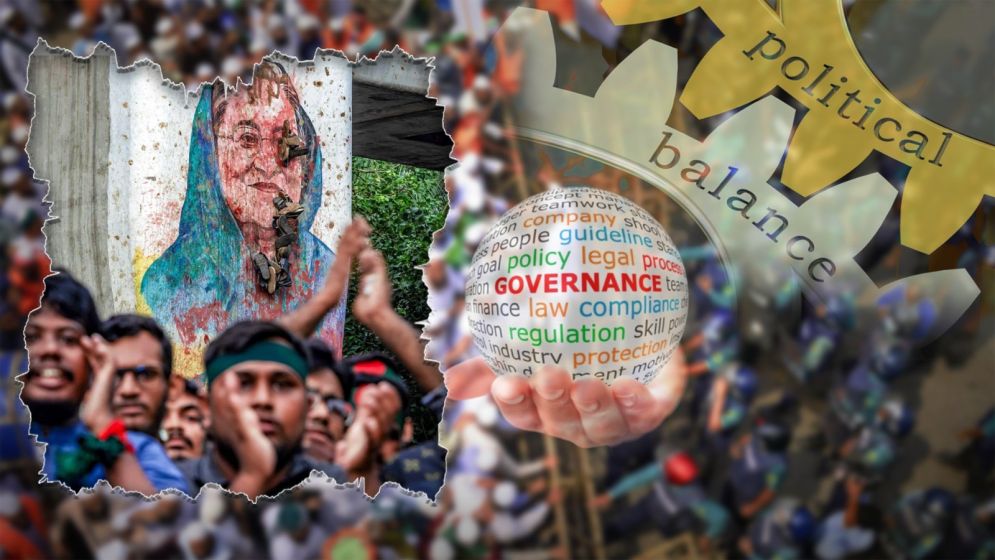
Over sixteen years of ruling in the name of “preventing” the far right, the Awami League did not merely fail to contain extremism; it laid bare—and ultimately unleashed—the worst pathologies of its own middle-class bourgeois core.
In the process, it squandered the hard-earned legacy of a progressive Muslim bourgeois politics that once gave the party moral authority. What remains today is a hollowed-out organization, chasing Facebook validation through political clownery, operating from exile, leaning on contract violence, and entangling itself with Indian sleeper networks.
This is the logical end point of a politics built solely on fear management. If the BNP now defines itself only by what it is not—“not far-right,” “preventing extremism”—it is likely to walk the same road to the same ruin.
This is what chronic stress looks like in political form. A body politic trapped indefinitely in fight-or-flight mode begins to cannibalize itself. Institutions weaken. Norms corrode.
Structural elements that sustain democratic life—trust, goodwill, accountability, restraint—atrophy under the strain. Bangladesh is now paying that price.

Any silver lining?
Escaping this condition requires more than electoral turnover. It demands a prior, and explicit, political consensus about the source of stress itself.
There must be a shared commitment to an open civil and political space—one that protects minorities, women, dissenters, and opposition voices as a matter of principle, not convenience.
That consensus must be constitutional, not rhetorical. The constitution must function as the central nervous system of the republic, guiding executive power rather than bending to it.
Think of it as a cricket match between Australia and South Africa. Fans can passionately want the other side to lose. Rivalry is natural; hostility is not the problem.
But both sides must agree that the game of cricket should exist and that its rules are worth preserving. If spectators must spend the entire match protesting the rules simply to keep the game going, then the game itself becomes impossible.
Bangladesh’s pro-election parties inevitably contain competing class interests. For some factions, it may appear clever and sophisticated to keep the specter of militancy permanently alive, to justify the suspension of democratic norms while quietly profiting from a politics of looting.
The Awami League perfected this method. And history has delivered its verdict. The party did not secure permanence; it secured irrelevance.
The question now is whether others will learn from this outcome. The BNP, the NCP, and any party serious about long-term political survival should regard the Awami League’s collapse as a warning, not an opportunity.
Short-term gains purchased through fear politics lead only to long-term extinction.
Bangladesh does not need another cycle of emergency rule masquerading as stability. It needs a workable—if imperfect—settlement that restores open civil, economic, and political rights, and allows politics to return to metabolism rather than panic.
One can only hope that those who aspire to govern possess the wisdom to recognize the dustbin of history before they are pushed into it.
—
Mikail Hossain is a writer and analyst