


During Sheikh Hasina’s 16-year long dictatorial rule, few images captured the Awami League’s mastery of performative grief more starkly than two carefully staged encounters.
Both of those were designed to project sympathy, but neither was capable of concealing culpability.
The first dates back to 2013, when Hasina met the family of BNP leader Ilias Ali after his enforced disappearance. The second came more than a decade later, at the height of last year’s July uprising, when she appeared before the family of Abu Sayeed, killed by police [rubber] bullets.
In both moments, the choreography was familiar. Solemn faces and sympathetic gestures while cameras rolling. And in both, the emotional vacancy on the faces of the bereaved—marked by anger and helpless restraint—betrayed a truth the Awami regime could not script away.
These were definitely not any acts of empathy. They were exercises in political theater, performed by a ruler fully aware of her government’s role in producing the very grief she pretended to mourn.
The country sensed it instantly. No amount of staged solemnity could obscure the reality that the Awami League carried no remorse for the machinery of repression that claimed Ilias Ali, Abu Sayeed, and countless others.
These gestures were not meant for the public—who had long ceased to believe them—but for internal consumption, a ritual reassurance to party loyalists that the regime still possessed moral cover.
This hollowness was neither new nor accidental. It had been rehearsed before, many other times.
When Arafat Rahman Coco, the younger son of Khaleda Zia, died, Hasina made a conspicuous show of visiting the grieving former prime minister at her Gulshan residence.
Yet the visit ended almost before it began. Hasina turned back from the door, offering no time, no space, no genuine engagement with a mother in mourning.
The regime’s media machinery quickly inverted the narrative, portraying Khaleda Zia as discourteous, even rude. But the optics were clear even then: this was another episode of calculated symbolism, not human sympathy—a gesture calibrated for headlines.
Such inversions are characteristic of authoritarian systems. The theater is constant; truth is expendable.

Tears of convenience
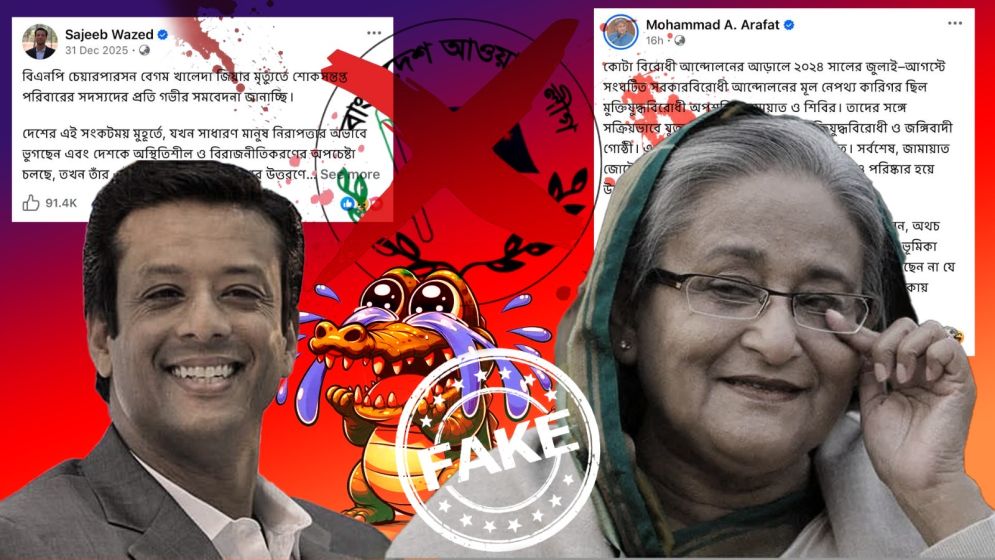
That pattern resurfaced again following Khaleda Zia’s death on December 30. From her safehouse in New Delhi, the ousted dictator issued a formal message of condolence.
Her son, Sajeeb Wajed, followed with his own expression of grief on social media. On the surface, the words appeared conciliatory, even civil. In substance, they rang hollow.
Those familiar with the Awami League’s political temperament understood immediately what this was not. It was not remorse. It was not a reckoning with the past.
For a regime that systematically imprisoned Khaleda Zia under politically motivated cases, denied her proper medical care, and subjected her to prolonged incarceration that visibly eroded her health, the language of condolence was impossible to separate from cruelty.
Her death was the endpoint of sustained state pressure.
The condolence messages were therefore not moral gestures but political calculations—an attempt, however clumsy, to reopen channels with the BNP at a moment when electoral arithmetic has shifted decisively.
With a general election scheduled for February 12 and the BNP widely seen as the frontrunner, the Awami League appeared to be testing whether symbolic civility could soften institutional memory.
If such gestures once existed organically in Bangladesh’s political culture, they were extinguished long ago—casualties of a regime that governed through intimidation after 2014.
The thing that remains is imitation. Gestures stripped of sincerity, deployed tactically.
That bluff did not survive long. At Khaleda Zia’s funeral, BNP standing committee member Nazrul Islam Khan addressed the largest funeral gathering in the country’s history and reminded the crowd that Khaleda Zia’s death did not occur in a vacuum—that it followed years of deliberate legal harassment and imprisonment under the Hasina government.
This was collective memory articulated aloud. The Awami League’s attempt at moral laundering collapsed in real time.

Desperate measures
Long before this failed overture, however, the party had already been recalibrating its narrative. For more than a decade, the Awami League collapsed its principal opponents into a single phrase, “BNP–Jamaat”, refusing even to name them separately.
Suddenly, after last year’s uprising, that linguistic habit shifted. BNP began to disappear from the accusation matrix. Jamaat and its student wing, Shibir, took center stage.
This was of course not coincidental.
The post-uprising political landscape altered old equations. The rift between BNP and Jamaat deepened—partly over ideology, partly over power.
For the first time, Jamaat-e-Islami emerged as a serious electoral contender rather than a junior partner. BNP, one of the two pillars of Bangladesh’s traditional two-party system, struggled to accept this new reality. Rivalry intensified.
But rivalry does not erase history. BNP remains the principal victim of Awami League repression—its leaders jailed, its activists disappeared, its grassroots strangled, its organizational structure systematically dismantled.
That record cannot be rewritten simply by redirecting blame.
Yet the Awami League has tried. Through commentaries and social media amplification, it has worked to present a revised narrative that its conflict was never with BNP, only with “anti-liberation forces”—Jamaat and Shibir.
BNP is quietly omitted, erased from the indictment, just for the sake of Awami convenience.
A recent Facebook post by former state minister for information Mohammad A. Arafat captured this strategy with unusual clarity.
In it, he claimed that the “ultimate masterminds” behind the July–August 2024 movement—carried out, he said, under the cover of anti-quota protests—were Jamaat and Shibir, joined by other “anti-liberation” and militant groups.
He asserted that this had now been conclusively proven, pointing to the NCP’s inclusion in a Jamaat-led alliance as further evidence.
What went unmentioned was BNP.
Ironically, in attempting to absolve itself by narrowing its list of enemies, the Awami League has exposed the very cynicism it hoped to conceal.
Its condolences ring hollow because they are not anchored in accountability. Its accusations falter because they are selectively applied.
And its political theater, once powerful, now plays to an audience that has learned to recognize the difference between grief and performance. The truth is, no is buying “crocodile tears” anymore.
—