

Khaleda Zia: At rest with power in a restless democracy

Shahadat Shadhin
Publish: 06 Jan 2026, 09:18 PM
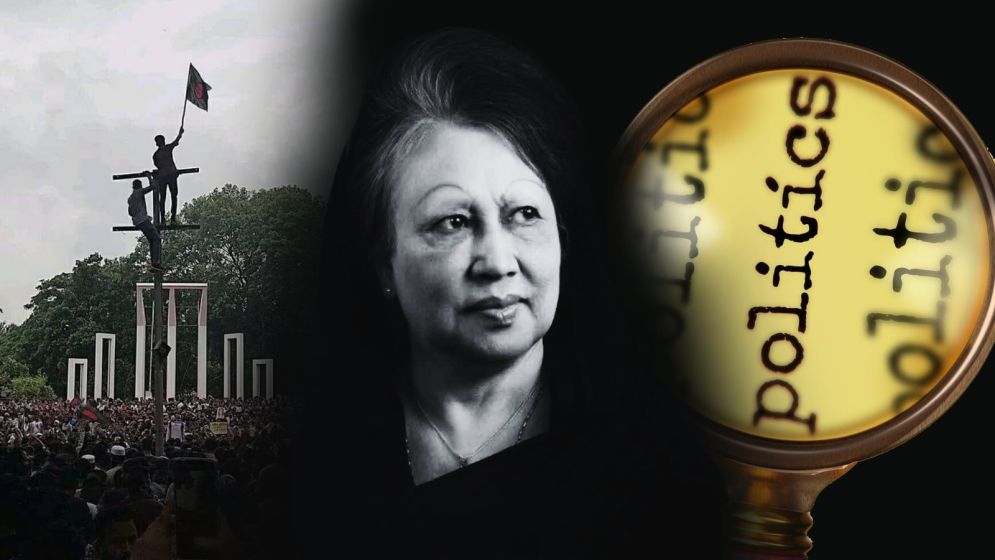
The life of a politically exposed person is rarely ordinary. In South Asia and Southeast Asia, it is often operatic—upheaval and, more often than not, tragedy.
For decades, women from elite political families have risen to lead their nations, leaving behind legacies as consequential as they are unsettled. Indira Gandhi in India, Benazir Bhutto in Pakistan, Begum Khaleda Zia in Bangladesh, Sirimavo Bandaranaike in Sri Lanka and Aung San Suu Kyi in Myanmar each bent the arc of their countries’ histories.
Few of them, however, were granted anything resembling a peaceful political ending.
Their paths to power were less a matter of ambition than of circumstance. In most cases, these women did not set out to become political leaders; they were propelled forward by catastrophe—the assassination of a father, a husband.
South Asia’s political dynasties operate under a uniquely brutal logic. By the late 20th century, many of the region’s most prominent families were trapped in a recurring cycle of political violence, losing their most formidable figures to coups or assassinations.
With male heirs eliminated or sidelined, women were thrust into leadership roles by necessity, earning the enduring, if misleading, label of “accidental politicians.”
Shakespeare’s question in Hamlet—“To be or not to be”—captures their predicament with uncanny precision. These women were forced to choose between private lives they never fully had the chance to live and public roles they could not easily refuse.
Personal grief became inseparable from political duty; ambition was eclipsed by obligation.
Few stories illustrate this tension more clearly than that of Begum Khaleda Zia of Bangladesh. Her political life closely tracked the broader experience of South Asia’s female leaders—sudden entry and enduring sacrifice.
Begum Khaleda Zia died in Dhaka on December 30, 2025, at the age of 80, at a moment when Bangladesh arguably needed her moral authority more than ever. She gave herself wholly to the country and emerged as one of the most consequential figures in its political history.
As Bangladesh’s first woman prime minister, she did more than occupy high office; she redefined it, expanding the space for women in public life.
Bangladesh’s democratic journey, like that of many of its neighbors, has been jagged and repeatedly interrupted. Military rule, political polarization and institutional breakdown have been recurring features rather than historical anomalies.
Through these convulsions, Begum Khaleda Zia remained steadfast—sometimes stubbornly so—in her commitment to democratic governance and political pluralism.

Begum Zia’s bold stance
Between 1982 and 1990, as Bangladesh’s politicians coalesced against military dictatorship, she emerged as a central figure in the struggle to restore civilian rule. Her transformation was abrupt and improbable.
A housewife with no prior political career, she entered public life only after the assassination of her husband, President Ziaur Rahman. Yet within a remarkably short span of time, she became a commanding presence—one of the principal architects of Bangladesh’s return to democracy, and a reminder that in South Asian politics, leadership is often forged by loss.
When Begum Khaleda Zia took office in 1991 she cracked a political ceiling that much of the Muslim world had long treated as immovable. As Bangladesh’s first woman prime minister—and only the second Muslim woman to hold the post globally, after Pakistan’s Benazir Bhutto—she became a quiet rebuke to the notion that political authority and Muslim womanhood were incompatible.
In her first term, her symbolism was matched by policy. Her government pushed aggressively for girls’ education and rolled out grassroots programs, including the free distribution of Black Bengal goats to rural women, aimed at poverty reduction and economic self-reliance.
Power, in her telling, was not just to be held, but redistributed.
Her return to office in 2001 confirmed her stature but also exposed the limits of her moment. The world had shifted after September 11, and her government struggled to adjust to a harsher, more scrutinized global order.
What followed was not merely political defeat but personal siege. After the contentious transfer of power in 2007, Khaleda was imprisoned. While behind bars, she lost her mother. Her elder son,
Tarique Rahman, was driven into exile in London. Khaleda, offered safer exits of her own, refused them. She stayed, choosing confinement over flight—a decision that hardened her public image as a leader unwilling to abandon her country, even when the state appeared to be turning against her.
The second act of her political life began in 2009, when elections resumed after two years of a military-backed caretaker regime. Leading from the opposition, Khaleda faced an increasingly hostile landscape—one stripped not only of democratic guardrails but of personal solace.
With one son in exile and the other abroad, she lived largely alone, politically cornered and emotionally isolated. In 2011, a court ruling widely seen as politically driven abolished the caretaker government system that had overseen elections for decades.
The move cleared the path for the consolidation of power by her rival, Sheikh Hasina, and marked a decisive narrowing of Bangladesh’s democratic space.
By 2014, the political environment had curdled. Khaleda’s party boycotted a general election it deemed irredeemably rigged. The result was predictable. One-sided vote, followed by her effective house arrest.
That same year delivered a blow from which she never fully recovered. Her younger son died suddenly in Malaysia. It was the most devastating loss in a life already crowded with grief.
Strength and honor
Tragedy, in fact, had been a constant companion since her entry into politics in the aftermath of her husband’s assassination.
Over the years, she lost her mother while imprisoned, her younger brother in 2012, and then her son in 2014. Yet even as her personal world collapsed, Khaleda Zia remained politically immovable, clinging to a vision of democratic pluralism that was steadily being extinguished around her.
In February 2018, she was jailed again on charges widely regarded as politically motivated. Once more, there were chances to leave the country. Once more, she refused.
The choice resonated with the public, reinforcing a narrative that had followed her for decades: that of a woman who endured power not as privilege, but as burden.
The farcical election of December 2018 sealed Bangladesh’s descent into open authoritarianism. Khaleda Zia, by then frail and gravely ill, languished in a decaying colonial-era prison as her health deteriorated.
Requests for medical treatment abroad were denied. Only sustained international pressure during the COVID-19 pandemic finally forced the government’s hand, leading to her release into house arrest.
By then, the damage—to her body, and to the country’s democratic institutions—had largely been done.
The January 2024 election, yet another carefully stage-managed exercise under Sheikh Hasina’s rule, stripped what remained of Bangladesh’s democratic pretensions. It was a one-party contest in all but name.
Khaleda Zia, still confined and gravely ill, could not participate—but she did not disappear. Even from detention, she remained a moral counterweight to a system increasingly hollowed out by fear and coercion.
For many Bangladeshis, her endurance had become a quiet form of resistance, a reminder that legitimacy does not always reside in office.
By mid-2024, as her health visibly deteriorated, a prevailing narrative took hold: Khaleda Zia would be remembered as a tragic heroine—respected for her suffering, mourned for her courage, but written off as politically finished.
History, however, had other plans.
The July Revolution of 2024 upended those assumptions. A mass uprising led by students and ordinary citizens tore through the political order with astonishing speed.
The Hasina regime collapsed, and Sheikh Hasina fled to India, ending a chapter defined by repression and electoral theater. What years of opposition politics could not achieve, the street finally did.
Throughout the uprising, Khaleda Zia—still imprisoned, still silent in public—loomed large. Protesters invoked her name as a symbol of democratic defiance, proof that the struggle had a lineage.
When the new authorities moved quickly to release her from house arrest, it was not merely an administrative act but a political acknowledgment. She was formally honored as a national figure within days of the regime’s fall, her sacrifices retroactively vindicated.
Her life’s arc—once dismissed as spent—was recast as central to Bangladesh’s democratic story.
Her enduring resonance became unmistakable on November 21, 2024, and again on the same date in 2025, during Bangladesh Armed Forces Day commemorations.
Appearing in public for the first time since 2017, Khaleda Zia commanded the nation’s attention without delivering a speech. Political leaders across divides—among them Chief Adviser Muhammad Yunus and the student leaders who had propelled the July uprising—paid their respects.
Even as political parties resumed their familiar quarrels over reforms and electoral advantage, one consensus held. Khaleda Zia remained above faction. Revered by supporters and acknowledged by rivals, she occupied a rare space in Bangladeshi politics—untouchable, if no longer active.
-695d271b40a73.jpeg)
The views that made her unique
After the political transition of August 5, her failing health made a return to frontline politics impossible. Yet she remained, in the fullest sense, “at rest with power.”
Physically confined to hospitals, but politically present until the end. In death, as in life, she commanded dignity rather than pity, respect rather than nostalgia—leaving behind not merely a career, but a standard against which Bangladesh’s democratic ambitions will long be measured.
Khaleda Zia’s view of the world was neither improvisational nor parochial. It was anchored firmly in South Asian regionalism, an outlook she inherited from—and consciously extended—the foreign policy legacy of her husband, President Ziaur Rahman.
Her governments invested political capital in regional cooperation through SAARC, even as skepticism about the bloc grew elsewhere, and pursued a “Look East” policy designed to pull Bangladesh more deliberately into the economic and strategic currents of Asia.
At successive SAARC summits, Khaleda Zia used the platform to press issues often sidelined in regional diplomacy: women’s empowerment, cross-border cooperation in education, climate resilience, and disaster management.
She traveled widely across South Asia, including to India and Pakistan, positioning Bangladesh as a serious regional actor rather than a peripheral one. That stature endured even after she lost power.
In 2015, while leading the opposition and under intense domestic pressure, she visited India and was received with notable warmth and protocol—a quiet reminder that her relevance extended well beyond Bangladesh’s internal political battles.
With her passing, attention has inevitably shifted to political succession. Khaleda Zia’s elder son, Tarique Rahman, now nearing 60, has emerged as the central figure of the Bangladesh Nationalist Party, serving as its acting president and consolidating authority within its ranks.
His leadership, once questioned, now commands broad organizational loyalty and growing electoral appeal. For now, debates about who might succeed him appear distant.
On December 25, after 17 years in exile in London, Tarique Rahman returned to Bangladesh. In his first public address, he struck a deliberate note of purpose. “We have a plan for the country and for the people of the country,” he declared—a line aimed as much at reassuring skeptics as energizing supporters.
That plan has been in gestation for several years. In 2022, under his leadership, the BNP and its allies unveiled a detailed 31-point reform agenda. The document signaled a conscious effort to move beyond protest politics toward a governing blueprint.
Its priorities are expansive: strengthening the rule of law and human rights, creating a media commission, safeguarding minority and labor rights, advancing women’s empowerment, upgrading education and skills training, confronting climate and environmental risks, and widening access to healthcare.
The emphasis is unmistakably on human capital and service-oriented governance.
In foreign affairs, Tarique Rahman is expected to advance what his allies describe as a “Bangladesh First” doctrine.
The approach stresses national development through peace, economic growth and regional cooperation—an updated iteration of the outward-looking, South Asia–centered vision long associated with his mother.
If Khaleda Zia’s legacy was to insist that Bangladesh mattered in its neighborhood, her political heir appears determined to ensure it still does.
—
Shahadat Shadhin is a journalist and Researcher. He completed his MPhil and MA in International Relations from South Asian University, New Delhi