


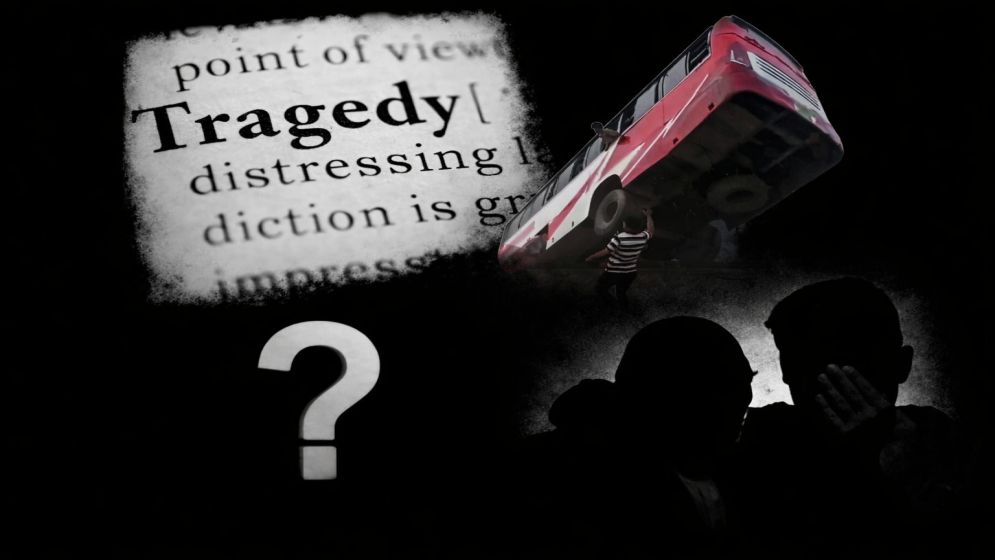
After every fatal accident in Bangladesh, a collapsing structure or a submerged bus, one question returns with unsettling persistence that surely there is someone whose job it is to prevent this.
Someone tasked not merely with responding after the fact, but with anticipating risk, designing safeguards and ensuring that such tragedies do not repeat themselves. And if that person exists, does the weight of these accidents reach them at all?
Do they lie awake at night, as ordinary citizens do, replaying the horror and asking what might have been done differently?
The public, after each new tragedy, grieves in a familiar rhythm….shock, anger, mourning, and then, gradually, resignation. But what is most striking is not only the recurrence of these events, but the eerie calm with which those in positions of authority seem to absorb them.
There is no visible rupture, no moral urgency commensurate with the scale of loss. It is as if two emotional worlds coexist in the same country, barely touching.
I was reminded of this divide by the work of Tanya Jakimow, a scholar of development studies who coined two terms that feel uncannily relevant to Bangladesh today: “affective privilege” and “affective resilience.”
Though she used them to describe relationships between international aid workers and local populations, the concepts illuminate something deeper and more troubling within Bangladesh’s own political order.
Affective privilege, as Jakimow defines it, is the luxury of not having to feel what others feel. It is the condition of being exempt from the emotional demands of a crisis…the grief and the moral discomfort that should accompany human suffering.
It is not simply indifference. It is structured detachment, built into systems of power.
In Bangladesh, this detachment has become institutionalized. When accidents occur, citizens experience them viscerally. The loss is intimate, even when the victims are strangers.
People imagine themselves in the place of the killed: a father who does not return home, a mother lost in a moment of negligence, a child whose life is permanently altered. The grief ripples outward, binding the public in a shared emotional experience.
Yet those charged with preventing such tragedies often appear untouched by that same current. Statements are issued, committees are formed, some compensations are paid and investigations are promised.
But the emotional register remains flat and almost antiseptic. There is little sense that these incidents disrupt the moral equilibrium of those in charge.

The distance that power creates
This is affective privilege in its most visible form—a governing class that is not required—by structure, by accountability, or even by consequence—to internalize the suffering of the people it governs.
Jakimow offers a compelling explanation for how such a condition emerges.
The powerful, she writes, are “socially light,” while the powerless are “socially heavy.” Those who are socially heavy are embedded in the dense ქს of everyday life—family, and shared vulnerability.
Their lives are shaped by the same risks that afflict their neighbors. Those who are socially light, by contrast, float above this web. They are insulated from its pressures, disconnected from its consequences.
In Bangladesh, this lightness has been carefully constructed. Years of centralized power, weakened democratic processes and limited accountability have created a class of decision-makers who are increasingly removed from the lived realities of ordinary citizens.
When systems fail—when infrastructure collapses, when safety protocols are ignored—the consequences are borne by the public, not by those responsible for oversight.
The result is a profound emotional blank. It is not that officials cannot understand the suffering of citizens; it is that they are not compelled to.
From this privilege flows what Jakimow calls affective resilience: the ability of those in power to withstand moral challenge. It is a kind of emotional armor, allowing individuals to encounter suffering without being transformed by it.
In a functioning system, tragedy should provoke reflection, even crisis, among those responsible. It should lead to accountability and to visible change.
But in Bangladesh, the repetition of similar accidents suggests a different dynamic at work. Each accident is absorbed, processed and ultimately neutralized without fundamentally altering the structures that produced it.
This is affective resilience—not resilience in the admirable sense, but in the sense of resistance to moral disturbance. It allows those in authority to move from one crisis to the next without confronting their own role in the pattern.
Power, it is often said, does not merely operate through laws or institutions; it circulates through feelings. Governments rely on fear and anxiety to shape public behavior.
Yet this emotional circuitry appears to function in only one direction. Citizens are expected to feel—fear consequences, trust assurances, absorb shocks—while those in power remain insulated from reciprocal emotional demands.

The resilience of indifference
If this imbalance is to be addressed, it must begin with a recognition that the very problem is there. It is about whose feelings matter and whose indifference is tolerated.
The persistence of affective privilege in Bangladesh is tied to deeper structural conditions. The absence of genuinely competitive elections reduces the need for political responsiveness.
The concentration of wealth and opportunity—often extending beyond national borders—further distances elites from local realities. A constrained media environment limits the amplification of civilian voices, while networks of intellectual and institutional support help normalize the status quo.
Transparency remains limited, and accountability mechanisms are weak.
Together, these factors produce a governing class that is, in Jakimow’s terms, socially light…untethered from the emotional gravity of the society it oversees.
The consequences are visible not only in policy failures but in human lives. When a construction project collapses due to negligence, when a vehicle plunges into water because of inadequate safety measures, the victims are parents and children, people whose lives are embedded in the very social fabric from which decision-makers have become detached.
What is missing is not knowledge. The causes of many of these accidents are well understood: lax enforcement and inadequate planning. And also a culture of impunity.
What is missing is the affective connection that would transform knowledge into urgency.
Jakimow speaks of the “potential to engender feelings that demand reflection and a response.” This may be the most crucial task facing Bangladesh today—not simply to diagnose failures, but to disrupt the emotional insulation that allows them to persist.
How does one do that? Through stronger institutions, certainly, but also through a reconfiguration of political culture. Through media that does not merely report tragedies but sustains attention on their causes.
Through real engagement that refuses to normalize repetition. Through systems of accountability that impose not just legal consequences but moral visibility.
Ultimately, the challenge is to bring power down from its elevated, almost celestial detachment and anchor it firmly in the realities of everyday life. To ensure that those who make decisions are not merely informed about the consequences, but are compelled to feel them.
Until that happens, the cycle will continue. And somewhere, a citizen will once again ask: is there no one whose job it is to prevent this—and to care enough to try?
—
Mikail Hossain is a writer and analyst