

The Awami League’s unmaking of Rabindranath Tagore in Bangladesh

Faisal Mahmud
Publish: 08 May 2026, 06:33 PM
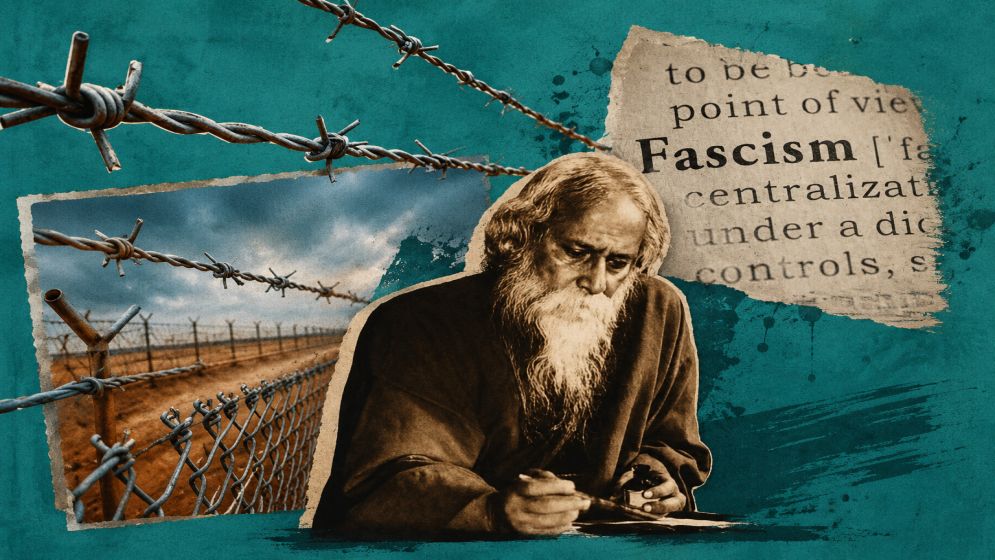
The deification of Rabindranath Tagore in Bangladesh was never about literature; it was about politics.
For the better part of fifteen years, the ousted Awami League regime occupied him. By turning a nineteenth-century universalist into a twenty-first-century ‘political’ mascot, the regime achieved a remarkable, if self-destructive, feat.
They made the most beloved poet of the Bengali language a polarizing figure of the street.
In the wake of the 2024 uprising, the backlash against Tagore thus is not an indictment of his poetry or literature, but a desperate, jagged recoil against the political suffocations of the "Rabindrik" state.
Under the Awami League government, Amar Shonar Bangla was transformed from a national anthem into an ideological litmus test. Under Sheikh Hasina’s tenure, Tagore was elevated to the status of a secular deity.
To admire him was a mandatory political credential; to question the state-curated version of him was to be branded a barbarian, a communalist, or a latent Islamist seditionist.
In the regime’s binary world, you were either a refined, Tagore-quoting citizen or a crude, suspicious insurgent.
This did not happen because Bangladeshis suddenly lost their ear for Rabindra Sangeet. It happened because the regime transformed cultural affiliation into a form of ideological policing.
The poet’s legacy was curated through state patronage, elite Dhaka institutions, and hollow urban performances that treated him less as a revolutionary thinker of his time and more as a sacred emblem to be ritually paraded.
The result was a "sanitized Rabindranath"—flattened into ceremonial recitations and state-approved slogans. By making Tagore the face of the establishment, the state ensured that when the establishment fell, the poet would be caught in the crossfire.

Irony of deification
The irony is as sharp as it is tragic. Tagore himself was a man who famously distrusted narrow nationalism and warned against the mechanical "idolatry of the nation."
Yet, his name was used to justify a rigid, state-sponsored secular-nationalist narrative that left little room for the complexities of a Muslim-majority society.
This framework also acquired a sharp class character. Dhaka’s cultural elite wielded "Rabindra culture" as a gatekeeping device, a way to signal their own enlightenment while dismissing the sensibilities of the rural and conservative masses as mere ignorance.
The alienation was compounded by a selective, almost allergic, approach to history.
When critics raised uncomfortable questions—such as Tagore’s debated role regarding the establishment of Dhaka University in 1912—the official response was not intellectual engagement but moral outrage.
By refusing to acknowledge any historical ambiguity, the state-sponsored intelligentsia reinforced the perception that Tagore had become part of an untouchable secular orthodoxy beyond the reach of ordinary people.
This defensive sanctification proved disastrous after the July 2024 uprising. Once the Awami League’s legitimacy collapsed under accusations of authoritarianism and bloodletting, the symbols it had co-opted suffered immediate collateral damage.
Because the regime had fused loyalty to the state, loyalty to secularism, and loyalty to Tagore into a single emotional package, the cracking of one pillar inevitably shook the others.
The post-uprising backlash—manifested in social media debates over Tagore’s "Hinduness" or his Sanskritized Bengali—is not a phenomenon born in a vacuum.
It is the predictable consequence of decades of state power transforming cultural taste into a political hierarchy. Indian commentators who view this shift as a simple rise in "Islamism" are being intellectually lazy.
The relationship has always been more pragmatic.

State’s ‘sacrifice’ of a poet
Bangladesh embraced Tagore during the 1971 Liberation War because his words articulated territorial love during a struggle against Pakistani domination.
But the state eventually expanded that symbolic role until his worship became a form of compulsory patriotism.
And compulsory patriotism, historically, is the quickest way to breed iconoclasm.
Even the linguistic debate is a proxy for this deeper resentment.
Critics now target Tagore’s Bengali as a "Kolkata-centric" standard that ignores the organic evolution of Bangladeshi Bangla, shaped by Persian influences and Muslim speech patterns.
The irony is that Tagore, a quintessential cosmopolitan, would likely have welcomed the fluid evolution of the language. His self-appointed guardians, however, used him to police linguistic "purity," further distancing him from the vernacular reality of the country.
There is, too, a geopolitical weight to this struggle. Because Tagore is a cornerstone of Indian cultural identity, his status in Dhaka became entangled with anxieties over national sovereignty.
During the years when the Awami League government was accused of subservience to Delhi, Tagore worship was seen by many as a cultural extension of that political imbalance.
Attacks on the poet were often less about his stanzas than about a rejection of a political order seen as culturally patronizing and geopolitically unequal.
None of this erodes Tagore’s literary genius. He remains a titan of the subcontinent. But genius is no protection against political misuse.
In Bangladesh, Rabindranath was asked to do too much: he had to certify secularism, authenticate nationalism, and shield the elite from the masses.
No writer can survive such overextension unscarred.
—
A elaborated version of this was published in Outlook magazine. Here is a link of that article