

Anti-Gambling Bill could restore sweeping state powers through a new legal route

Asif Shahriyar Sushmit
Publish: 03 Jun 2026, 06:55 PM
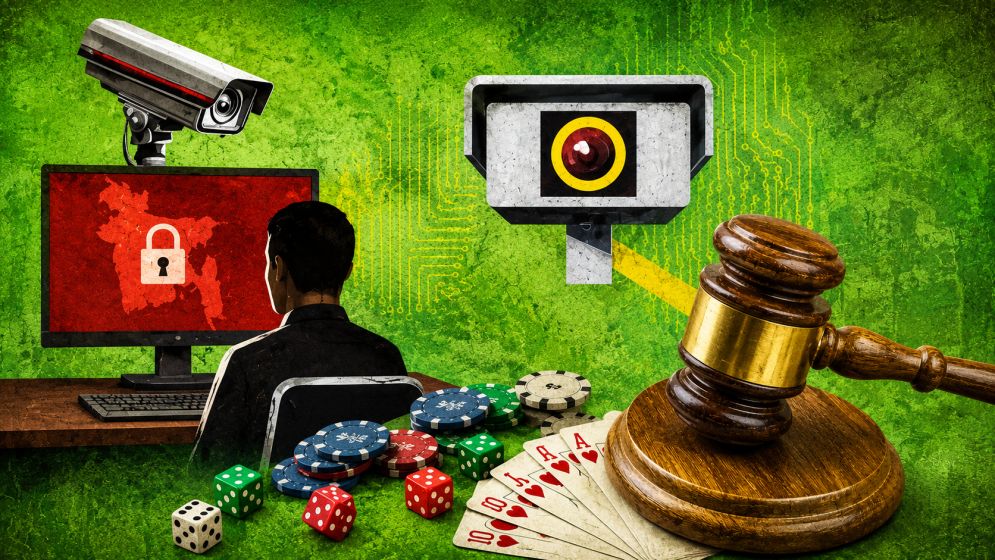
The proposed Betting and Gambling Prevention Act, 2026 is being promoted as a long-overdue replacement for the colonial-era Public Gambling Act of 1867.
Few would dispute the need for stronger action against online gambling, which has expanded rapidly through mobile apps, social media platforms and digital payment systems.
However, a close reading of the draft suggests that its most far-reaching provisions extend well beyond gambling enforcement and into areas of surveillance, data collection and executive authority.
Online gambling is already a criminal offense under Bangladesh's Cyber Security Act, 2026. Section 20 of the law criminalizes the operation, promotion and participation in online gambling, carrying a maximum punishment of two years' imprisonment or a fine of up to 10 million taka. The offense is bailable.
The existence of this legal framework raises a fundamental question: if online gambling is already prohibited, what additional purpose does a separate law serve?
The answer appears to lie in the powers created by the new draft rather than in the prohibition itself.
The proposed law dramatically increases penalties, introducing prison terms ranging from seven to twelve years and fines reaching 100 million taka for conduct that is already punishable under existing legislation.
More significantly, it changes the legal character of these offenses by making them non-bailable and non-compoundable.
The draft also creates a new enforcement infrastructure centered on extensive surveillance and monitoring mechanisms.

Blanket surveillance
Section 43 establishes a National Digital Blacklist that would allow authorities to maintain records containing names, National Identity numbers, SIM registrations, bank accounts, mobile financial service accounts, digital wallets, devices, domains and IP addresses.
The draft provides no detailed framework explaining how individuals would be added to or removed from the database. It does not specify notification requirements, appeal procedures, review mechanisms or time limits for retaining information.
Section 44 goes further by proposing the integration of NID records, SIM registrations and financial accounts while authorizing biometric verification and facial-recognition technologies.
The result would be a system linking identity, communication and financial activity within a unified monitoring framework. Section 47 adds another layer by authorizing Deep Packet Inspection (DPI) and artificial intelligence-based monitoring tools.
DPI technology enables the inspection of internet traffic beyond routing information and can reveal the content and nature of online communications.
The draft does not require judicial approval before these technologies are deployed, allowing implementation through executive notification.
The relationship between the proposed law and existing privacy protections is another area of concern. Section 3 states that the law will prevail over any conflicting legislation.
As drafted, this provision could override safeguards contained in the recently enacted Personal Data Protection Act, 2026, limiting the effectiveness of data-protection standards that Parliament has already approved.
The bill also expands enforcement powers considerably. Section 39 permits searches, seizures and arrests without warrants based on "reasonable belief."
These powers would not be limited to conventional law enforcement agencies.
Intelligence bodies, including the National Security Intelligence (NSI) and the Directorate General of Forces Intelligence (DGFI), would also be authorized to conduct investigations and enforcement activities under the Act.
Combined with the non-bailable nature of offenses under Section 7, the proposal grants investigators broad authority while reducing judicial oversight at the initial stages of enforcement.
Further controversy may arise from Section 36, which assigns cases under the law to mobile courts.
The use of executive magistrates in criminal adjudication has been the subject of legal challenges in the past, making the provision likely to attract constitutional scrutiny if enacted.
Questions of proportionality also remain unresolved. The proposed penalties are significantly higher than those contained in the Cyber Security Act for substantially similar conduct.

Regulatory blackhole
While many countries impose strict sanctions on illegal gambling operators, regulatory systems in jurisdictions such as the United Kingdom and Singapore generally focus on licensing, compliance and enforcement against organized operators rather than lengthy prison sentences for individual participants.
The Bangladeshi proposal adopts a far more punitive approach.
Legal uncertainty is another issue. The draft's definition of "financially risky games" is broad enough to create ambiguity regarding legitimate financial activities.
Without explicit exemptions, certain forms of investment, trading or other regulated financial transactions could potentially fall within the scope of interpretation.
The draft also contains technical inconsistencies, including duplicate definitions and incorrect cross-references between sections, raising concerns about legislative quality and enforceability.
Not all aspects of the bill have attracted criticism. The inclusion of rehabilitation and counseling programs for gambling addiction reflects a public-health approach that many experts support.
The draft also criminalizes match-fixing and spot-fixing, introduces provisions for international cooperation, mandates the publication of annual reports and statistical data, and includes an official English version to improve accessibility and legal certainty.
The central policy debate is therefore no longer about whether online gambling should be addressed. There is broad agreement that stronger measures are needed to combat illegal betting networks and the social harms associated with gambling addiction.
The more significant question is whether those objectives require a legal framework that combines gambling enforcement with extensive surveillance powers, biometric monitoring, financial tracking, warrantless searches and centralized blacklisting.
As public consultation continues, scrutiny is likely to focus less on gambling itself and more on whether the proposed enforcement architecture is proportionate, necessary and compatible with the broader legal reforms that followed the repeal of Bangladesh's previous digital security regime.
The outcome of that debate may ultimately determine whether the law is remembered as a targeted anti-gambling measure or as one of the country's most expansive digital enforcement statutes.
—
Asif Shahriyar Sushmit is an engineer and activist. He was the chief coordinator of the taskforce formed during the interim government to investigate irregularities and corruption in various projects under the Information and Communication Technology sector during the Hasina regime