

Trivedi wins Delhi’s confidence as Bangladesh’s outgoing envoy leaves with little to show

Shaquib Ahmed
Publish: 18 Oct 2026, 12:10 AM
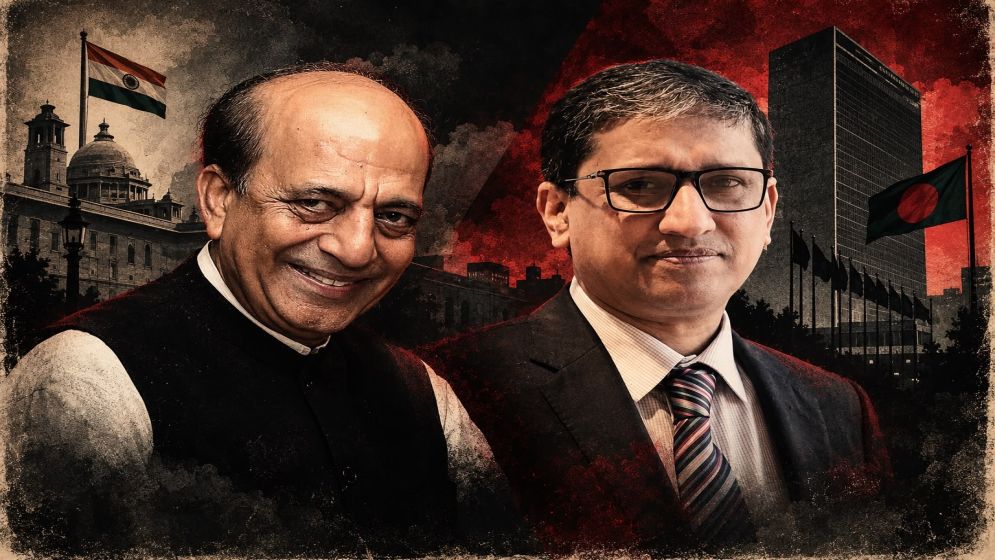
India’s political appointee has gained access to the highest levels of government and seized control of the diplomatic narrative. Bangladesh’s career diplomat M Riaz Hamidullah, meanwhile, leaves New Delhi with relations still strained, key disputes unresolved and serious questions about the effectiveness of his tenure.
India’s High Commissioner to Bangladesh, Dinesh Trivedi, has achieved something his Bangladeshi counterpart M Riaz Hamidullah struggled to deliver: political access, influence over the bilateral agenda and the confidence of his own government.
An opinion piece published by Indian news outlet ThePrint on Saturday declared Trivedi's appointment a success, crediting him with shifting the debate over former prime minister Sheikh Hasina's presence in India.
The assessment comes as Hamidullah leaves New Delhi for Geneva, where he has been appointed Bangladesh's permanent representative to the United Nations.
The contrast is striking.
Trivedi, a former Indian cabinet minister rather than a career diplomat, has established direct channels with Bangladesh's political leadership. He has also briefed Indian Prime Minister Narendra Modi on the state of bilateral relations.
Hamidullah, despite his diplomatic experience and extensive cultural outreach, leaves without a breakthrough on Hasina's extradition, the proposed visit of Prime Minister Tarique Rahman or several other outstanding disputes.
Relations have remained deeply strained throughout his tenure.
The question is no longer simply whether Bangladesh's diplomacy kept communication channels open. It is whether those channels produced meaningful results.
How Trivedi turned the Hasina debate around
ThePrint's October 17 commentary argued that Trivedi had demonstrated why New Delhi chose a politician rather than a conventional diplomat for one of its most sensitive postings.
His intervention came during the Bay of Bengal Conversation in Dhaka on October 3.
Asked about Hasina's presence in India, Trivedi said New Delhi had not arranged her departure from Bangladesh and was unprepared for her arrival in August 2024.
He stressed that Hasina had travelled aboard a Bangladeshi military aircraft, not an Indian one.
India, he argued, had little choice but to allow the aircraft to land under the circumstances.
The remarks shifted attention from India's decision to shelter Hasina to the role of Bangladesh's own military in facilitating her departure.
ThePrint described this as a diplomatic success that put Dhaka on the defensive.
That interpretation is politically significant. Bangladesh has repeatedly demanded Hasina's extradition and protested against her political activities from Indian territory.
Her August 5, 2026, press conference in New Delhi triggered another diplomatic confrontation, complicating plans for Tarique Rahman's visit.
Trivedi did not resolve the extradition dispute. But he offered a counterargument that changed the terms of public debate.
His political access has been equally important.
According to ThePrint's October 13 reporting, Trivedi travelled to New Delhi between October 4 and 8, held consultations with senior officials and briefed Modi.
The Indian envoy has also emerged as an important communication channel between the two governments, alongside contacts involving their national security establishments.
These developments suggest that New Delhi's decision to appoint a politically connected former minister was deliberate.
Trivedi's appointment initially raised questions within India's diplomatic establishment. His subsequent access to the country's highest decision-makers has strengthened the argument for that choice.
Hamidullah's diplomacy failed to deliver political leverage
The contrast with Bangladesh's outgoing high commissioner is difficult to ignore.
An October 8 analysis published by Daily Waadaa found that Hamidullah had only two publicly reported engagements with Indian External Affairs Minister S Jaishankar during the period it examined. One was an introductory meeting. The other was a farewell call.
The analysis also reported that Hamidullah had failed to secure a meeting with India's foreign secretary during the interim government's tenure.
Trivedi, meanwhile, had held at least 10 substantive meetings with Bangladesh's state leadership, excluding initial protocol engagements, according to the Waadaa assessment.
His contacts extended to the prime minister, foreign minister, home minister, senior advisers and officials responsible for defence, trade, energy and water resources.
The difference was not merely ceremonial. Trivedi was engaging the people who could influence decisions. Hamidullah's publicly documented access to India's political establishment was far more limited.
Hamidullah instead invested heavily in cultural diplomacy.
His mission organised jamdani exhibitions, promoted Tangail sarees and pursued initiatives involving hilsa and other symbols of shared Bengali heritage.
An October 9 opinion article in Al Jazeera acknowledged that these initiatives helped preserve communication and goodwill. But it also identified their fundamental limitation: cultural familiarity could not substitute for political negotiations.
The results bear out that concern.
Hasina remains in India. Her extradition remains unresolved. The proposed visit by Tarique Rahman has yet to materialise. The Ganges water-sharing treaty approaches its December expiry without a publicly announced renewal agreement.
Visa services have resumed, but issuance remains below pre-2024 levels.
None of these failures can be attributed solely to Hamidullah. Decisions on extradition, water-sharing and high-level visits rest with governments, not individual diplomats.
Nevertheless, his tenure raises a legitimate question about diplomatic effectiveness: did Bangladesh's mission in New Delhi build sufficient political influence to advance Dhaka's interests?
The available record offers little evidence of a major breakthrough.
Hamidullah has defended his approach. Following his farewell meeting with Jaishankar, he said he had worked to strengthen relations through mutual trust, dignity and shared interests.
Jaishankar also publicly appreciated his contribution during a difficult period.
Those acknowledgments deserve recognition. Maintaining communication during a diplomatic crisis has value.
But maintaining contact and changing policy are different achievements.
The two envoys also operated under different political constraints. India controls the decision on Hasina's extradition, while Bangladesh cannot compel New Delhi to grant its representative access or accept its demands.
That makes a direct comparison imperfect. It does not make the disparity in political access any less important.
Hamidullah's reassignment to Geneva comes as Bangladesh prepares to send Foreign Secretary Asad Alam Siam to New Delhi.
Siam will inherit a relationship in which India's envoy has already established extensive contacts across Bangladesh's political and administrative establishments.
The immediate challenge will be to secure comparable access in New Delhi and convert it into tangible diplomatic outcomes.
Trivedi has not repaired India-Bangladesh relations. His government's continued protection of Hasina remains a major obstacle.
But he has demonstrated the practical value of political connections, strategic messaging and direct access to decision-makers.
Hamidullah leaves with a record of cultural engagement but few visible political gains.
—
Shaquib Ahmed is a Dhaka-based journalist