


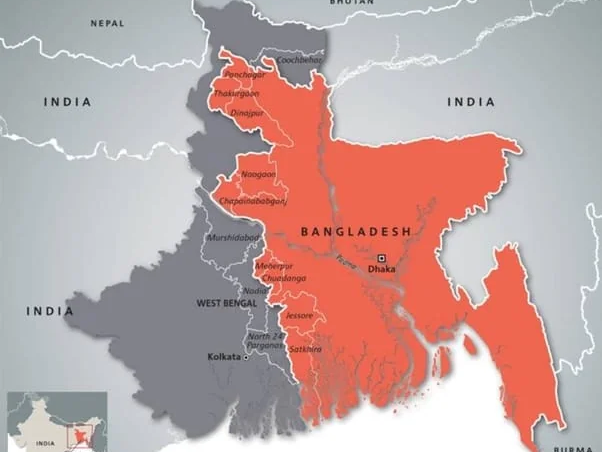
The historic bond between Bangladesh and India is bittersweet. Bengali people live on either side of the frontier and apart from language they have similarity in many other cultural aspects.
However, the religion was chosen as the dividing factor between these people and the historic animosity got elevated rather than the amity. India’s involvement in the war of independence for Bangladesh made the relationship sweeter.
But, India, the largest country in the region failed to honour this and started to stretch its claws over the neighbours. The political and economic aggression were often irksome for the Bangladeshi and the attitude by the West Bengal people, who have only a state as opposed to a country of the Bangladeshis, has been often paternalistic and arrogant.
Ashoke Mitra, a reputed Indian scholar said just after the independence ‘the attitude of the West Bengalis, who came from the East as refugees [during and after the partition of India in 1947], changed as if they had regained their zamindaris in Bangladesh’.
Mitra found it dangerous and, therefore, advised the Indian authorities concerned in an article to adopt the ‘policy of sympathetic indifference’ towards Bangladesh, arguing that the ‘Bangladeshis would not kneel and bow their head to us only because we helped to get their independence; it would be good for both of us if we keep a little distance and do not poke our nose too much into their affairs’. Many years later, Mitra recalled that the Indian ‘authorities did not pay heed to the advice.
And therefore, Mitra's worries became real. West Bengal has gradually lost its hegemony on culture and language as a mere province while Bangladesh is becoming the undisputed centre of Bangla language and culture. Yet, West Bengal refuses to comprehend that, and continues to show a hedonistic attitude.
Things become worse as India is ruled and ravaged by the forces of Hindutva. They found it politically useful if they can portray Bangladesh as a country of ‘’Islamic extremists’ to invigorate extremism in India. They became brazen in political and economic encroachment. The border killing has raised over the years, Indian billionaires are siphoning Bangladeshi money through irrational business deals that are signed for vested political interests and above all the unabashed support for tyrants in Bangladesh.
As a result, the hatred for India is ever-growing among the Bangladeshi people and things became worse when the Indian regime openly supported the tyrannical government of Bangladesh to stage a farcical election and bury all sorts of democratic practice in the country in January.
Surely, with all their power, Bangladesh people will recoil against the Indian regime but many Indians and their sycophants on either side of the frontier will try to mar those feelings as mere anti-Hindu sentiment. It will be a grave mistake to cover the whole thing with the blanket of communal hatred.
Indian people, especially the progressive ones, must understand the situation to eradicate Hindutva in their own land and reduce the hatred of Bangladeshi people towards them.
The Boxer: The author is one of the indefatigable working-class Bangladeshis who have been trying to change the fate of the nation but were betrayed by the ruling elites and autocrats. The name is inspired by a character in George Orwell's 1945 novel Animal Farm.