

The Politics of Polarization: A Case Study of the Anti-Student Politics Movement at BUET

Dilshad Siddika Swati
Publish: 07 Apr 2024, 06:35 AM
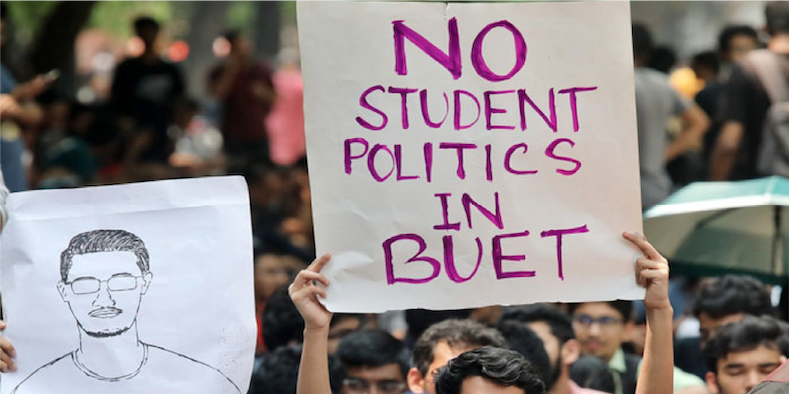
The recent movement to ban student politics at BUET has once again brought to the forefront the politics of polarization. It seems to be a challenging yet crucial task to navigate out of this polarization.
Interestingly, this movement brings to light various issues, both old and new, prompting reflections on global matters and making it a potential case study for political analysts. There's a perception that BUET has long been inclined towards anti-student politics, which isn't a new phenomenon in the context of BUET. However, there's a tendency to interpret BUET's disengagement from politics as apolitical or even as an 'I hate politics' attitude, which is a separate discussion altogether.
Currently, the focus is on how the general students at BUET are perceiving and organizing against the resurgence of student politics. Is there a political polarization and representation at play here as well?
Globally, there's a longstanding polarization between Muslims and non-Muslims, often reducing individuals to mere religious affiliations and overlooking other aspects. This portrayal of Muslims as war-mongers, dominators, misogynists, and sexually permissive is an old political narrative, widely disseminated by mass media. The role of media in this context is dual, necessitating a closer look at who plays what role. For instance, Israel recently banned Al Jazeera's broadcasts. Why? What was Al Jazeera reporting?
And what about the rest of the Western media?
Do they apply the same narrative to non-Muslim terrorist activities? How do they portray entities like Hamas, Saddam's Iraq, or the Taliban in Afghanistan? Suggesting that mentioning these groups implies support for them only reinforces a simplistic, binary view of politics, which most discerning individuals no longer subscribe to. However, in the context of the BUET movement, there's a common narrative that the absence of student politics, specifically the Bangladesh Chhatra League, implies an increase in political islamists activities on campus. This raises questions about the very definition of student politics and who crafts these narratives, often labeling any anti-government activism as "Razakar/Shibir," without a thorough investigation.
This "Shibir fear" was also noticeable in the administration's rhetoric, reducing the entire discourse to a binary of Chhatra League versus Shibir, as if nothing else exists beyond this dichotomy. This age-old politics of representation, deeply ingrained in historical narratives, often necessitates counterarguments and detailed explanations to break through the constructed realities and re-created truths, which are otherwise buried under dominant narratives. Our brains tend to gravitate towards generalized information and quickly categorize it into binary decisions of support or disdain, but it's crucial to recognize that these behaviors have historical roots and must be understood in that context to avoid missing key insights.
In the Western-dominated media, recent coverage of the severe conflict in Palestine highlighted Israel's brutal actions, marking a shift in the perception among Americans and Europeans, including both the general white populace and migrants, Muslims and non-Muslims alike, raising voices against Israel's atrocities. This indicates a waning influence of one-sided Western media narratives.
However, the same Western media often underreports the atrocities against Uighur Muslims in China, the persecution by fanatic Hindus in India, and the plight of Dalit Hindus. Incidents of rape in Bangladesh, especially by madrasa teachers, receive disproportionate attention compared to other forms of violence. It's only when Muslims in Kashmir or Delhi raise their voices against oppression that their plight is heard.
Beyond these highlighted issues, there's a silence. No evidence, no outcry, and consequently, our emotional responses remain muted.
As a result, moderate Muslims often find themselves in various countries holding placards declaring "We are/I am not a terrorist." Yet, it's also a reality that acts of terrorism do occur globally, with many perpetrators identified as Muslims. Ignoring this leads to denial, a stance that previously resulted in tragedies like the Holy Artisan incident. However, non-Muslim extremist actions also occur, such as mass shootings in schools. Extremism and fanaticism exist within all ideologies, at least potentially. To think that politics can exist without opposing actions and politics is naive. Interpreting these actions solely through the lens of conspiracy theories provides only a partial view. For instance, the issue with India. Is India constantly conspiring against Bangladesh? A few strategic moves have led us to either uphold an overly favorable image of India or succumb to anti-Muslim sentiments, a pillar of which is the portrayal of India's politics as internationally mafia-like, aspiring for veto power in the UN, which it might achieve soon, especially under Modi's government.
The anti-student politics movement initiated by general students at BUET shows that even educated, politically aware citizens can fall prey to binary politics. Not everyone may be affected, but within even a small movement, there are diverse voices. Yet, they collectively rejected any form of student politics and dismissed expressions of solidarity from student groups as politically motivated. Whether a non-political stance is even possible is something BUET's brilliant students might have considered. Was Abrar Fahad outside this realm of political awareness?
The silver lining is the growing recognition that beyond the prevalent black-and-white perceptions, events need to be viewed from multiple perspectives, a sentiment increasingly being voiced and discussed.
A popular saying among historians is that the history of human civilization we receive is written by the powerful, with the pen always in their hands. This led to the creation of histories from the perspective of the powerless.
When examining the narratives within the politics of representation, what we find is mostly a clear, seemingly straightforward account filtered through the lens of power, with the 'muddier' parts often omitted.
Thus, perhaps it's the 'muddy' parts that warrant more attention.
Note: Dilshad Siddika Swati, Anthropologist and Researcher. Comments are based on online news coverage, articles in social media feeds, and statements and press releases from students involved in the BUET movement. This represents a limited view and, by no way, a comprehensive outline. In this fragmented political climate, it's virtually impossible for anyone to obtain a complete picture.