

What message are the student protests sending in U.S. politics?

Online desk
Publish: 29 Apr 2024, 03:46 PM
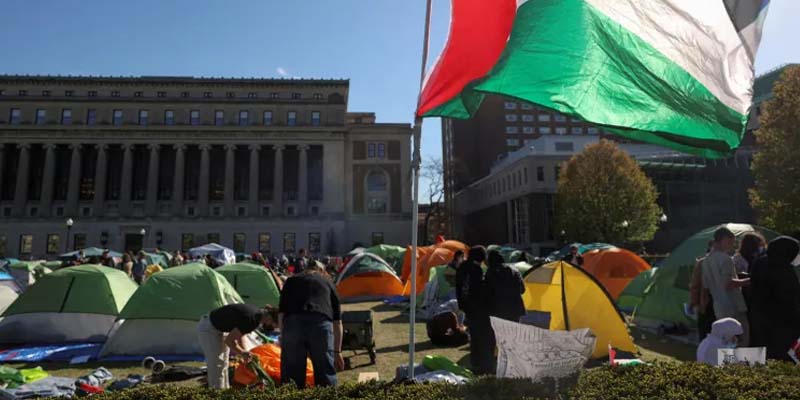
Student protests over Gaza are ongoing in U.S. university campuses, highlighting generational differences in the U.S. regarding support for Israel. Despite nationwide movements, U.S. youth are challenging politicians and university authorities on their support for Israel. According to a report by the Qatar-based news agency Al Jazeera, citing analysts, the current generation is more sympathetic towards Palestinians than previous ones. This generational divide poses a risk to President Joe Biden's (81) re-election chances and threatens the bipartisan support Israel has historically received in Washington.
Omar Wasow, Assistant Professor of Political Science at the University of California, noted that we are already witnessing a generational divide on Israel, which could become a long-term issue for the Democratic Party. The ongoing protests have intensified this divide.
Last week, students at Columbia University in New York set up a temporary camp on campus in solidarity with Palestine, leading to clashes when the university administration called the police, resulting in the arrest of over a hundred students who are also facing disciplinary actions. Despite these consequences, similar movements continue across U.S. university campuses.
The students primarily demand transparency in their universities' investments and urge that no investments be made in companies producing arms for Israel or linked with the Israeli military, and that any such invested funds be withdrawn.
The White House and pro-Israel groups accuse the students of inciting anti-Semitism, which the protesters clearly deny. According to Eman Abdelhadi, a sociologist at the University of Chicago, there is growing disillusionment among U.S. youth with both domestic and foreign policies, reflecting genuine dissatisfaction with the older generation's ongoing policies.
Abdelhadi stated that the student protests have broadened the "moment of division" in American public opinion. Historically, significant student protests or their aftermath have led to major shifts in public opinion, potentially laying the groundwork for political changes in the country. There is a belief that these protests could determine the country's future.
Concerns for Biden
Recent polls show that the younger generation in the U.S. is more sympathetic towards Palestinians and critical of Israel. The negative sentiment towards Israel's actions, especially its ongoing conflict in Gaza, has increased among Americans.
Several polls indicate that a large portion of Americans support a permanent ceasefire in the Gaza Strip. Since the Israeli military's devastating offensive in Gaza on October 7, over 34,000 Palestinians have been killed, mostly women and children, with much of the valley turned into rubble.
Despite these atrocities, President Biden has continued to offer strong support to Israel, a stance that could prove politically costly as he faces potential re-election against Republican candidate and former president Donald Trump this November.
Poll results suggest Biden must maintain his Democratic base to win the election, but unity among Democrats on supporting Israel is not as solid as among Republicans.
Angus Johnston, a historian of student movements in the U.S., noted that the generational divide on Israel is particularly evident among Democrats, viewing it as a disconnect between the party's young voters and most politicians. The same disconnect is now seen between students and administrators at universities, who manage the institutions with alumni and donors.
Changes in Foreign Policy
Protesting students are not engaging in party politics but are emphasizing their demand to assist in protecting Palestinian human rights.
Questions arise whether the protesters can influence changes in U.S. foreign policy and ensure that the country disengages from "genocide."
Historian Johnston remarked that it might not be immediately possible for U.S. universities to sever ties with major corporations and defense sectors aiding Israel. However, the demand for transparency in institutional investments is justified, and long-term changes are feasible, though not overnight.
He observed that student protests have historically brought changes in foreign policy, although not always quickly or exactly as the students wanted.