

Trucks are rolling across a new US pier into Gaza. But challenges remain to getting enough aid in

UNB
Publish: 19 May 2024, 02:09 AM
WASHINGTON,
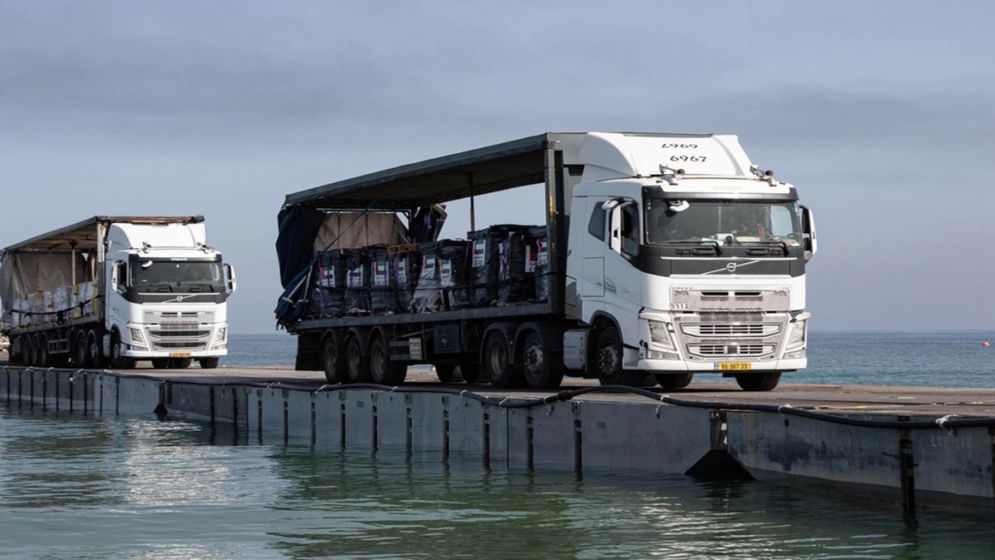
May 18 (AP/UNB) - Trucks carrying badly needed aid for the Gaza Strip rolled
across a newly built U.S. pier and into the besieged enclave for the first time
Friday as Israeli restrictions on border crossings and heavy fighting hindered
the delivery of food and other supplies.
The shipment is the
first in an operation that American military officials anticipate could scale
up to 150 truckloads a day, all while Israel presses in on the southern city of
Rafah in its seven-month offensive against Hamas. At the White House, National
Security Council spokesman John Kirby said "more than 300 pallets" of
aid were in the initial delivery and handed over to the U.N., which was
preparing it for distribution.
Kirby said the U.S. has
gotten indications that "some of that aid was already moving into
Gaza."
But the U.S., U.N. and
aid groups warn that the floating pier project is not a substitute for land
deliveries that could bring in all the food, water and fuel needed in Gaza.
Before the war, more than 500 truckloads entered the Palestinian territory on an
average day.
The operation's success
also remains tenuous because of the risk of militant attack, logistical hurdles
and a growing shortage of fuel for the aid trucks due to the Israeli blockade
of Gaza since Hamas' Oct. 7 attack. Militants killed 1,200 people and took 250
others hostage in that assault on southern Israel. The Israeli offensive since
has killed more than 35,000 Palestinians in Gaza, local health officials say,
while hundreds more have been killed in the West Bank.
Aid agencies say they
are running out of food in southern Gaza, while the U.N. World Food Program
says famine has already taken hold in Gaza's north.
Troops finished
installing the floating pier on Thursday, and the U.S. military's Central
Command said the first aid crossed into Gaza at 9 a.m. Friday. It said no
American troops went ashore in the operation.
The Pentagon said no
backups were expected in the distribution process. The U.S. plan is for the
United Nations, through the World Food Program, to take charge of the aid once
it leaves the pier. This will involve coordinating the arrival of empty trucks
and their registration, overseeing the transfer of goods coming through the
floating dock to the trucks and their dispatch to warehouses across Gaza, and,
finally, handing over the supplies to aid groups for delivery.
The WFP said Friday
evening that aid had that come through the pier had been transported to its
warehouses in Deir al-Balah and was ready for collection and distribution.
The U.K. said some of
its aid for Gaza was in the first shipment that went ashore, including the
first of 8,400 kits to provide temporary shelter made of plastic sheeting. And
it said more aid, including 2,000 additional shelter kits, 900 tents, five forklift
trucks and 9,200 hygiene kits, will follow in the coming weeks.
"This is the
culmination of a Herculean joint international effort," said Prime
Minister Rishi Sunak. "We know the maritime route is not the only answer.
We need to see more land routes open, including via the Rafah crossing, to
ensure much more aid gets safely to civilians in desperate need of help."
The U.N. humanitarian
aid coordinating agency said the start of the operation was welcome but not a
replacement for deliveries by land.
"I think everyone
in the operation has said it: Any and all aid into Gaza is welcome by any
route," Jens Laerke, spokesman of the Office for the Coordination of
Humanitarian Affairs, told journalists in Geneva on Friday. Getting aid to
people in Gaza "cannot and should not depend on a floating dock far from
where needs are most acute."
Anastasia Moran, an
associate director of the International Rescue Committee, argues that the pier
is in fact diverting attention from the surging humanitarian crisis.
Over the past couple of
months, "the maritime route has been taking time and energy and resources
at a time when aid has not been scaled up," she said. "And now that
the maritime route is up and running, the land crossings have been effectively
shut down."
During the nine-day
period between May 6, when Israel began the Rafah offensive, and May 15, a
total of 154 trucks carrying food and 156 carrying flour have entered Gaza
through three land crossings, U.N. deputy spokesperson Farhan Haq said Friday.
Haq also warned this week that almost no fuel is getting through.
Israel fears Hamas will
use fuel in the war, but it asserts it places no limits on the entry of
humanitarian aid and blames the U.N. for delays in distributing goods entering
Gaza. Under pressure from the U.S., Israel has opened a pair of crossings to deliver
aid into the territory's hard-hit north in recent weeks.
It has said that a
series of Hamas attacks on the main crossing, Kerem Shalom, have disrupted the
flow of goods. The U.N. says fighting, Israeli fire and chaotic security
conditions have hindered delivery. There have also been violent protests by
Israelis that disrupted aid shipments.
Israel recently seized
the Rafah border crossing in its push against Hamas around that city on the
Egyptian border, raising fears about civilians' safety while also cutting off
the main entry for aid into the Gaza Strip.
U.S. President Joe Biden
ordered the pier project, expected to cost $320 million. The boatloads of aid
will be deposited at a port facility built by the Israelis just southwest of
Gaza City. The U.S. has closely coordinated with Israel on how to protect the
ships and personnel working on the beach.
Concern about the safety
of aid workers was highlighted last month when an Israeli strike killed seven
relief workers from World Central Kitchen whose trip had been coordinated with
Israeli officials. The group had also brought aid in by sea.
Pentagon officials have
made it clear that security conditions will be monitored closely and could
prompt a shutdown of the maritime route, even if just temporarily. Already, the
site has been targeted by mortar fire during its construction, and Hamas has
threatened to target any foreign forces who "occupy" the Gaza Strip.
Israeli forces are in
charge of security on shore, but there are also two U.S. Navy warships nearby
that can protect U.S. troops and others.
The aid for the sea
route is collected and inspected in Cyprus, then loaded onto ships and taken
about 200 miles (320 kilometers) to the large floating pier off the Gaza coast.
There, the pallets are transferred onto the trucks that then drive onto the Army
boats, which will shuttle the trucks from the pier to a floating causeway
anchored to the beach. Once the trucks drop off the aid, they return to the
boats.