

Airstrike kills 27 in central Gaza and fighting rages as Israel's leaders are increasingly divided

UNB
Publish: 21 May 2024, 12:45 AM
DEIR
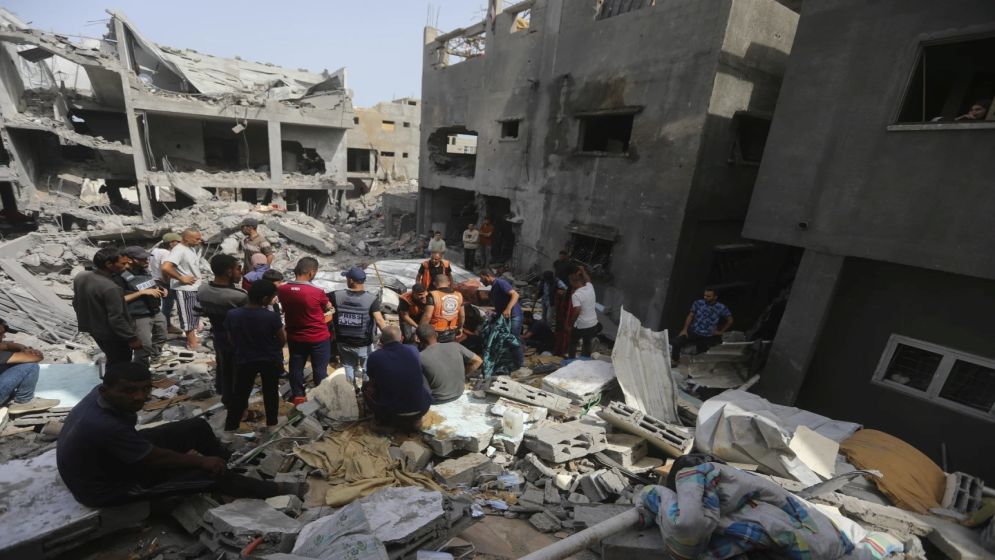
AL-BALAH, Gaza Strip, May 20 (AP/UNB) - An Israeli airstrike killed 27 people
in central Gaza, mostly women and children, and fighting with Hamas raged
across the north on Sunday as Israel's leaders aired divisions over who should
govern Gaza after the war, now in its eighth month.
Prime Minister Benjamin
Netanyahu faces criticism from the other members of his War Cabinet, with main
political rival Benny Gantz threatening to leave the government if a plan is
not created by June 8 that includes an international administration for postwar
Gaza. His departure would leave Netanyahu more reliant on far-right allies who
support full military occupation of Gaza and rebuilding of Jewish settlements
there.
U.S. National Security
Adviser Jake Sullivan met with Netanyahu to discuss an ambitious U.S. plan for
Saudi Arabia to recognize Israel and help the Palestinian Authority govern Gaza
in exchange for a path to eventual statehood. Netanyahu's office in a statement
said they focused on Israel's military operation in the southern Gaza city of
Rafah, humanitarian aid and hostages held in Gaza.
Netanyahu opposes
Palestinian statehood, saying Israel will maintain open-ended security control
over Gaza and partner with local Palestinians unaffiliated with Hamas or the
Western-backed Palestinian Authority.
The U.S. said Sullivan
said Israel should "connect its military operations to a political
strategy" and proposed measures to ensure more aid "surges" into
Gaza.
In recent weeks, Hamas
militants have regrouped in parts of northern Gaza that were heavily bombed in
the war's early days.
The airstrike in
Nuseirat, a built-up Palestinian refugee camp in central Gaza dating back to
the 1948 Arab-Israeli war, killed 27 people, including 10 women and seven
children, according to records at Al-Aqsa Martyrs Hospital in nearby Deir
al-Balah, which received the bodies.
A separate strike on a
Nuseirat street killed five people, according to the Palestinian Red Crescent
emergency service. In Deir al-Balah, a strike killed Zahed al-Houli, a senior
officer in the Hamas-run police, and another man, according to the hospital.
Palestinians reported
more airstrikes and heavy fighting in northern Gaza, which has been largely
isolated by Israeli troops for months and where the World Food Program says a
famine is underway.
The Civil Defense said
strikes hit several homes near Kamal Adwan Hospital in Beit Lahiya, killing at
least 10 people. And in the urban Jabaliya refugee camp nearby, residents
reported a heavy wave of artillery and airstrikes.
Abdel-Kareem Radwan, 48,
said the whole eastern side has become a battle zone where the Israeli fighter
jets "strike anything that moves."
Mahmoud Bassal, a
spokesman for the Civil Defense, said rescuers had recovered at least 150
bodies, more than half of them women and children, since Israel launched the
operation in Jabaliya last week.
Israel launched its
offensive after Hamas' Oct. 7 attack in which militants stormed into southern
Israel, killing around 1,200 people, mostly civilians, and abducting about 250.
Mourners gathered Sunday for the funeral of one of four hostages killed in the
attack whose bodies were recently found by Israeli troops in Gaza.
The war has killed at
least 35,000 Palestinians, according to Gaza's Health Ministry, which doesn't
distinguish between combatants and civilians. Around 80% of the population of
2.3 million Palestinians have been displaced within the territory, often multiple
times.
"We need a decent
life to live," said Reem Al-Bayed, who left Gaza City and shelters with
thousands in the gritty coastal Muwasi camp in the south without basic
facilities like wells. "All countries live a decent life except us."
She took a quick
mouthful of bread before tearing the rest into pieces for half a dozen
children, then poured them a can of beans.
Israel says it tries to
avoid harming civilians and blames the high death toll on Hamas, which it says
operates in dense residential areas.
Netanyahu's critics,
including thousands of Israeli protesters, accuse him of prolonging the war and
rejecting a cease-fire deal so he can avoid a reckoning over security failures.
They also seek early elections in which polls show that Gantz, a political
centrist, would likely succeed Netanyahu. That would expose Netanyahu to
prosecution on longstanding corruption allegations.
Netanyahu denies any
political motives and says the offensive must continue until Hamas is
dismantled and the estimated 100 hostages still held with the remains of more
than 30 others are returned.
Netanyahu also faces
pressure from Israel's closest ally, the United States, which has provided
military aid and diplomatic cover for the offensive while expressing growing
frustration with Israel's conduct of the war and the humanitarian crisis.
President Joe Biden's
administration recently held up a shipment of 3,500 bombs and said the U.S.
would not provide offensive weapons for a full-scale invasion of Rafah, citing
fears of a humanitarian catastrophe.
But last week, after
Israel launched what it called a limited operation in Rafah, the Biden
administration told legislators it would move forward with the sale of $1
billion worth of arms, according to congressional aides.
The Palestinian
Crossings Authority in a statement said humanitarian aid has not entered
through the vital Rafah border crossing with Egypt since the military operation
began almost two weeks ago.