

Millions vote in India's grueling election with Prime Minister Modi's party likely to win a 3rd term

UNB
Publish: 25 May 2024, 05:22 PM
NEW
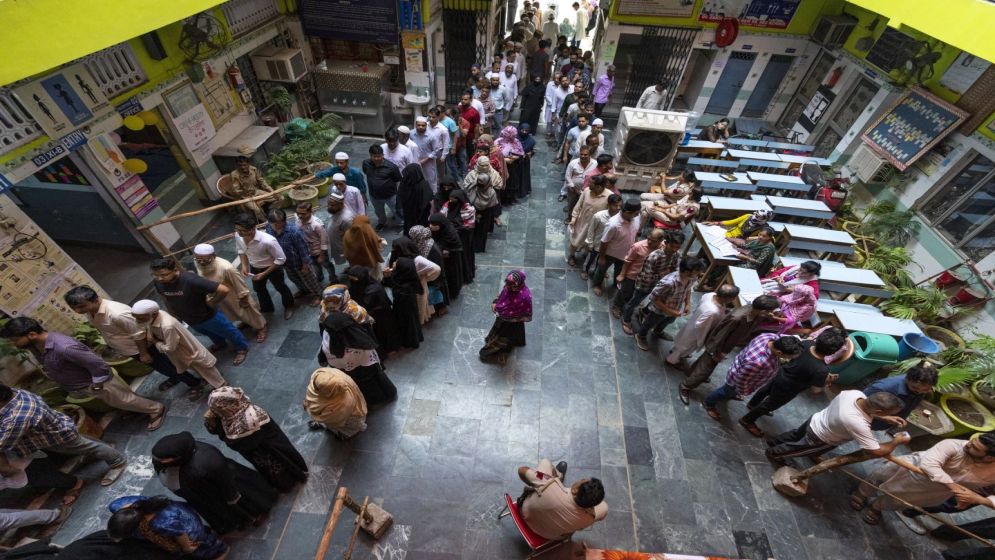
DELHI, May 25 (AP/UNB) - Millions of Indians are voting Saturday in the
next-to-last round of a grueling national election with a combined opposition
trying to rattle Prime Minister Narendra Modi's campaign for a
third-consecutive term for himself and his Hindu nationalist party.
Many people lined
polling stations before the start of voting at 7 a.m. to avoid the blazing sun
later in the day at the peak of Indian summer.
Saturday's voting in 58
constituencies, including seven in New Delhi, will complete polling for 89.5%
of 543 seats in the lower house of Parliament.
The voting for the
remaining 57 seats on June 1 will wrap up a six-week election. The votes will
be counted on June 4.
This election is
considered one of the most consequential in India's history and will test
Modi's political dominance. If Modi wins, he'll be only the second Indian
leader to retain power for a third term, after Jawaharlal Nehru, the country's
first prime minister.
A less-than-expected
voter turnout in the previous five rounds of voting seems to have left both
sides guessing about the outcome of the election.
Temperatures are likely
to rise above 45 Celsius (113 Fahrenheit) in some places on Saturday. Election
authorities said they are taking steps to ensure voters' comfort, such as
setting up fans and tents and providing drinking water.
Most polls predict a win
for Modi's Hindu nationalist Bharatiya Janata Party, which is up against a
broad opposition alliance led by the Indian National Congress and powerful
regional parties.
Modi was involved in a
highly acrimonious and mudslinging campaign with the opposition, led by Rahul
Gandhi, the scion of the Nehru-Gandhi family that has produced three prime
ministers.
"When the polls
began it felt like a one-horse race, with Modi leading from the front. But now
we are seeing some kind of shift," political analyst Rasheed Kidwai said.
"The opposition is doing better than expected and it appears that Modi's
party is rattled. That's the reason you see Modi ramping up anti-Muslim
rhetoric to polarize voters."
Kidwai said the
opposition has challenged Modi by centering its campaign narrative on social
justice and rising unemployment, making the contest closer than expected.
Modi ran his campaign
like a presidential race, a referendum on his 10 years of rule. He claimed to
help the poorest with charity, free health care, providing toilets in their
homes, and helping women get free or cheap cooking gas cylinders.
But he changed tack
after a poor turnout of voters in the first round of the election and began
stirring Hindu nationalism by accusing the Congress party of pandering to
minority Muslims for votes.
Hindus account for 80%,
and Muslims nearly 14%, of India's over 1.4 billion people.
Nearly 970 million
voters - more than 10% of the world's population - were eligible to elect 543
members to the lower house of Parliament for five years.
Voters' relative apathy
has surprised some political analysts. In the five rounds of polling the voter
turnout ranged between 62.2% to 69.16% - averaging 65.9%. By comparison,
India's 2019 national election registered the highest-ever voter turnout -
67.11%. Modi's BJP won 303 seats in parliament in 2019.
Modi's inauguration of a
massive Hindu temple for the most revered Lord Rama, his massive roadshows, and
big public rallies raised the BJP's hopes of a massive a surge of voters in its
favor.
Modi came to power in
2014, dislodging the Congress party that governed the country for nearly 55
years after India won independence from British colonialists in 1947.
Before the election, the
opposition INDIA alliance was seen bickering, but it has since held together,
particularly after two chief ministers of two opposition-controlled states were
sent to jail on corruption charges. Both deny the accusations.
One of them - New Delhi
Chief Minister Arvind Kejriwal - has since been released on bail and returned
to the campaign trail.
In March, Gandhi
completed a 6,713-kilometer (4,171-mile) walk across the country, starting in
the violence-hit northeastern state of Manipur, to raise issues of poverty,
unemployment, and democracy with voters.
"The walk helped
Gandhi boost his image as a serious politician among the voters, and that is
helping the opposition," Kidwai said.
End/UNB/AP/HM