

Top UN court orders Israel to halt military offensive in Rafah; Israel is unlikely to comply

UNB
Publish: 25 May 2024, 05:29 PM
THE
HAGUE, Netherlands, May 24 (AP/UNB) - The top United Nations court ordered
Israel on Friday to immediately halt its military offensive in the southern
Gaza city of Rafah - but stopped short of ordering a cease-fire for the
enclave. Although Israel is unlikely to comply with the order, it will ratchet
up the pressure on the increasingly isolated country.
Criticism of Israel's
conduct in the war in Gaza has been growing, particularly once it turned its
focus to Rafah. This week alone, three European countries announced they would
recognize a Palestinian state, and the chief prosecutor for another
international court requested arrest warrants for Israeli leaders, along with
Hamas officials.
Israeli Prime Minister
Benjamin Netanyahu is also under heavy pressure at home to end the war, which
was triggered when Hamas-led militants stormed into Israel, killing 1,200
people, most civilians, and taking some 250 captive. Thousands of Israelis have
joined weekly demonstrations calling on the government to reach a deal to bring
the hostages home, fearing that time is running out.
While the ruling by the
International Court of Justice is a blow to Israel's international standing,
the court does not have a police force to enforce its orders. In another case
on its docket, Russia has so far ignored a 2022 order by the court to halt its
full-scale invasion of Ukraine.
Earlier, Israel signaled
it, too, would brush off an ICJ order to stop its operations. "No power on
earth will stop Israel from protecting its citizens and going after Hamas in
Gaza," Avi Hyman, the government spokesperson, said in a press briefing
Thursday.
Immediately after the
ruling, Netanyahu announced that he would hold a special ministerial meeting to
decide how to respond. Yair Lapid, the leader of the opposition, derided the
decision.
"The fact that the
ICJ did not even directly connect the end of the military operation in Rafah to
the release of the hostages and to Israel's right to defend itself against
terror is an abject moral failure," he said.
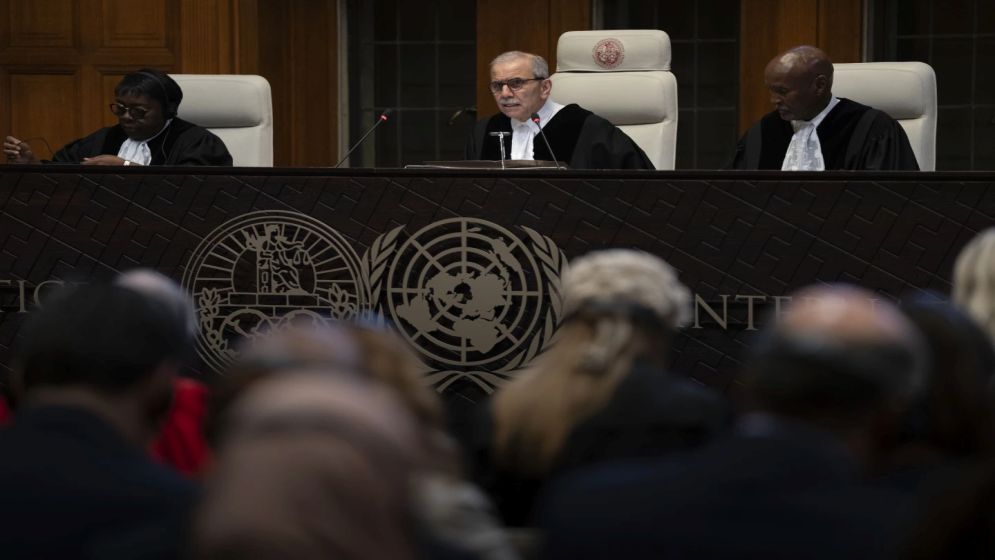
The court's president,
Nawaf Salam, read out the ruling, as a small group of pro-Palestinian
protesters demonstrated outside.
Fears the court
expressed earlier this year about an operation in Rafah have
"materialized," the ruling said, and Israel must "immediately
halt its military offensive" in the city and anything else that might
result in conditions that could cause the "physical destruction in whole
or in part" of Palestinians there.
Rafah is in the
southernmost part of the Gaza Strip, on the border with Egypt, and over 1
million people sought refuge there in recent months after fleeing fighting
elsewhere, with many of them living in teeming tent camps. Israel has been
vowing for months to invade Rafah, saying it was Hamas' last major stronghold,
even as several allies warned an all-out assault would spell disaster.
Israel started issuing
evacuation orders about two weeks ago as it began operations on the edge of the
city. Since then, the army says an estimated 1 million people have left as
forces press deeper inside.
Rafah is also home to a
critical crossing for aid, and the U.N. says the flow of aid reaching it has
plunged since the incursion began, though commercial trucking has continued to
enter Gaza.
The court ordered Israel
to keep the Rafah crossing open, saying "the humanitarian situation is now
to be characterized as disastrous."
But it did not call for
a full cease-fire throughout Gaza as South Africa, which brought the case,
requested at hearings last week.
South Africa's foreign
minister, Naledi Pandor, said the country's allegation that a genocide is
underway is getting "stronger and stronger by the day."
"We are really
pleased that the court has given very serious consideration to the matters that
we put before it and has affirmed that an urgent decision is needed from the
court to pause this onslaught against innocent Palestinian people," she told
South African state broadcaster SABC, adding that it's now up to the U.N.
Security Council to determine how to protect the Palestinians.
Balkees Jarrah,
associate international justice director at Human Rights Watch, said the
court's order "underlines the gravity of the situation facing Palestinians
in Gaza, who have for months endured the blocking of basic services and
humanitarian aid amid continued fighting."
"The ICJ's decision
opens up the possibility for relief, but only if governments use their
leverage, including through arms embargoes and targeted sanctions, to press
Israel to urgently enforce the court's measures," Jarrah said.
The cease-fire request
is part of a case filed late last year, accusing Israel of committing genocide
during its Gaza campaign. Israel vehemently denies the allegations. The case
will take years to resolve, but South Africa wants interim orders to protect
Palestinians while the legal wrangling continues.
The court ruled Friday
that Israel must ensure access for any fact-finding or investigative mission
sent by the United Nations to investigate the genocide allegations.
At public hearings last
week at the International Court of Justice, South Africa's ambassador to the
Netherlands, Vusimuzi Madonsela, urged the panel of 15 international judges to
order Israel to "totally and unconditionally withdraw" from the Gaza
Strip.
The court has already
found that Israel's military operations pose a "real and imminent
risk" to the Palestinian people in Gaza.
Israel's offensive has
killed more than 35,000 Palestinians, according to Gaza's Health Ministry,
which does not distinguish between combatants and civilians. The operation has
obliterated entire neighborhoods, sent hundreds of thousands of people fleeing
their homes, and pushed parts of the territory into famine.
"This may well be
the last chance for the court to act," Irish lawyer Blinne Ni Ghralaigh,
who is part of South Africa's legal team, told judges last week.
Israel rejects the
claims by South Africa, a nation with historic ties to the Palestinian people.
"Israel takes
extraordinary measures in order to minimize the harm to civilians in
Gaza," Tamar Kaplan-Tourgeman, a member of Israel's legal team, told the
court last week.
In January, ICJ judges
ordered Israel to do all it can to prevent death, destruction and any acts of
genocide in Gaza, but the panel stopped short of ordering an end to the
military offensive. In a second order in March, the court said Israel must take
measures to improve the humanitarian situation.
The ICJ rules in
disputes between nations. A few kilometers (miles) away, the International
Criminal Court files charges against individuals it considers most responsible
for war crimes, crimes against humanity and genocide.
On Monday, its chief
prosecutor, Karim Khan, said he has asked ICC judges to approve arrest warrants
for Netanyahu, Defense Minister Yoav Gallant and three top Hamas leaders -
Yahya Sinwar, Mohammed Deif and Ismail Haniyeh - of war crimes and crimes
against humanity in the Gaza Strip and Israel.
Israel is not an ICC
member, so even if the arrest warrants are issued, Netanyahu and Gallant do not
face any immediate risk of prosecution. But the threat of arrest could make it
difficult for the Israeli leaders to travel abroad.
End/UNB/AP/HM