

Papua New Guinea government says Friday's landslide buried 2,000 people and formally asks for help

UNB
Publish: 27 May 2024, 06:40 PM
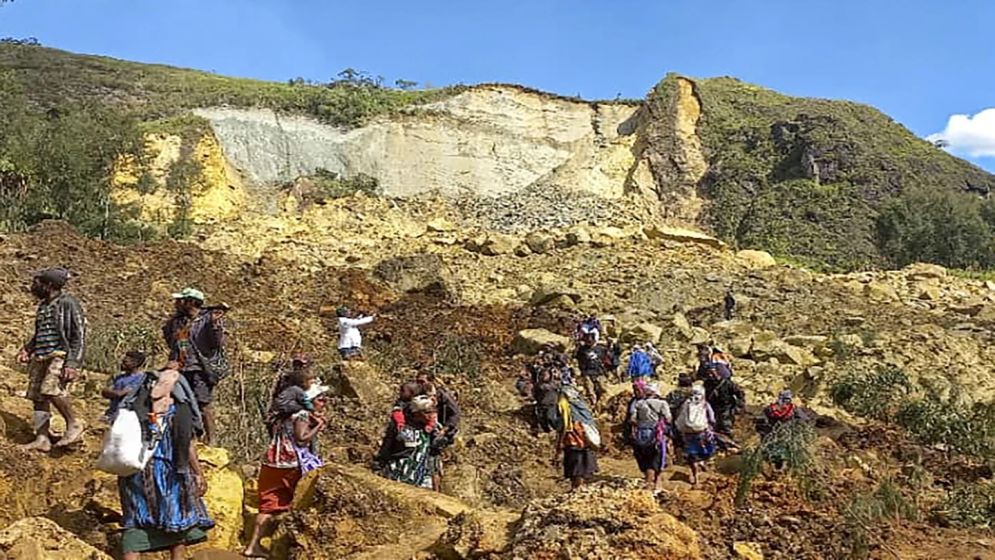
MELBOURNE,
Australia (AP) - The Papua New Guinea government said a landslide Friday buried
more than 2,000 people and has formally asked for international help.
The government figure is
around three times more than a United Nations' estimate of 670.
In a letter seen by The
Associated Press to the United Nations resident coordinator dated Sunday, the
acting director of the South Pacific island nation's National Disaster Center
said the landslide "buried more than 2000 people alive" and caused
"major destruction."
Estimates of the
casualties have varied widely since the disaster occurred, and it was not
immediately clear how officials arrived the number of people affected.
THIS IS A BREAKING NEWS
UPDATE. AP's earlier story follows below.
MELBOURNE, Australia
(AP) - Australia prepared on Monday to send aircraft and other equipment to
help at the site of a deadly landslide in Papua New Guinea as overnight rains
in the South Pacific nation's mountainous interior raised fears that the tons of
rubble that buried hundreds of villagers could become dangerously unstable.
Australian Defense
Minister Richard Marles said his officials have been talking with their Papua
New Guinea counterparts since Friday, when a mountainside collapsed on Yambali
village in Enga province, which the United Nations estimates killed 670 people.
The remains of only six people had been recovered so far.
"The exact nature
of the support that we do provide will play out over the coming days,"
Marles told Australian Broadcasting Corp.
"We've got
obviously airlift capacity to get people there. There may be other equipment
that we can bring to bear in terms of the search and rescue and all of that we
are talking through with PNG right now," Marles added.
Papua New Guinea is
Australia's nearest neighbor and the countries are developing closer defense
ties as part of an Australian effort to counter China's growing influence in
the region. Australia is also the most generous provider of foreign aid to its
former colony, which became independent in 1975.
Heavy rain fell for two
hours overnight in the provincial capital of Wabag, 60 kilometers (35 miles)
from the devastated village. A weather report was not immediately available
from Yambali, where communications are limited.
But emergency responders
were concerned about the impact of rain on the already unstable mass of debris
lying 6 to 8 meters (20 to 26 feet) deep over an area the size of three to four
football fields.
An excavator donated by
a local builder Sunday became the first piece of heavy earth-moving machinery
brought in to help villagers who have been digging with shovels and farming
tools to find bodies. Working around the still-shifting debris is treacherous.
Serhan Aktoprak, the
chief of the International Organization for Migration's mission in Papua New
Guinea, said water was seeping between the debris and the earth below,
increasing the risk of a further landslide.
He did not expect to
learn the weather conditions at Yambali until Monday afternoon.
"What really
worries me personally very much is the weather, weather, weather,"
Aktoprak said. "Because the land is still sliding. Rocks are
falling," he added.
Papua New Guinea's
defense minister, Billy Joseph, and the government's National Disaster Center
director, Laso Mana, flew on Sunday in an Australian military helicopter from
the capital of Port Moresby to Yambali, 600 kilometers (370 miles) to the northwest,
to gain a firsthand perspective of what is needed.
Mana's office posted a
photo of him at Yambali handing a local official a check for 500,000 kina
($130,000) to buy emergency supplies for the 4,000 displaced survivors.
The purpose of the visit
was to decide whether Papua New Guinea's government needed to officially
request more international support.
Earth-moving equipment
used by Papua New Guinea's military was being transported to the disaster scene
400 kilometers (250 miles) from the east coast city of Lae.
Traumatized villagers
are divided over whether heavy machinery should be allowed to dig up and
potentially further damage the bodies of their buried relatives, officials
said.