

North Korean rocket carrying its 2nd spy satellite explodes shortly after launch

UNB
Publish: 28 May 2024, 05:14 PM
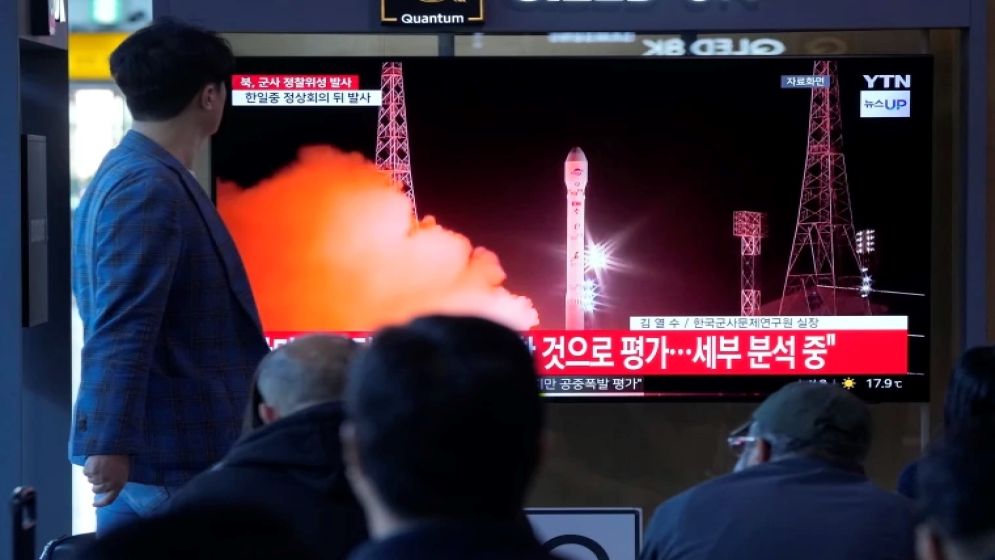
SEOUL,
South Korea, May 28 (AP/UNB) - A rocket launched by North Korea to deploy the
country's second spy satellite exploded shortly after liftoff Monday, state
media reported, in a setback for leader Kim Jong Un's hopes to operate multiple
satellites to better monitor the U.S. and South Korea.
Monday's failed launch
came hours after leaders of South Korea, China and Japan met in Seoul in their
first trilateral meeting in more than four years. It's highly unusual for North
Korea to take provocative action when China, its major ally and economic
pipeline, is engaging in high-level diplomacy in the region.
The launch drew rebukes
from the North's neighbors because the U.N. bans North Korea from conducting
any such launches, viewing them as covers for testing long-range missile
technology.
The North's official
Korean Central News Agency said it launched a spy satellite aboard a new rocket
at its main northwestern space center. But KCNA said the rocket blew up during
a first-stage flight soon after liftoff due to a suspected engine problem.
KCNA cited the
unidentified vice director of the National Aerospace Technology Administration
as saying that a preliminary examination showed that the explosion was related
to the reliability of operation of the newly developed liquid oxygen-petroleum
engine. He said other possible causes will be investigated, according to KCNA.
Japan's government
briefly issued a missile warning for the southern prefecture of Okinawa, urging
residents to take shelter inside buildings and other safer places. The warning
was lifted later because the region was no longer in danger, Chief Cabinet
Secretary Yoshimasa Hayashi said.
Japanese Defense
Minister Minoru Kihara called the North's launch "a serious challenge to
the entire world." The U.S. Indo-Pacific Command criticized the launch as
a "brazen violation" of U.N. Security Council resolutions and said it
involved technologies that are directly related to North Korea's
intercontinental ballistic missile program. South Korea's Unification Ministry
called a satellite launch by the North "a provocation that seriously
threatens our and regional security."
North Korea has
steadfastly maintained it has the right to launch satellites and test missiles
in the face of U.S.-led military threats. North Korea says the operation of spy
satellites will allow it to better monitor the U.S. and South Korea and improve
the precision-striking capabilities of its missiles.
During the trilateral
meeting with Japanese Prime Minister Fumio Kishida and Chinese Premier Li Qiang
earlier Monday, South Korean President Yoon Suk Yeol called for stern
international action if North Korea went ahead with its launch plan.
Kishida, for his part,
urged the North to withdraw its launch plan, but Li didn't mention the launch
plan as he offered general comments about promoting peace and stability on the
Korean Peninsula through a political resolution.
Earlier Monday, North
Korea had notified Japan's coast guard about its planned launch with a warning
to exercise caution in the waters between the Korean Peninsula and China and
east of the main Philippine island of Luzon during a launch window from Monday
through June 3.
Some observers say that
North Korea's satellite launch on the first day of its eight-day window might
have been aimed at casting a chill over the Seoul-Beijing-Tokyo meeting and
registering its displeasure with China. Kim Jong Un has been embracing the idea
of a "new Cold War" and seeking to boost ties with Beijing and Moscow
to forge a united front against Washington, so China's diplomacy with Seoul and
Tokyo might have been a disturbing development for Pyongyang.
Kim's primary focus in
recent months has been on Russia, as Pyongyang and Moscow - both locked in
confrontations with Washington - expand their military cooperation. China,
which is much more sensitive about its international reputation, has joined
Russia in blocking U.S.-led efforts at the U.N. Security Council to tighten
sanctions on the North but has been less bold and open about supporting Kim's
"new Cold War" drive.
North Korea's Foreign
Ministry on Monday strongly criticized a joint statement issued by Li, Yoon and
Kishida, calling it "wanton interference in its internal affairs."
The ministry took issue with parts of the joint statement that said the three
leaders re-emphasized their existing positions on the issue of denuclearization
of the Korean Peninsula.
While North Korea
focused much of its criticism on South Korea for allegedly being chiefly
responsible for the statement, it's still extremely rare for North Korea to
slam a statement signed by China.
The failed satellite
launch is a blow to Kim's plan to launch three more military spy satellites in
2024 in addition to his country's first military reconnaissance satellite that
was placed in orbit last November.
The November launch
followed two failed liftoffs.
In the first attempt,
the North Korean rocket carrying the satellite crashed into the ocean soon
after liftoff. After the second attempt, North Korea said there was an error in
the emergency blasting system during the third-stage flight.
END/UNB/AP/PR