

North Korea fires missile barrage toward its eastern waters days after failed satellite launch

UNB
Publish: 30 May 2024, 04:26 PM
SEOUL,
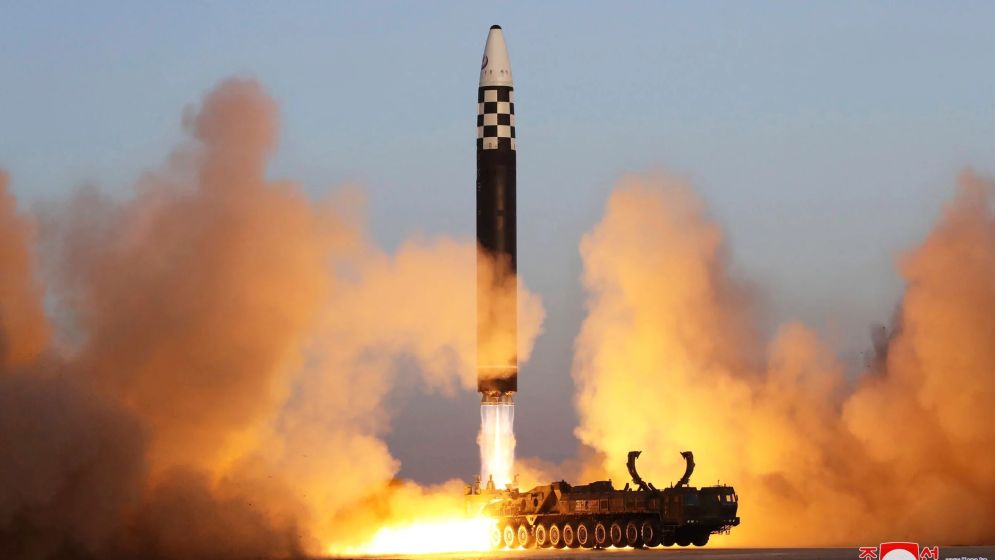
South Korea, May 30 (AP/UNB) - North Korea on Thursday fired a barrage of
suspected ballistic missiles toward its eastern sea, according to South Korea's
military, days after its attempt to launch a military reconnaissance satellite
ended in failure but still drew strong condemnation from its rivals.
South Korea's Joint
Chiefs of Staff said it detected the North firing around 10 projectiles that
appeared to be short-range ballistic missiles from an area near its capital,
Pyongyang. It said the suspected missiles flew around 350 kilometers (217
miles) before landing in waters off the North's eastern coast. It said the
South Korean military has increased surveillance and vigilance and is closely
sharing information with the United States and Japan.
Japan's coast guard
issued a maritime safety advisory over the North Korean launches and urged
ships to exercise caution if they find any fallen objects. Japan's Prime
Minister Fumio Kishida told reporters that the suspected missiles were believed
to have landed in waters outside of Japan's exclusive economic zone and there
were no immediate reports of damages. He said Tokyo "strongly
condemns" the launches, which are in violation of U.N. Security Council
resolutions against the North.
Tensions on the Korean
Peninsula have increased in recent months as the pace of both North Korea's
weapons testing and South Korea's combined military exercises with the United
States and Japan have intensified in a cycle of tit-for-tat.
Thursday's launches came
after North Korea flew hundreds of trash-carrying balloons toward the South
since Tuesday night in retaliation against South Korean activists flying
anti-North Korean propaganda leaflets across the border. North Korean leader
Kim Jong Un had warned of unspecified "overwhelming actions" against
South Korea after it staged an aerial exercise involving 20 fighter jets near
the inter-Korean border hours before North Korea attempted to launch its second
military reconnaissance satellite.
The rocket exploded
shortly after liftoff, but Kim has urged his military scientists to overcome
the failure and continue developing space-based reconnaissance capabilities,
which he described as crucial for monitoring U.S. and South Korean military
activities and enhancing the threat of his nuclear-capable missiles. Also on
Thursday, North Korea hit back at international condemnation of its failed
satellite launch, which drew strong rebukes from the United Nations and other
countries as it involves technologies used for developing intercontinental
range ballistic missiles. The North had successfully launched its first
military spy satellite in November, but Monday's failure posed a possible
setback to Kim's plans to launch three more military spy satellites in 2024.
"We will never tolerate any moves of the hostile forces to violate the
inviolable sphere under the exercise of sovereignty nor step back from having
access to the space reconnaissance capability which should be done surely no
matter what others may say," North Korean Vice Foreign Minister Kim Son
Gyong said in a statement published on state media.
Kim Son Gyong's
statement came as response to U.N. Secretary-General Antonio Guterres'
condemnation of Monday's launch, which he called a violation of Security
Council resolutions that prohibit the North from conducting any launches
involving ballistic missile technology.
Thursday's launches were
the latest in a series of weapons tests by North Korea.
On May 17, South Korea's
military said that North Korea fired suspected short-range ballistic missiles
off its east coast. North Korea later said it tested a tactical ballistic
missile with a new autonomous navigation system.
The North this year
tested various cruise missiles and artillery systems and flight-tested what it
described as a solid-fuel intermediate range missile with hypersonic warhead
capabilities. Experts say it is designed to reach remote U.S. targets in the Pacific,
including the military hub of Guam.
END/UNB/AP/PR