

Israel could have used smaller weapons against Hamas to avoid deaths in Gaza tent fire, experts say

UNB
Publish: 31 May 2024, 07:48 PM
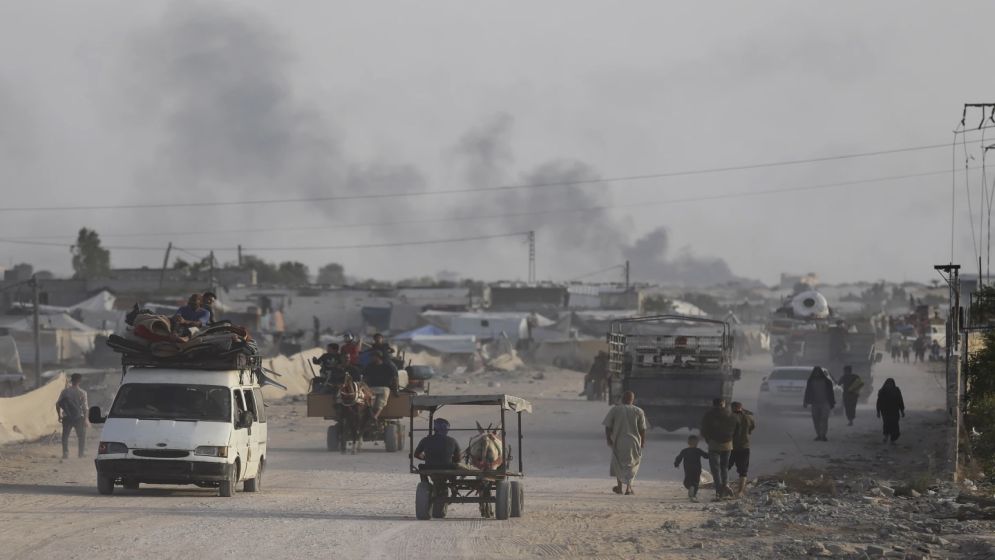
WASHINGTON,
May 31 (AP/UNB) - Defense experts who have reviewed debris images from an
Israeli airstrike that ignited a deadly fire in a camp for displaced
Palestinians questioned why Israel did not use smaller, more precise weapons
when so many civilians were nearby. They said the bombs used were likely
U.S.-made.
The strikes, targeting
Hamas operatives, killed as many as 45 people sheltering in a temporary
displacement camp near the southern Gaza city of Rafah on Sunday and have drawn
international condemnation.
Israel is investigating
the attack but says the Hamas targets were 1.7 kilometers (1 mile) away from a
declared humanitarian zone and that its review before the strike determined no
expected harm to civilians.
But displaced civilians
were scattered throughout the area, and Israel had not ordered evacuations. So
even if the tents that burned were not inside the marked humanitarian zone, the
civilians there thought it was safe.
Israel, which was
attacked by Hamas on Oct. 7, 2023, has not said where the burned tents were in
relation to the compound it bombed on Sunday, but has released one satellite
image showing there were some known civilian shelters located about 180 meters
(600 feet) away. It emphasized that while there were no tents "in the
immediate vicinity," due to "unforeseen circumstances, a fire ignited
tragically taking the lives of Gazan civilians nearby."
Footage released by the
Israeli military appears to show people walking next to the targeted buildings
before the blast. The footage also appears to show tents nearby.
Israel has not
identified the bombs it used, but Rear Adm. Daniel Hagari, an Israel Defense
Forces spokesman, has emphasized that the country chose the smallest munition
its jets could carry - with 17 kilograms (37 pounds) of explosive material each
- and that an unintended secondary explosion may have caused the fire.
Even the smallest
jet-launched munition may be too big when civilians are near because of how
they explode and can send fragments far, defense experts said.
Images posted on social
media from the tent camp on Monday and verified by The Associated Press showed
a CAGE code, a unique identifier assigned to U.S. government suppliers, on
pieces of the exploded weapons.
Based on those images
and satellite photos of the debris field, two defense experts said the bombs
used were likely U.S.-made 250-pound (113-kilogram) GBU-39 small-diameter
bombs.
Though they're smaller
than many other weapons the U.S. has provided to Israel, these bombs can still
create a wide swath of damage. The entire 250-pound shell and components are
designed to spew fragments that can travel as far as 2,000 feet (600 meters).
"You essentially
have two bombs they use that the fragments can travel 600 meters in a densely
packed area. So that just doesn't check out if they're trying to limit
casualties," said Trevor Ball, a former Army explosive ordnance demolition
technician.
Ball said the serial
number on the pieces of the tail kit and the shell debris shown in the photographs
identify the munitions as the 250-pound GBU-39. It's unusual to describe a bomb
by its explosive load - in this case, 37 pounds - instead of its total weight,
according to Ball and Mark Cancian, a retired Marine Corps Reserves colonel and
senior adviser to the Center for Strategic and International Studies.
The debris field in Gaza
is indicative of the bombs possibly being set to detonate before impact, which
would ensure their intended targets were killed but also risk unintended
deaths, Ball and Cancian said. The images showed a small hole where shrapnel
was found.
The GBU-39's fuse
settings can be adjusted to have the bomb explode on impact, which would create
a crater at the site, or set for a delayed blast if the goal is to have it more
deeply penetrate a target first.
They can also be set to
detonate in the air, right before impact, to ensure multiple targets are hit.
But that setting also maximizes area damage, which could explain a secondary
explosion even if weapons or other flammable materials were some distance away,
Ball said.
Secretary of State
Antony Blinken told reporters on Wednesday during a visit to Moldova that the
U.S. is waiting for an investigation to show what weapons were used and how
they were deployed.
Even if that confirms
Israel used a small-diameter weapon, "we also see that even limited,
focused, targeted attacks - designed to deal with terrorists who have killed
innocent civilians that are plotting to kill more - even those kinds of
operations can have terrible, horrific, unintended consequences," Blinken
said.
The defense experts said
Israel had better options to turn to than the GBU-39 when civilians were
nearby.
The Israelis have
previously deployed drones to launch weapons that are smaller and more precise,
Cancian said. These precision airstrikes used over the years have caused little
damage beyond the immediate target.
Israel, for example, in
this strike could have used a smaller anti-personnel weapon called the
mini-Spike, which would not have created as wide an area of debris, if it was
targeting specific Hamas leaders, Cancian said.
The U.S. has withheld a
shipment of even larger 2,000-pound (900-kilogram) bombs from Israel out of
concern they would be used in Israel's Rafah operation, where more than 1
million Palestinians crowded after Israel bombed other parts of Gaza. Now, that
same number of people have escaped Rafah and are scattered across makeshift
tent camps and other areas.
Sunday's strike shows
that even the smaller 250-pound bombs the U.S. has continued to provide can be
too large for use near densely packed refugee areas, Cancian said.
White House national
security spokesman John Kirby said Wednesday that the U.S. was still trying to
gather information from Israel about the deadly Rafah strike. He declined to
discuss the specific munitions used by Israel but said Israel's public comments
about the munitions used "certainly indicate a desire to be more
deliberate and more precise in their targeting."