

Historic Trump verdict: Things you need to know

Nazmus Saqib
Publish: 01 Jun 2024, 02:24 PM
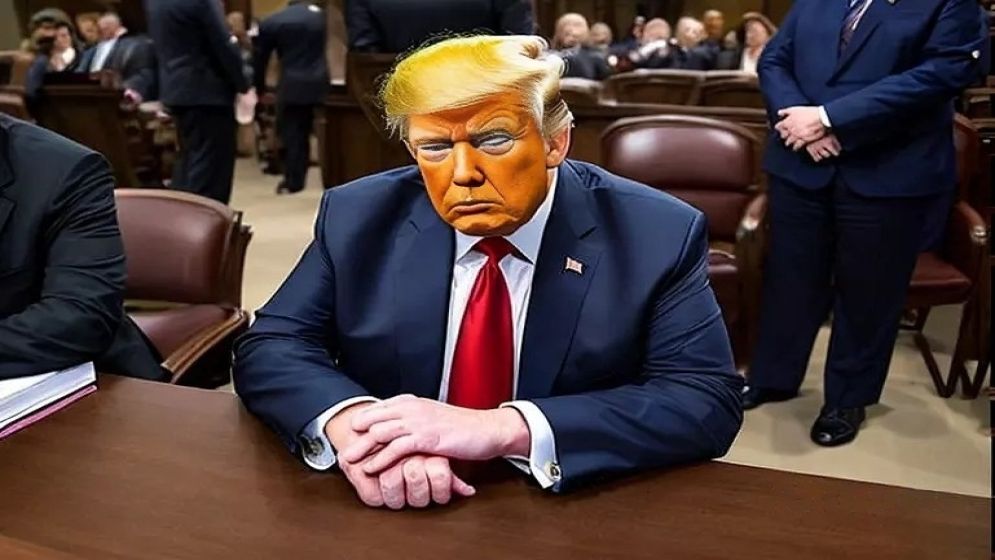
In a landmark ruling that has sent shockwaves through the world's political landscape, Donald Trump, the 45th President of the United States, has become the first former US president as well as a running presidential nominee to be convicted of a felony.
Following a trial in a Manhattan court, Trump was found guilty on 34 counts on May 30, marking a significant moment in American legal and political history.
Not long ago, the notion of a former president, let alone a major-party presidential nominee, facing such severe legal consequences would have seemed implausible. However, the reality has shifted dramatically. Trump's conviction underscores the evolving nature of accountability for those who have held the highest office in a nation like the United States.
With sentencing scheduled for this summer, the ramifications of this verdict are profound, prompting a reassessment of the boundaries of presidential power and legal scrutiny, legal pundits and experts noted. As the world’s lone super power grapples with this unprecedented development, the reverberations are sure to be felt for years to come, the experts feel.
Apart from the Manhattan conviction, Trump is confronting an additional 57 felony charges spanning across a state court and two distinct federal districts, each carrying the possibility of imprisonment.
Moreover, a civil lawsuit loss in New York threatens to impede his business ventures, alongside sizable defamation rulings against him. Concurrently, he remains the presumed Republican presidential nominee, juxtaposing his legal battles with his political aspirations, as voters contemplate his future.
Can Trump still contest for the presidency
Judge Juan Merchan has set Trump's sentencing on July 11. Merchan could sentence Trump to probation or up to 4 years on each count in state prison, with a maximum of 20 years. For now, the former president will remain out of prison as he awaits his sentencing. Prosecutors did not ask for Trump to post any bond, reported New York Times.
Trump has continuously pursued appeals against court rulings as a tactic to prolong proceedings or steer his case towards a favorable court. The scenario in the New York case mirrors this pattern.
Following Trump's conviction, his attorney, Todd Blanche, promptly petitioned Judge Merchan for an acquittal despite the guilty verdict. However, the judge dismissed this procedural request, reported CBS news.
Interestingly, throughout the trial, Trump's legal representatives strategically safeguarded their ability to appeal a potential guilty verdict, closely monitoring the judge's decisions regarding testimonies and evidence. It appears highly likely that they will initiate such an appeal in the ensuing weeks.
Richard L. Hasen, a prominent authority on election law and a professor at the University of California, Los Angeles, has consistently emphasized that according to the US Constitution, there are no provisions prohibiting a convicted criminal from seeking the presidency.
"In terms of legality, Trump's candidacy remains unchanged," stated Hasen in his Election Law Blog on Thursday. Hasen elaborated, stating, "The Constitution outlines only minimal requirements for presidential candidacy (being at least 35 years old, a natural-born citizen, and a resident of the US for at least 14 years)."
Furthermore, Hasen noted that states are unable to disqualify Trump from running due to his attempts to challenge the 2020 election, citing a recent Supreme Court ruling. He asserted, "States are also prohibited from imposing additional criteria, such as excluding convicted felons from the ballot."
What was the Manhattan case about?
The world was stunned on October 7, 2016, when an audio recording featuring the Republican nominee Trump boasting about how his celebrity status empowered him to engage in inappropriate behavior with women. On the subsequent day, a spokesperson for adult film actress Stormy Daniels informed the National Enquirer that she was ready to disclose her own troubling and exploitative experience involving Donald Trump.
Trump had established a strong relationship with the Enquirer, prompting the tabloid to intervene in response to Daniels' intentions by attempting to facilitate a confidential financial agreement between her and Trump's personal lawyer, Michael Cohen.
In order to secure the funds needed to silence Daniels, thus preventing a potentially damaging news story that could have prolonged negative publicity from the Access Hollywood tape and Trump's controversial sexual conduct during the final stages of the campaign, Cohen utilized his home equity and channeled the payment through a shell company based in Delaware.
Subsequently, Trump reimbursed Cohen for these payments, categorizing them as legal expenses.
In New York, the act of falsifying business records with the intent to deceive constitutes a misdemeanor, while falsification aimed at concealing another crime is deemed a felony.
Prosecutors contended that Trump manipulated business documents to disguise the nature of payments to Cohen, intending to deceive others and to conceal an additional offense: namely, violating a little-known New York state statute prohibiting conspiracies to influence elections through unlawful means, reported Vox media.
The prosecution contended that Cohen's payment to Daniels essentially amounted to a contribution to Trump's campaign, as its purpose was to aid his election by suppressing potentially damaging information.
This payment far surpassed the legal limit for individual donations to a candidate, thereby breaching federal campaign finance regulations. Cohen admitted to this violation when he pleaded guilty to campaign finance infractions in 2018. Consequently, according to the district attorney's office, Trump had collaborated with Cohen to advance his own election bid through illicit methods.
Will the conviction cost Trump his right to vote?
Despite being a resident of Florida, where stringent regulations restrict voting rights for individuals with felony convictions, Trump might find advantage in recent legislative changes in New York in 2021, which facilitate the restoration of voting rights for felons.
Regarding the recent guilty verdict in Manhattan, Trump's eligibility to vote in the November election in Florida hinges on whether he receives a prison sentence and completes serving it before the election takes place.
Florida prohibits felons from voting until they have fulfilled the entirety of their sentence, including any periods of supervised release, and until they have settled any outstanding fines and fees.
The latter stipulation became a point of contention following the passage of legislation by Florida's GOP-led legislature, which undermined a state constitutional amendment enabling individuals with felony convictions to reclaim their voting rights.
These restrictions on felon voting in Florida extend to individuals with convictions from out-of-state. However, if a Floridian's conviction occurred in another state, Florida adheres to the laws of that state regarding the restoration of felon voting rights.
In contrast, New York's 2021 legislation allows individuals with felony convictions to regain their voting rights upon completion of their incarceration term, even if they are still under parole supervision. Consequently, Trump would only be barred from voting in Florida if he is serving a prison sentence for the Manhattan conviction during the election period.