

Israeli leader Netanyahu faces growing pressure at home after Biden's Gaza proposal

UNB
Publish: 02 Jun 2024, 04:28 PM
TEL
AVIV, Israel, Jun 01(AP/UNB) - Israel's prime minister faced growing pressure
Saturday after U.S. President Joe Biden announced a proposed agreement to end
the fighting in Gaza, with many Israelis urging Benjamin Netanyahu to embrace
the deal but far-right allies threatening to collapse his government if he
does.
Netanyahu called a
permanent cease-fire in Gaza a "nonstarter" until long-standing
conditions for ending the war are met, appearing to undermine the proposal that
Biden described as an Israeli one.
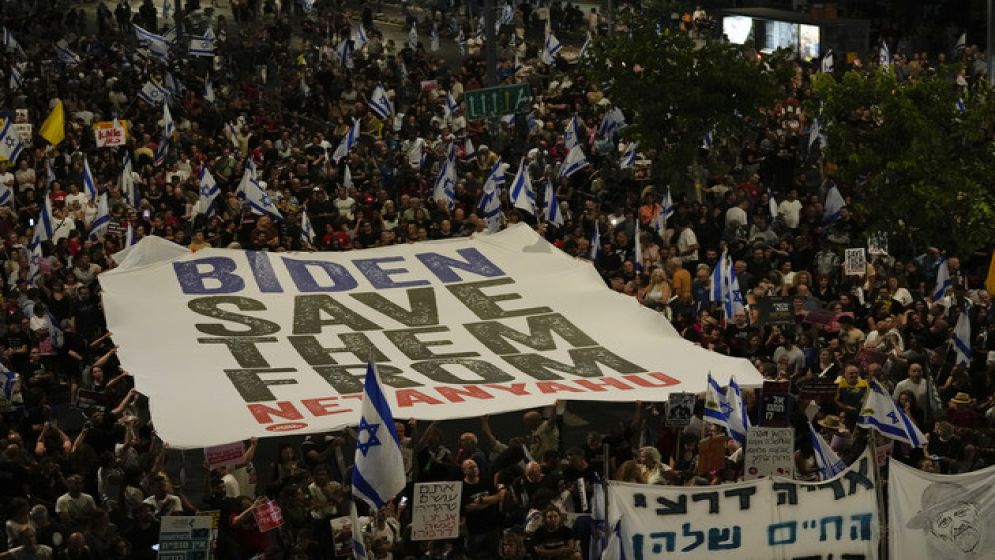
A huge demonstration in
Israel on Saturday night, led by families of hostages held by Hamas, urged the
government to act now. Mediators the U.S., Egypt and Qatar pressed Israel and
Hamas, saying the proposed deal "offers a road map for a permanent cease-fire
and ending the crisis" and gives immediate relief to both hostages and
Gaza residents.
But far-right Finance
Minister Bezalel Smotrich and Minister of National Security Itamar Ben Gvir
said they would break up the government if it takes the deal. That could expose
Netanyahu to new elections, scrutiny over security failures that led to the war
and - if he loses the prime minister post - prosecution on longstanding
corruption charges.
Netanyahu's statement
said that "Israel's conditions for ending the war have not changed: the
destruction of Hamas' military and governing capabilities, the freeing of all
hostages and ensuring that Gaza no longer poses a threat to Israel. Under the
proposal, Israel will continue to insist these conditions are met before a
permanent cease-fire is put in place."
In a separate statement,
Netanyahu accepted an invitation from U.S. congressional leaders to deliver an
address at the Capitol, a show of support for Israel while top ally the U.S.
shows frustration. No date has been set.
Biden on Friday asserted
that Hamas militants are "no longer capable" of carrying out a
large-scale attack on Israel like the one on Oct. 7. He urged Israel and Hamas
to reach an agreement to release about 100 remaining hostages, along with the
bodies of around 30 more, for an extended cease-fire.
Talks on a deal halted
last month after a push by mediators in hopes of averting a full-scale Israeli
invasion of Gaza's southern city of Rafah. Israel says the Rafah operation is
key to uprooting remaining Hamas battalions, even as the militants regroup
elsewhere in the territory.
Israel on Friday
confirmed its troops were operating in central parts of Rafah. Around 1 million
Palestinians - almost half of Gaza's population - have left Rafah, and the U.N.
World Food Program has called living conditions "horrific and
apocalyptic" as hunger grows.
Families of hostages
said time was running out.
"This might be the
last chance to save lives," Gili Roman told The Associated Press. His
sister, Yarden Roman-Gat, was freed during a weeklong cease-fire in November,
but sister-in-law Carmel is still held. "Our leadership must not disappoint
us. But mostly, all eyes should be on Hamas," Roman said.
Families described an
aggressive meeting Thursday with Israel's national security adviser, Tzachi
Hanegbi, who told them the government wasn't ready to sign a deal to bring all
hostages home and there was no plan B.
Many hostages' families
accuse the government of a lack of will.
"We know that the
government of Israel has done an awful lot to delay reaching a deal, and that
has cost the lives of many people who survived in captivity for weeks and weeks
and months and months," Sharone Lifschitz said. Her mother, Yocheved, was
freed in November but her father, Oded, is still held.
The first phase of the
deal described by Biden would last for six weeks and include a "full and
complete cease-fire," a withdrawal of Israeli forces from all densely
populated areas of Gaza and the release of a number of hostages, including women,
older people and the wounded, in exchange for the release of hundreds of
Palestinian prisoners.
The second phase would
include the release of all remaining living hostages, including male soldiers,
and the withdrawal of Israeli forces from Gaza. The third phase calls for the
start of a major reconstruction of Gaza, which faces decades of rebuilding from
the war's devastation.
Biden acknowledged that
keeping the proposal on track would be difficult, with "details to
negotiate" to move from the first phase to the second. Biden said if Hamas
fails to fulfil its commitment under the deal, Israel can resume military operations.
Hamas has said it viewed
the proposal "positively" and called on Israel to declare an explicit
commitment to an agreement that includes a permanent cease-fire, a complete
withdrawal of Israeli troops from Gaza, a prisoner exchange and other
conditions.
In Deir al-Balah, where
many Palestinians have fled following Israel's assault on Rafah, there was some
hope.
"This proposal came
late, but better late than never," said Akram Abu Al-Hasan.
The main difference from
previous proposals is the readiness to stop the war for an undefined period,
according to analysts. It leaves Israel the option to renew the war and
diminish Hamas' ability to govern, but over time, said Michael Milshtein, head
of the Palestinian Studies Forum in Dayan Center at Tel Aviv University.
"It was a very good
speech ... it seems that Biden is trying to force it on the Israeli government.
He was clearly speaking directly to the Israeli people," said Gershon
Baskin, director for the Middle East at the International Communities Organization.
Also on Saturday,
Egypt's state-run Al-Qahera News said officials from Egypt, the United States
and Israel would meet in Cairo over the weekend about the Rafah crossing, a
crucial aid entry point that has been closed since Israel took over the
Palestinian side in May. Egypt has refused to open its side, fearing the
Israeli control will be permanent.
Hamas' attack on Oct. 7
killed around 1,200 people - mostly civilians - and abducted about 250. More
than 36,370 Palestinians have been killed in Gaza by Israel's offensive,
according to Gaza's Health Ministry. Its count doesn't differentiate between
civilians and combatants.