

A third term for Modi? All eyes on India’s poll results

Faisal Mahmud
Publish: 04 Jun 2024, 04:01 PM
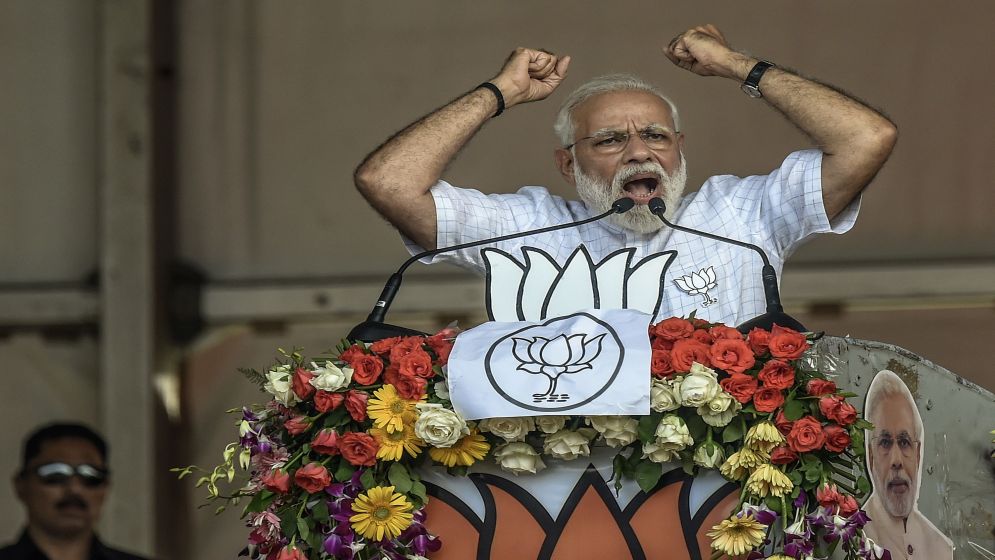
India has started counting votes from the world’s — and history’s — largest ever democratic exercise and assuming there isn't a significant political upset, incumbent Prime Minister Narendra Modi appears poised to embark on his third term by the end of the day.
Exit polls conducted by prominent television networks indicated a decisive victory for Modi’s Hindu nationalist Bharatiya Janata Party (BJP) and its coalition partners against a wide-ranging opposition coalition spearheaded by the Congress party, with Rahul Gandhi at its forefront.
Historically, however, Indian television channels have demonstrated varied accuracy in forecasting election outcomes.
The six-week-long election was perceived as a referendum on Modi's leadership in many ways.
Should the 73-year-old secure victory, it would mark only the second instance in Indian history where a leader has secured a third consecutive term, following Jawaharlal Nehru, the nation's inaugural prime minister.
India's political environment has dramatically changed under Modi's ten years in office. From Nehruvian secular India, the country with the world’s largest population has become a polarized nation in which minorities are facing existential threats.
Modi’s popularity also has eclipsed that of his party, causing a legislative election to resemble a presidential campaign in every way. As a result, even in state elections, local politicians are losing support to the BJP, which depends more and more on Modi's durable brand to stay in power.
Modi's proponents view him as a resilient, assertive leader who has elevated India's global stature, attributing the nation's ascent to the fifth-largest economy to his pro-business initiatives.
However, his critics and opponents argue that his prioritization of Hindu-centric politics has fostered intolerance, fueled hate speech, and exacerbated blatant assaults on minority groups, particularly the Muslim community, which constitutes 14% of the population.
They also claim that Modi and his administration has been using strong-arm techniques to suppress dissent, stifle independent media, and tame political opponents, causing the nation's democracy to deteriorate.
Modi's chief opponents, the Congress-led INDIA coalition, have focused on unemployment, inflation, and inequality in an attempt to capitalize on the brewing economic unrest during its campaign.
However, ideological disagreements and defections have plagued the wide alliance of more than a dozen political groups, casting doubt on their efficacy.
The alliance has countered that they have been unfairly singled out, citing a flurry of politically motivated federal agency raids, arrests, and corruption investigations against their leaders. This has, of course, been refuted by the government.
What makes Modi an invincible force?
A number of analysts believe Modi has acquired the most prized of political assets: He is seen by most voters as the embodiment and custodian of their best interests.
Modi towers over his party with presidential brio, extraordinary vote-winning charisma and unchallenged authority. The three-time former chief minister of Gujarat (Modi's home state on the west coast) has overseen a unique concentration of executive decision-making in the federal capital.
Many believe that he has successfully replicated much of Gujarat's business-enabling environment, notably easing the burden of doing business along with courtship of foreign investors and ushered a new era of prosperity for the Indian citizen.
Judging solely by economic growth metrics, the Modi government's performance appears impressive. Upon assuming office in 2014, Modi inherited an economy grappling with sluggish growth exacerbated by a series of high-profile corruption scandals that eroded investor confidence.
However, from 2014 to 2022, India's gross domestic product (GDP) per capita, a gauge of income per individual, surged from $5,000 to over $7,000, marking an approximate 40% increase over eight years. These calculations employ purchasing power parity, facilitating comparisons of general purchasing power across different time periods and nations.
The Indian economy is also expanding at a rate exceeding 7%, and over 500 million Indians have acquired bank accounts under his leadership — a significant stride towards formalizing an economy where numerous jobs remain unrecorded and untaxed.
Additionally, Modi’s administration has allocated billions of dollars towards revitalizing the nation's aging infrastructure to attract investment.
Notably, they have streamlined the extensive welfare program, catering to approximately 60% of the population. BJP is strategically utilizing this program to appeal to impoverished and disenchanted voters.
Even with economic progress under Modi, his policies haven't successfully transitioned people from low-wage, unstable jobs into stable, salaried positions. This has resulted in a stark rise in inequality, unemployment, and underemployment, making these issues key focuses in the upcoming election.
While India sees a growing number of millionaires, the vast majority (nearly 90%) of the working-age population earns below the national average annual income of roughly $2,770.
This disparity is further highlighted by the fact that the wealthiest 1% control over 40% of the country's wealth, while the bottom 50% own just over 6%.
-665e9f5ab031d.jpg)
Future of India’s democracy and foreign policy under Modi’s third term
Indian author and academic Nishita Gautam told NDTV that this general election would go down in India's political history as a single-agenda election– do you want Narendra Modi to continue being the Prime Minister of India?
“The voter responded to this simple question. Nothing more, nothing less. If the exit poll numbers are correct, the nation has responded with a resounding yes. Not just the number of seats, the BJP is also projected to claim a historic vote share” she said.
Gautam said Indian voters simply wanted to put more trust in “the known devil than the unchartered waters of the deep sea.” She believed people have either given the incumbent government their approval or have made peace with them and termed it a curious mix of optimism and fatalism.
“Many independent think-tanks and research organizations now hesitate to call India a proper democracy and I don’t disagree with them. Another term of Narendra Modi will surely not improve the situation on that front,” Gautam said, adding that this however matters little as Indian people ultimately have the right to decide their own fate.
Also, she cautioned that electoral contestation, however vigorous and vibrant, is not an antidote to authoritarianism. “Elections are not a panacea for all socio-political ills in any society. They are, most certainly, a managing mechanism for the malaise of authoritarianism,” said Gautam.
While the BJP's ten years in power have significantly changed Indian politics and society, there is still a lot of continuity between Modi's administration and the previous administrations of Manmohan Singh and Atal Bihari Vajpayee when it comes to foreign policy.
Modi's foreign policy is genuinely unique in that it is not so much in content as it is in style. Elites in India and the general people are now eager for their nation to become a major power and exert influence on a worldwide scale.
Indian analyst Anand Mohad wrote in The Diplomat that although the Modi government's boasting of India's global standing is more spin than reality, it is indisputable that they have bundled their foreign policy and aligned it with the spirit of an ambitious nation.
“Unless the opposition can find the idiom that convinces voters that it can lead the country to triumphant heights, it will leave the foreign policy terrain open for the sole advantage of the ruling party,” wrote Mohan.
While the Modi administration’s foreign policy has largely been successful in maintaining balance with global and regional powers, it has created a rising anti-Indian sentiment across South Asia, particularly in Bangladesh and the Maldives.
Recent "India Out" campaigns have led to boycotts of Indian goods in Bangladesh and deterred Indian tourists from visiting the Maldives. These actions could diminish India's role as the primary regional security provider and exacerbate its rivalry with the Asian giant–China.
Tessa Walker, of Lowy Institute said, historically, smaller South Asian countries had to carefully navigate the power dynamics between these two giants. However, recent developments, such as the "India Out" campaign gaining traction in several states, suggest a change in this dynamic, she pointed out.
“For example, the Maldives is asserting its independence, while the opposition in Bangladesh seeks to exploit these changing circumstances. This new assertiveness by smaller states could further complicate the geopolitical situation in the region,” Walker said.
“If Modi comes to power for another term, his
administration surely has to find a solution to pacify this brewing discontent
in the neighborhoods,” she added.