

US urges UN Security Council to support cease-fire plan in Gaza announced by President Biden

UNB
Publish: 04 Jun 2024, 07:11 PM
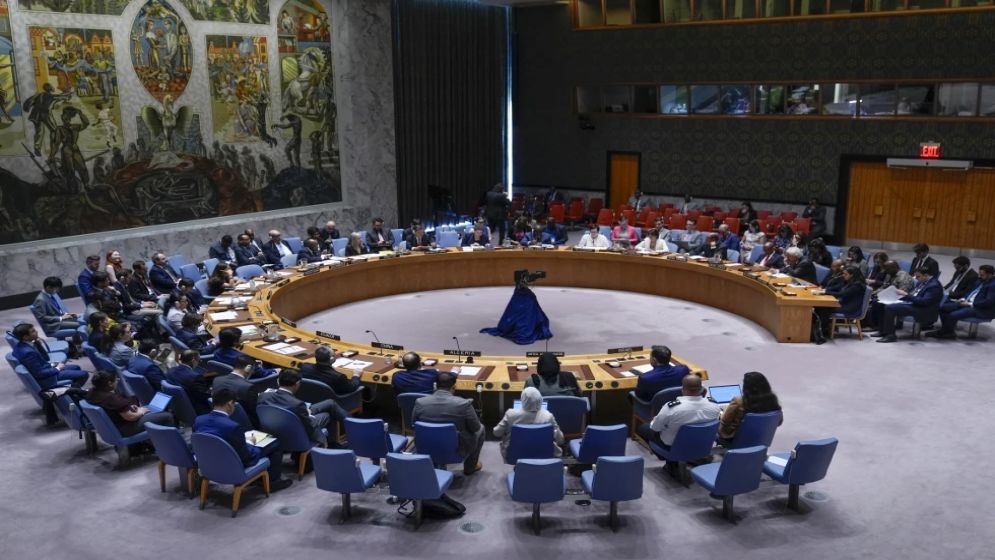
UNITED
NATIONS, Jun 04 (AP/UNB) - The United States urged the U.N. Security Council on
Monday to support the three-phase plan announced by President Joe Biden aimed
at ending the nearly eight-month war in Gaza, freeing all hostages and sending
massive aid into the devastated territory.
U.S. Ambassador Linda
Thomas-Greenfield said the United States circulated a draft resolution to the
14 other council members to back the proposal for ending the conflict that
began with Hamas' surprise attack in southern Israel on Oct. 7 that killed some
1,200 people, mostly Israeli civilians.
"Numerous leaders
and governments, including in the region, have endorsed this plan and we call
on the Security Council to join them in calling for implementation of this deal
without delay and without further conditions," she said in a statement.
The brief draft
resolution, obtained by The Associated Press, would welcome the May 31 deal
announced by Biden and call on Hamas "to accept it fully and implement its
terms without delay and without condition." Hamas has said it views the
proposal "positively."
It makes no mention of
Israeli acceptance of the deal.
When Biden made the
announcement he called it an Israeli offer that includes an "enduring
cease-fire" and Israeli withdrawal from Gaza if Hamas releases all
hostages it is holding.
Israeli Prime Minister
Benjamin Netanyahu told his hardline governing partners Monday the proposal
announced by Biden would meet Israel's goal of destroying Hamas, according to
local media. The ultranationalists have threatened to bring down his government
if Netanyahu agrees to a deal that doesn't eliminate Hamas.
Netanyahu told
parliament's Foreign Affairs and Defense Committee on Monday that Biden gave an
outline of the deal but not all the details, and he said there are
"gaps."
Biden said the first
phase of the proposed deal would last for six weeks and include a "full
and complete cease-fire," a withdrawal of Israeli forces from all
populated areas of Gaza and the release of some hostages, including women, the
elderly and the wounded, in exchange for the release of hundreds of Palestinian
prisoners.
American hostages would
be released at this stage, and remains of hostages who have been killed would
be returned to their families. There would be a surge in humanitarian
assistance, with 600 trucks a day entering Gaza.
In the second phase, all
the rest of the living hostages would be released, including soldiers, and
Israeli forces would withdraw from Gaza. Biden said if Hamas lives up to its
commitments, the temporary cease-fire would become a "cessation of
hostilities permanently."
About 250 people, mainly
Israeli civilians, were abducted on Oct. 7, then more than 100 were freed in a
short truce in late November and early December. Israel says about 80 hostages
are believed to still be captive, alongside the remains of about 43 others.
Israeli bombardments and
ground offensives in Gaza, which Hamas has ruled, have killed more than 36,000
Palestinians, according to Gaza's Health Ministry, which does not distinguish
between combatants and civilians.
The third phase of the
plan announced by Biden calls for the start of a major reconstruction of Gaza,
which faces decades of rebuilding from devastation caused by the war.
The draft resolution
stresses the importance of Israel and Hamas adhering to the deal once it is
agreed to, "with the aim of bringing about a permanent cessation of
hostilities, and calls upon all member states and the United Nations to support
its implementation."
The draft would also
reiterate the council's "unwavering commitment" to a two-state
solution, and stress the importance of unifying the Gaza Strip and the West
Bank under the Palestinian Authority.
Thomas-Greenfield, the
U.S. ambassador, said Security Council members "have consistently called
for the steps outlined in this deal: bringing the hostages home, ensuring a
complete ceasefire, enabling a surge of humanitarian assistance into Gaza and
in the refurbishment of essential services, and setting the stage for a
long-term reconstruction plan for Gaza."
"Council members
should not let this opportunity pass by," she said. "We must speak
with one voice in support of this deal."
On Monday, the foreign
ministers of five key Arab nations - Jordan, the United Arab Emirates, Saudi
Arabia, Qatar and Egypt - urged Israel and Hamas to consider Biden's proposal
"seriously and positively."
The group of seven major
industrialized nations - the U.S., Britain, France, Germany, Japan, Canada and
Italy - also backed the cease-fire plan.
END/UNB/AP/PR