

India’s opposition, written off as too weak, makes a stunning comeback to slow Modi's juggernaut

UNB
Publish: 06 Jun 2024, 04:30 PM
NEW
DELHI, Jun 06(AP/UNB) - India's bruised and battered opposition was largely
written off in the lead-up to the national election as too weak and fragmented
to take on Prime Minister Narendra Modi and his powerful Hindu nationalist
governing party.
It scored a stunning
comeback, slowing the Modi juggernaut and pushing his Bharatiya Janata Party
well below the majority mark. It's unchartered territory for the populist prime
minister, who needs the help of his allies to stay in power. That could significantly
change his governance style after he enjoyed a commanding majority in
Parliament for a decade.
The election results
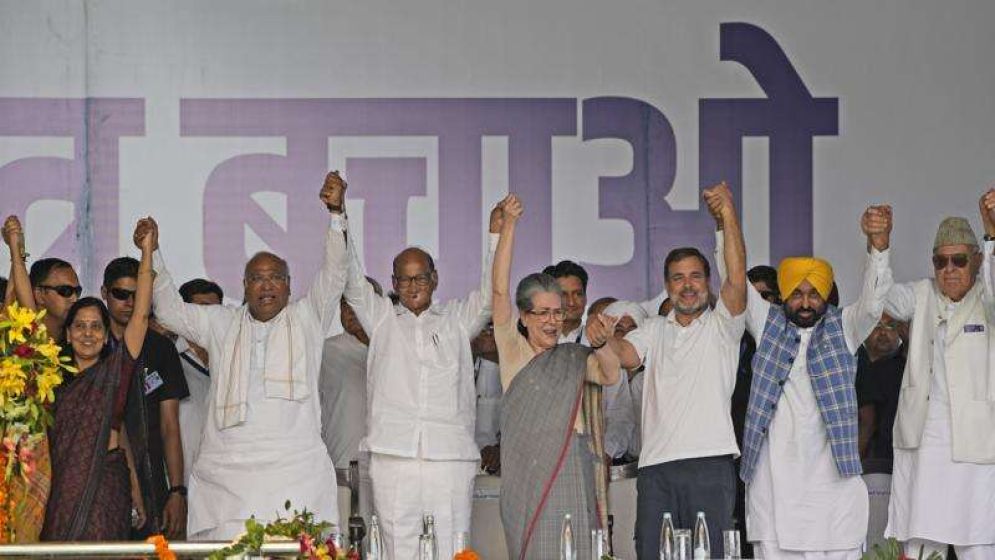
released Wednesday also marked a revival for the main opposition Congress party
and its allies, who defied predictions of decline and made deep inroads into
governing party strongholds, resetting India's political landscape. The opposition
won a total of 232 seats out of 543, doubling its strength from the last
election.
"The opposition has
proved to be tremendously resilient and shown courage of conviction. In many
ways it has saved India's democracy and shown Modi that he can be challenged -
and even humbled by denting his image of electoral invincibility," said
journalist and political analyst Rasheed Kidwai.
The unwieldy grouping of
more than two dozen opposition parties, called INDIA, was formed last year.
Beset with ideological differences and personality clashes, what glued them
together was a shared perceived threat: what they call Modi's tightening grip
on India's democratic institutions and Parliament, and his strident Hindu
nationalism that has targeted the country's minorities, particularly Muslims.
The election battle is
between "Narendra Modi and INDIA, his ideology and INDIA," the
alliance's campaign face, Rahul Gandhi, said at an opposition meeting last
year.
Gandhi, heir to India's
Nehru-Gandhi dynasty, has long been mocked by Modi, his party and his
supporters as a beneficiary of dynastic politics. Gandhi's father, grandmother
and great-grandfather were all prime ministers.
Under his leadership,
the Congress party was reduced to a paltry 52 seats in 2019 when Modi romped to
victory in a landslide win. And last year he was expelled from Parliament due
to a defamation case after Modi's party accused him of mocking the prime minister's
surname. (He was later returned to his seat by India's top court.)
But ahead of the 2024
election, Gandhi went through a transformation - he embarked on two
cross-country marches against what he called Modi's politics of hate,
re-energizing his party's members and rehabilitating his image.
During the election
campaign, he, along with other opposition leaders, sought to galvanize voters
on issues such as high unemployment, growing inequality and economic and social
injustice, while targeting Modi over his polarizing campaign and anti-Muslim
rhetoric.
"They certainly
gained significant momentum through the course of the campaign, to the point
where the opposition agendas became the agenda points of this election,"
said Yamini Aiyar, a public policy scholar.
The election results
showed his messaging worked with the voters, as his party made substantial
gains in BJP-governed states such as Uttar Pradesh, Rajasthan, Haryana and
Maharashtra by tapping into economic stress. It won 99 seats across India.
"Rahul Gandhi has
emerged as a strong national leader and that should worry Modi," Kidwai
said.
The opposition proved
even more successful in a Modi party bastion where it flipped the largest
number of seats: Uttar Pradesh, which sends the most lawmakers of any state -
80 - to Parliament.
Long considered the
biggest prize in Indian elections, the opposition clinched a staggering 44
parliamentary seats in the state, with the regional Samajwadi Party winning a
whopping 37, leaving Modi's party with less than half of the seats. In the 2019
election, the BJP won 62 seats in the state.
The opposition also
managed to wrest away BJP's seat in Ayodhya city, a deeply symbolic loss for
Modi's party after the prime minister opened a controversial grand Hindu temple
on the site of a razed mosque there in January. The opening of the temple
dedicated to Lord Ram, at which Modi performed rituals, marked the unofficial
start of his election campaign, with his party hoping it would resonate with
the Hindu majority and bring more voters into its fold.
"The BJP lost
because its leadership did not have its ears to the ground. They believed that
the issue of the Ram Temple would secure their victory, but they overlooked
important issues like jobs and inflation," said political analyst Amarnath
Agarwal.
A strong showing by the
Trinamool Congress in West Bengal and the Dravida Munnetra Kazhagam party in
Tamil Nadu further boosted the opposition's numbers, denying Modi the
supermajority he hoped for after exhibiting confidence his alliance would take
400 seats.
It also meant that the
regional parties, once relegated to the margins after Modi's dominating wins in
2014 and 2019, will acquire a greater political space in Indian politics.
"It also gives a
lot of power back to the states," said Milan Vaishnav, director of the
South Asia Program at the Carnegie Endowment for International Peace.
"We've seen a lot of centralization in the hands of the executive, in the
hands of the Prime Minister's Office specifically."
The opposition's
surprise gains came against the backdrop of what it calls Modi's intensified
political crackdown against them.
Modi and his government
have increasingly wielded strong-arm tactics to subdue political opponents. In
the run-up to the election, opposition leaders and parties faced a slew of
legal and financial challenges. The chief ministers of two opposition-controlled
states were thrown in jail and the bank accounts of the Congress party were
temporarily frozen.
Aiyar, the public policy
scholar, said the opposition was able to "palpably catch on to signs of
discontentment" even as it faced "fairly significant constraints of
their own."
"This was certainly
not a level playing field at the start of the election," she said.
As election results
showed the opposition doing better than expected on Tuesday, a beaming Gandhi
pulled out a red-jacketed copy of India's Constitution that he had displayed on
the campaign trail and said his alliance's performance was the "first step
in its fight" to save the charter.
"India's poorest
stood up to save the Constitution," he said.
END/UNB/AP/PR