

An Israeli strike on a Gaza school that the military claims was being used by Hamas kills 30 people

UNB
Publish: 06 Jun 2024, 04:36 PM
DEIR
AL-BALAH, Gaza Strip, Jun 06 (AP/UNB) - An Israeli strike early Thursday on a
school-turned-shelter in central Gaza that the military claimed was being used
as a Hamas compound killed at least 30 people, including five children,
according to local health officials.
The strike came after
the military said it was launching new air and ground operations in central
Gaza in an apparent widening of its nearly eight-month offensive, launched
after Hamas' Oct. 7 attack. An international medical charity had reported
soaring casualties even before Thursday's strike.
The Al-Aqsa Martyrs
Hospital in Deir al-Balah received at least 30 bodies from the strike on the
school run by the United Nations agency for Palestinian refugees - known by the
acronym UNRWA - and another six from a separate strike on a home, according to
hospital records and an Associated Press reporter at the hospital. Hamas-run TV
had earlier reported a higher toll.
Mohammed al-Kareem, a
displaced Palestinian sheltering near the hospital, described chaotic scenes
outside the facility. He said vehicles arrived one after the other, as
distressed people rushed wounded people into the emergency department. Videos
circulating online appeared to show several wounded people being treated on the
floor of the hospital, a common scene in Gaza's overwhelmed medical wards.
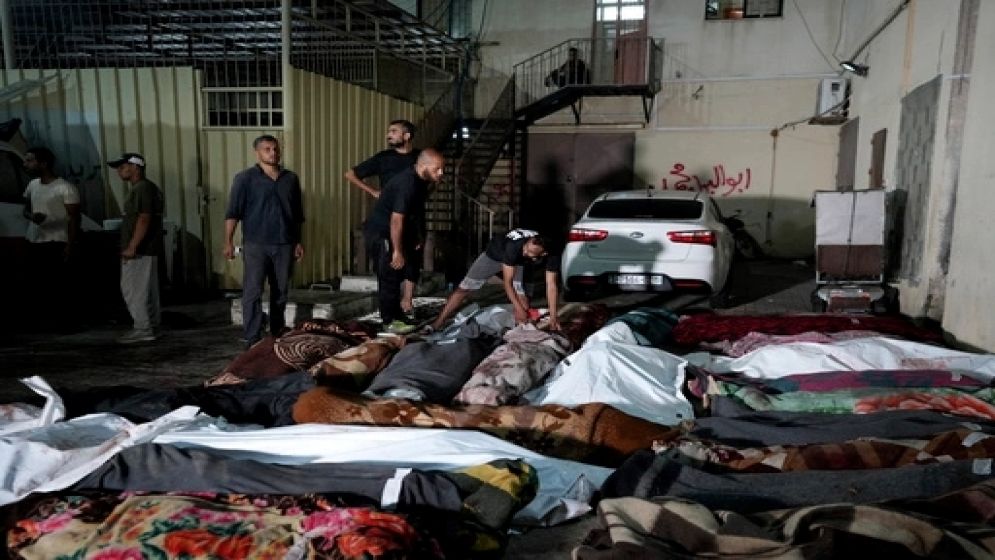
Later, he saw people
searching for their loved ones among bodies wrapped in white shrouds in the
hospital courtyard. He said one woman kept asking medical workers to open them
up to see if her son was inside.
"The situation is
tragic," he said.
The Israeli military
said its fighter jets struck the school that it claimed, without immediately
offering evidence, that Hamas and the Islamic Jihad used as cover for their
operations.
UNRWA schools across
Gaza have functioned as shelters since the start of the war, which has
displaced most of the territory's population of 2.3 million Palestinians.
"Before the strike,
a number of steps were taken to reduce the risk of harming uninvolved civilians
during the strike, including conducting aerial surveillance, and additional
intelligence information," the Israeli military said.
Both strikes occurred in
Nuseirat, one of several built-up refugee camps in Gaza dating back to the 1948
war surrounding Israel's creation, when hundreds of thousands of Palestinians
fled or were driven from their homes in what became the new state.
The latest war began
with Hamas' Oct. 7 attack into Israel, in which militants killed some 1,200
people and took another 250 hostage. Israel's offensive has killed at least
36,000 Palestinians, according to Gaza's Health Ministry, which does not
distinguish between fighters and civilians in its figures.
Israel says it takes
measures to avoid harming civilians and blames their deaths of Hamas because it
positions fighters, tunnels and rocket launchers in residential areas. The
military rarely comments on individual strikes, which often kill women and children.
The United States has
thrown its weight behind a phased cease-fire and hostage release outlined by
President Joe Biden last week. But Israel says it won't end the war without
destroying Hamas, while the militant group is demanding a lasting cease-fire
and the full withdrawal of Israeli forces.
The military said
Wednesday that forces were operating "both above and below ground" in
eastern parts of Deir al-Balah and the Bureij refugee camp in central Gaza. It
said the operation began with airstrikes on militant infrastructure, after which
troops began a "targeted daylight operation" in both areas.
Doctors Without Borders
said at least 70 bodies and 300 wounded people, mostly women and children, were
brought to a hospital in central Gaza on Tuesday and Wednesday after a wave of
Israeli strikes.
The international
charity said Wednesday in a post on X that Al-Aqsa Martyrs Hospital is
struggling to treat "a huge influx of patients, many of them arriving with
severe burns, shrapnel wounds, fractures, and other traumatic injuries."
Gaza's health system has
nearly collapsed through almost eight months of war. The hospital, which was
treating some 700 wounded and sick people before the latest strikes, said
Wednesday that one of its two electrical generators had stopped working,
threatening its ability to keep operating ventilators and incubators for
premature babies.
Israel has routinely
launched airstrikes in all parts of Gaza since the start of the war and has
carried out massive ground operations in the territory's two largest cities,
Gaza City and Khan Younis, that left much of them in ruins.
The military waged an
offensive earlier this year for several weeks in Bureij and several other
nearby refugee camps in central Gaza.
Troops pulled out of the
Jabaliya camp in northern Gaza last Friday after weeks of fighting caused
widespread destruction. First responders have recovered the bodies of 360
people, mostly women and children, killed during the battles.
Israel sent troops into
Rafah in May in what it said was a limited incursion, but those forces are now
operating in central parts of Gaza's southernmost city. More than 1 million
people have fled Rafah since the start of the operation, with many heading
toward central Gaza.
END/UNB/AP/PR