

In Mecca's sweltering heat, Muslims start this year's Hajj pilgrimage

Staff Reporter
Publish: 15 Jun 2024, 01:02 AM
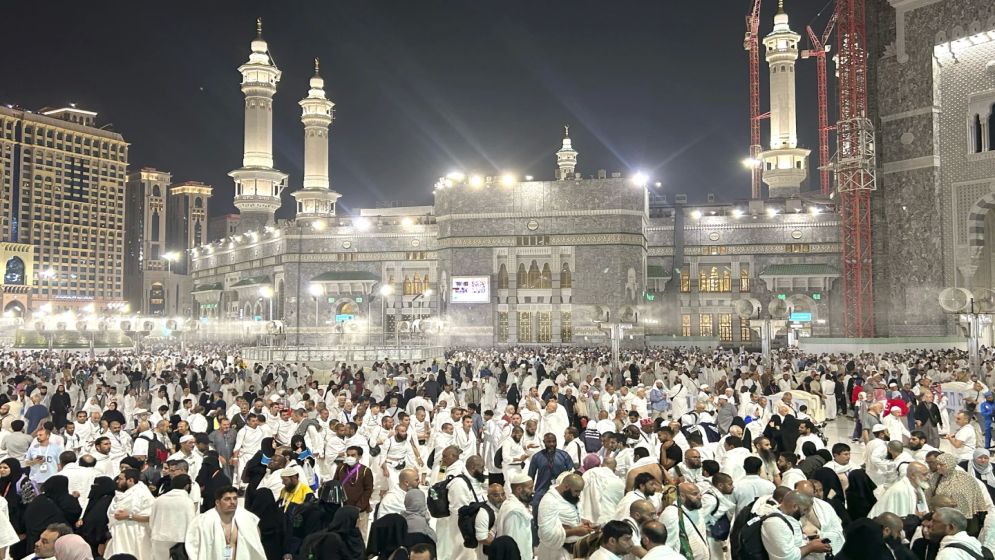
MINA,
Saudi Arabia, Jun 14 (AP/UNB) - In sweltering temperatures, Muslim pilgrims in
Mecca converged on a vast tent camp in the desert on Friday, officially opening
the annual Hajj pilgrimage. Ahead of their trip, they circled the cube-shaped
Kaaba in the Grand Mosque, Islam's holiest site.
More than 1.5 million
pilgrims from around the world have already amassed in and around Mecca for the
Hajj, and the number was still growing as more pilgrims from inside Saudi
Arabia joined. Saudi authorities expected the number of pilgrims to exceed 2
million this year.
This year's Hajj came
against the backdrop of the raging war in the Gaza Strip between Israel and
Palestinian militants, which pushed the entire Middle East to the brink of a
regional war between Israel and its allies on one side and Iran-backed militant
groups on the other.
Palestinians in the
coastal enclave of Gaza were not able to travel to Mecca for Hajj this year
because of the closure of the Rafah crossing in May when Israel extended its ground
offensive to the strip's southern city of Rafah on the border with Egypt.
Palestinian authorities
said 4,200 pilgrims from the occupied West Bank arrived in Mecca for Hajj.
Saudi authorities said 1,000 more from the families of Palestinians killed or
wounded in the war in Gaza also arrived to perform Hajj at the invitation of King
Salman of Saudi Arabia. The 1,000 invitees were already outside Gaza - mostly
in Egypt - before closure of the Rafah crossing.
"We are deprived of
(performing) Hajj because the crossing is closed, and because of the raging
wars and destruction," said Amna Abu Mutlaq, a 75-year-old Palestinian
woman from Gaza's southern city of Khan Younis who had planned to perform Hajj
this year. "They (Israel) deprived us from everything."
This year's Hajj also
saw Syrian pilgrims traveling to Mecca on direct flights from Damascus for the
first time in more than a decade. The move was part of an ongoing thaw in
relations between Saudi Arabia and conflict-stricken Syria. Syrians in rebel-held
areas used to cross the border into neighboring Turkey in their exhausting trip
to Mecca for Hajj.
"This is the
natural thing: Pilgrims go to Hajj directly from their home countries,"
said Abdel-Aziz al-Ashqar, a Syrian coordinator of the group of pilgrims who
left Damascus this year for Hajj.
The pilgrimage is one of
the Five Pillars of Islam, and all Muslims are required to make the five-day
Hajj at least once in their lives if they are physically and financially able
to do it.
It is a moving spiritual
experience for pilgrims who believe it absolves sins and brings them closer to
God, while uniting the world's more than 2 billion Muslims. It's also a chance
to pray for peace in many conflict-stricken Arab and Muslim countries,
including Yemen and Sudan, where more than a year of war between rival generals
created the world's largest displacement crisis.
For many Muslims, the
Hajj is the only major journey that they made in their life. Some spend years
saving up money and waiting for a permit to embark on the journey in their 50s
and 60s after they raised their children.
The rituals during the
Hajj largely commemorate the Quran's accounts of Prophet Ibrahim, his son
Prophet Ismail and Ismail's mother Hajar - or Abraham and Ismael as they are
named in the Bible.
Male pilgrims wear an
ihram, two unstitched sheets of white cloth that resemble a shroud, while women
dress conservative, loose-fitting clothing with headscarves, and forgo makeup
and perfume. They have been doing the ritual circuit around the cube-shaped
Kaaba, counter-clockwise in the seven-minaret Grand Mosque since arriving in
Mecca over recent days.
Saudi authorities have
adopted security restrictions in and around Mecca, with checkpoints set up on
roads leading to the city to prevent those who don't have Hajj permits from
reaching the holy sites.
Security authorities
arrested many people who attempted to take pilgrims to Mecca who didn't have
Hajj permits, said Lt. Gen. Muhammad al-Bassami, head of Hajj Security Committee.
Most of them were expelled from the country, while travel agents faced jail for
up to six months, according to the Interior Ministry.
On Friday, the pilgrims
made their way to Mina, officially opening the Hajj. They then will move for a
daylong vigil Saturday on Mount Arafat, a desert hill where the Prophet
Muhammad is said to have delivered his final speech, known as the Farewell Sermon.
Healthy pilgrims make the trip on foot, others use bus or train.
The time of year when
the Hajj takes place varies, given that Hajj is set for five days in the second
week of Dhu al-Hijjah, the last month in the Islamic lunar calendar.
Most of the Hajj rituals
are held outdoors with little if any shade. When it falls in the summer months,
temperatures can soar to over 40 Celsius (104 Fahrenheit). The Health Ministry
has cautioned that temperatures in the holy sites could reach 48 Celsius (118
Fahrenheit). Many pilgrims carried umbrellas against the burning sun.
After Saturday's warship
in Arafat, pilgrims will travel a few kilometers (miles) to a site known as
Muzdalifa to collect pebbles that they will use in the symbolic stoning of
pillars representing the devil back in Mina.
Pilgrims then return to
Mina for three days, coinciding with the festive Eid al-Adha holiday, when
financially able Muslims around the world slaughter livestock and distribute
the meat to the poor. Afterwards, they return to Mecca for final circumambulation,
known as Farewell Tawaf.
In recent years, the
annual pilgrimage has returned to its monumental scale after three years of
heavy restrictions because of the coronavirus pandemic. Last year, more than
1.8 million pilgrims performed Hajj, approaching the 2019 level when more than
2.4 million pilgrims participated in the pilgrimage.