

A usually joyous Muslim holiday reminds families in Gaza of war's punishing toll

UNB
Publish: 15 Jun 2024, 05:39 PM
DEIR
AL-BALAH, Gaza Strip, June 15 (AP/UNB) - Last summer, Palestinians in the Gaza
Strip celebrated the Muslim holiday of Eid al-Adha the way it's supposed to be:
with large family feasts, meat shared with those less fortunate, and new
clothes and gifts for children.
But this year, after
eight months of devastating war between Israel and Hamas, many families will
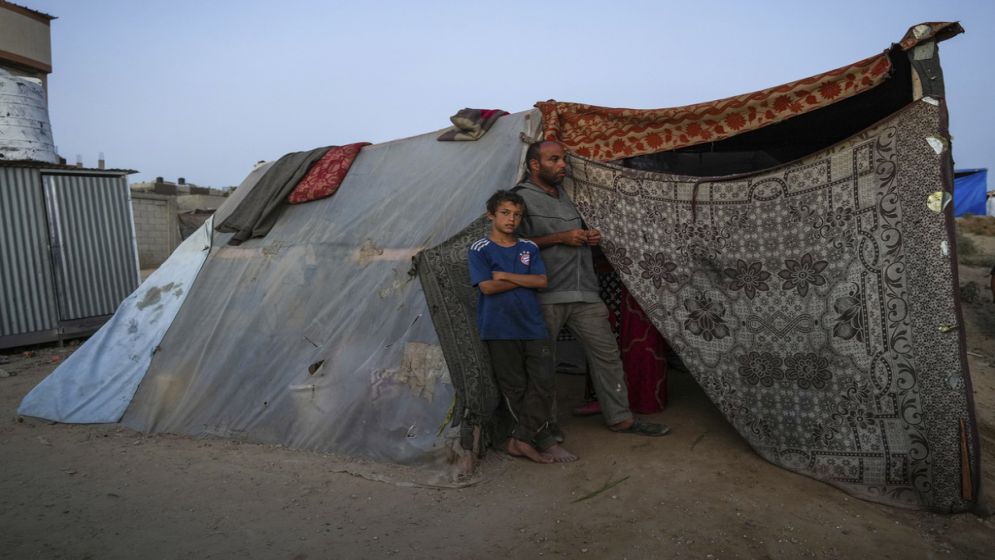
eat canned food in stifling tents. There's hardly any meat or livestock at
local markets, and no money for holiday treats or presents - only war, hunger
and misery, with no end in sight.
"There is no Eid
this year," said Nadia Hamouda, whose daughter was killed in the war and
who fled from her home in northern Gaza months ago and is staying in a tent in
the central town of Deir al-Balah. "When we hear the call to prayer, we
cry over those we lost and the things we lost, and what has happened to us, and
how we used to live before."
Muslims around the world
will celebrate the four-day Eid al-Adha, the Feast of the Sacrifice, early in
the week. It commemorates the Prophet Ibrahim's willingness to sacrifice his
son, Ismail, as recounted in the Quran. In the Jewish and Christian traditions,
Abraham is called to sacrifice his other son, Isaac.
Gaza was impoverished
and isolated even before the war, but people still managed to celebrate by
hanging up colorful decorations, surprising children with treats and gifts, and
purchasing meat or slaughtering livestock to share with those less fortunate.
"It was a real
Eid," Hamouda said. "Everyone was happy, including the
children."
Now much of Gaza is in
ruins and most of the population of 2.3 million Palestinians have fled their
homes. After Hamas' surprise attack into Israel on Oct. 7, in which Palestinian
militants killed some 1,200 people and took another 250 hostage, Israel launched
a massive air and ground assault.
The war has killed over
37,000 Palestinians, according to the Hamas-run Health Ministry. It has
destroyed most of Gaza's agriculture and food production, leaving people
reliant on humanitarian aid that has been held up by Israeli restrictions and
the ongoing fighting.
United Nations agencies
have warned that over a million people - nearly half the population - could
experience the highest level of starvation in the coming weeks.
In early May, Egypt shut
down its crossing into the southern Gazan city of Rafah after Israel captured
the Palestinian side of it, sealing the only route for people to enter or leave
the territory. That means virtually no Palestinians from Gaza will be able to
make the annual Hajj pilgrimage that precedes the Eid.
Ashraf Sahwiel, who was
among hundreds of thousands of Palestinians who fled from Gaza City earlier in
the war and is also living in a tent, has no idea when or if he'll be able to
return.
"We don't even know
what happened to our houses or whether we'll be able to live in them again, or
if it's even possible to rebuild," he said.
Abdelsattar al-Batsh
said he and his family of seven haven't eaten meat since the war began. A
kilogram (2 pounds) of meat costs 200 shekels (around $50). A live sheep, which
could be bought for as little as $200 before the war, now costs $1,300 - if
it's even available.
"Today, there is
only war. No money. No work. Our houses have been destroyed. I have
nothing," al-Batsh said.
Iyad al-Bayouk, who owns
a now-shuttered cattle farm in southern Gaza, said severe shortages of both
livestock and feed due to Israel's blockade have driven up prices. Some local
farms have been turned into shelters.
Mohammed Abdel Rahim,
who has been sheltering in a building in an empty cattle farm in central Gaza
for months, said the farm-turned-shelter was particularly bad in the winter,
when it smelled like animals and was infested with bugs. As the heat set in,
the ground dried out, making it more bearable, he said.
Abdelkarim Motawq,
another displaced Palestinian from northern Gaza, used to work in the local
meat industry, which did brisk business ahead of the holiday. This year, his
family can only afford rice and beans.
"I wish I could
work again," he said. "It was a busy season for me, during which I
would bring money home and buy food, clothing, nuts, and meat for my children.
But today there's nothing left."
End/UNB/AP/MB