

What's known, and not known, about the partnership agreement signed by Russia and North Korea

UNB
Publish: 20 Jun 2024, 07:47 PM
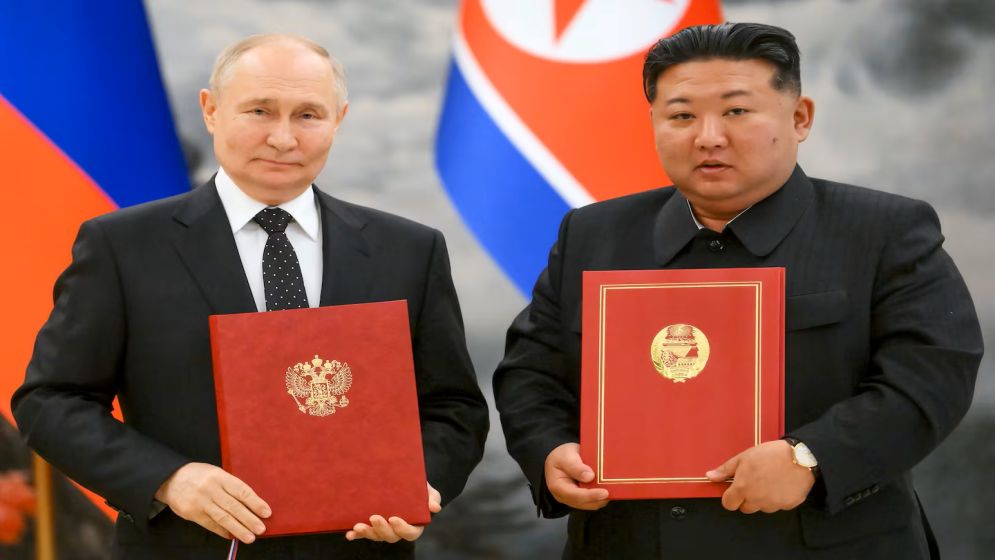
SEOUL,
South Korea (AP/UNB) - Both Russian President Vladimir Putin and North Korean
leader Kim Jong Un say the strategic partnership they signed in their summit in
Pyongyang is a breakthrough, but what it means for their relationship is still
uncertain.
While the agreement
could represent the countries' strongest deal signed after the Cold War, there
are differing opinions on how strong of a security commitment Russia made to
North Korea.
Kim claimed that the
deal elevated bilateral relations to the level of an alliance, although Putin
was more understated and did not call it an alliance.
The day after the deal
was signed at a Pyongyang summit on Wednesday afternoon, North Korean state
media released the text of the agreement, which vows mutual defense assistance
and broader cooperation in military, foreign policy and trade. Russia has still
not published its version of the text.
Officials in rival South
Korean said they're still trying to assess what it all means, including what
Russia's response might be if the North comes under attack.
Relations between
sprawling Russia and small, isolated North Korea - both of them nuclear powers
- have warmed significantly in recent years amid Russia's growing acrimony with
the West over the invasion of Ukraine and suppression of all domestic opposition.
The new agreement could
bring them even closer, while also posing new challenges to the international
community.
What's in the new
partnership, according to Kim and Putin:
What did Russia promise?
Most of the debate over
Putin and Kim's comprehensive partnership agreement revolves around Article 4.
According to North Korean state media, the article states that if one of the
countries gets invaded and is pushed into a state of war, the other must deploy
"all means at its disposal without delay" to provide "military
and other assistance."
But it also says that
such actions must be in accordance with the laws of both countries and Article
51 of the United Nations Charter, which recognizes a U.N. member state's right
to self-defense.
To some analysts, that
sounds like a promise that Moscow will intervene if North Korea comes under
attack, renewing a promise made under a 1961 treaty between North Korea and the
Soviet Union. That deal was discarded after the collapse of the USSR, replaced
in 2000 by one that offered weaker security assurances.
Cheong Seong Chang, an
analyst at South Korea's Sejong Institute, said the agreement echoes the
language of the 1961 treaty, as well as provisions of the U.S.-South Korea
mutual defense treaty about activating channels to coordinate if either of
faces the threat of invasion.
"North Korea and
Russia have completely restored their Cold War-era military alliance,"
Cheong said.
But other experts were
cautious. Ankit Panda, a senior analyst at the Carnegie Endowment for
International Peace, said Article 4 is carefully worded to avoid implying
automatic intervention. It's also not clear why the article invokes the U.N.
Charter.
Still, the big picture
is that "both sides are willing to put down on paper, and show the world,
just how widely they intend to expand the scope of their cooperation,"
Panda said.
How far will military
cooperation go?
Putin essentially linked
military cooperation with North Korea to Western supplies of weapons to
Ukraine, referring to high-precision weapons systems, warplanes and other
high-tech weapons.
"The Russian
Federation does not exclude the development of military-technical cooperation
with the Democratic People's Republic of Korea in accordance with the document
signed today," Putin said.
That statement in effect
formalizes something Western countries claim is already happening.
The U.S. and other
allies allege that Russia has received ballistic missiles and ammunition from
North Korea as the Ukraine war depletes Moscow's inventory, and that Russia has
made technology transfers to Pyongyang that could enhance the threat posed by
Kim's nuclear weapons and missile program.
North Korean state media
said the agreement requires the countries to take steps to strengthen their
joint defense capabilities, but didn't specify what those steps would be, or
whether they would include combined military training.
The agreement also calls
for the countries to actively cooperate in efforts to establish a "just
and multipolar new world order," the North's Korean Central News Agency
said, underscoring how the countries are aligning in face of their separate,
escalating confrontations with the Untied States and its allies.
Panda said the
agreement's language about joint measures on strengthening defense capabilities
are "broadly indicative of continued cooperation on a range of technical
initiatives."
What's the economic
aspect of the pact?
The partnership also
calls for developing economic ties, an especially important issue for North
Korea as it suffers under an array of international sanctions. North Korea
needs goods and material, and in turn can supply Russia's war-depleted workforce
with labor; those workers in turn could convert wages in rubles to dollars or
euros and send hard-currency back home.
Putin said the
Russian-North Korean trade turnover has risen nine-fold over the past year, but
admitted that the amount itself remains "modest."
Ahead of the summit,
South Korean analysts said the North might seek to increase labor exports to
Russia and other activities to get foreign currency in defiance of U.N.
sanctions, although sensitive details of agreements between Kim and Putin
weren't likely to be publicized. The text published by North Korea called for
strengthened cooperation in a broad range of areas, including trade, science,
technology and tourism.
END/AP/UNB/SIS